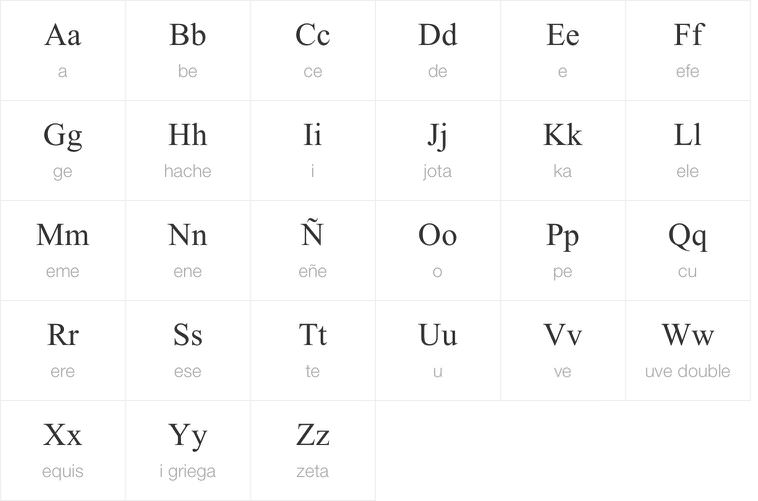
Quick Answer The Spanish alphabet, or abecedarioin
Spanish, is composed of 27 letters. It includes one letter, la
letra ñ, that we don’t have in English.
Abecedario
What’s in a (Letter) Name?
The majority of the letters in Spanish have their own special names
(some even have more than one!) and people use them all the time when
spelling out words.
Below you’ll find all 27 letters of the abecedario
and their names, along with an example word for each.
Letter
Spanish Name (s)
Example Word
a
a
armadillo (armadillo)
b
be or be larga or be alta
biblioteca (library)
c
ce
carcajada (loud laugh)
d
de
decidir (to decide)
e
e
elefante (elephant)
f
efe
falsificar (to forge)
g
ge
gigante (giant)
h
hache
hechizo (spell)
i
i or i latina
iniciar (to begin)
j
jota
jajajear (to laugh)
k
ka
kaki (khaki)
l
ele
labial (lipstick)
m
eme
mamá(mom)
n
ene
nene (baby)
ñ
eñe
ñoño (weakling)
o
o
coco (coconut)
p
pe
papá(dad)
q
cu
quiquiriquí (cock-a-doodle-doo)
r
erre
ronronear (to purr)
s
ese
sisear (to hiss)
t
te
tetera (teapot)
u
u
ulular (to hoot)
v
uve or ve corta or ve chica or ve baja
vivir (to live)
w
uve doble or doble uve or doble ve or doble u
wifi (Wi-Fi)
x
equis
sexto (sixth)
y
ye or i griega
yoyó (yoyo)
z
zeta
zarzamora (blackberry)
The Company You Keep Matters
While the majority of the letters in Spanish are always pronounced
the same way, there are a few whose pronunciation changes depending on
the letters with which they combine. Let’s take a look at some of the
trickier combinations.
Ge Before a Vowel
When ge comes before i or
e, it’s pronounced like a raspy English h.
gente (people)
Gibraltar (Gibraltar)
Before other vowels (a, o,
u), it’s pronounced like the g in English
good.
gol (goal)
guapo (handsome)
gato (cat)
Ce Before hache
When ce comes before hache, it’s pronounced like the ch in
English cheese.
chícharo (pea)
chicharra (cicada)
Double ele
When two eles appear together, they can be pronounced like the
y in English yellow, the j in English
judge, or the sh in English show, depending
on what country you’re in.
llamar (to call)
valle (valley)
Double erre
When two erres appear together, they are trilled (the sound you make
when you roll your tongue). A single erre at the beginning of a word is
also trilled.
carro (car)
burro (donkey)
rojo (red)
Equis Marks the Spot
The equis is usually pronounced like the ks in English
socks. However, in place and person names (especially those
from Mexico), it can be pronounced like a raspy English h, an
s, or even the sh in English show.
Check out these examples:
Like the ks in English socks: examen
(exam)
Like a raspy English h: México (Mexico)
Like an s: Xochimilco (Xochimilco, a neighborhood
in Mexico City)
Like sh in English show Xicalango
(Xicalango, a town in Mexico)
Let’s finish up by seeing how the abecedario is used
in everyday life!
Customer: Buenas tardes. Vengo a recoger un paquete.
Good afternoon. I’m here to pick up a package.
Clerk: Muy bien. ¿Cuál es su nombre? Very good.
What’s your name?
Customer: Me llamo Víctor Hugo. My name is
Victor Hugo.
Clerk: No lo encuentro. ¿Cómo se deletrea su
apellido? I can’t find it. How do you spell your last name?
Customer: Hache-u-ge-o. H-u-g-o.
Clerk: Ah, sí. Aquí está su paquete. Ah, yes.
Here’s your package.
Here are the words for the simple mathematical functions and how
they’re used with numbers:
Addition (Suma): Dos más tres son cinco. (Two plus three is five.)
Note that in other contexts, más is usually an adverb.
Subtraction (Resta): Cinco menos cuatro son uno. (Five minus four is
one.)
Multiplication (Multiplicación): Tres por cuatro son doce. (Three
times four is twelve.) In other contexts, por is a common
preposition.
Division (División): Doce dividido entre cuatro son tres. (Twelve
divided by four is three.) Doce dividido por cuatro son tres. (Twelve
divided by four is three.) Entre is another common preposition.
Note that all of these sentences use the verb son, which is plural,
in contrast with the singular verb “is” of English. It is also possible
to use es or the phrase es igual a (is equal to).
Other Mathematical Terms
Here are some less common mathematical terms:
el cuadrado de — the square of
el cubo de — the cube of
ecuación — equation
elevado a la enésima potencia — raised to the nth power
función — function
número imaginario — imaginary number
promedio — average, mean
quebrado, fracción — fraction
raíz cuadrada — square root
raíz cúbica — cube root
Sample Sentences
Solo un idiota que no sabe que dos más dos son cuatro le creería.
(Only an idiot who doesn’t know that two plus two equals four would
believe him.)
Una fracción es un número que se obtiene de dividir un entero en
partes iguales. (A fraction is a number that is obtained by dividing a
whole number into equal parts.)
Pi se obtiene al dividir la circunferencia de un círculo del
diámetro. (Pi is obtained by dividing the circumference of a circle by
the diameter.)
El triple de un número menos el doble del mismo número son ese
número. (Three times a number minus two times that number is that
number.)
Una función es como una máquina: tiene una entrada y una salida. (A
function is like a machine: It has an input and an output.)
Una ecuación es una igualdad matemática entre dos expresiones
matemáticas. (An equation is an equality between two mathematical
expressions.)
La ciudad está dividida en dos partes iguales. (The city is divided
into two equal parts.)
¿Cuál es el resultado de dividir 20 por 0.5? (What is the quotient
of 20 divided by 0.5?)
El cuadrado de un número menos el doble del mismo número son 48.
¿Cuál es ese número? (The square root of a number minus double the same
number is 48. What is that number?)
El promedio de edad de los estudiantes es de 25 años. (The average
age of the students is 25.)
La división entre cero es una indeterminación. Así la expresión 1/0
carece de sentio. (Division by zero yields an indeterminable number.
Thus the expression 1/0 doesn’t make sense.)
Los números imaginarios pueden describirse como el producto de un
número real por la unidad imaginaria i, en donde i denota la raíz
cuadrada de -1. (Imaginary numbers can be described as the product of a
real number by the imaginary unit i, where i denotes the square root of
-1.)