
And gladly wolde he lerne and gladly teche.
—CHAUCER
A hardcover edition of this book was originally published in 1951 by Doubleday. It is here reprinted by arrangement with Doubleday.
Madrigal’s Magic Key to Spanish. Copyright © 1951, 1953, 1989 by Margarita Madrigal. All rights reserved. Printed in the United States of America. No part of this book may be reproduced or transmitted in any form or by any means, electronic or mechanical, including photocopying, recording, or by any information storage and retrieval system, without written permission from the publisher. For information, address: Broadway Books, a division of Random House, Inc., 1540 Broadway, New York, NY 10036.
BROADWAY BOOKS and its logo, a letter B bisected on the diagonal, are trademarks of Broadway Books, a division of Random House, Inc.
Visit our website at www.broadwaybooks.com
First Broadway Books trade paperback edition published 2001.
Library of Congress Cataloging-in-Publication Data
Madrigal, Margarita.
[Magic key to Spanish]
Madrigal’s magic key to Spanish/Margarita
Madrigal: illustrations by Andrew Warhol.—1st ed.
p. cm.
Includes index.
eISBN: 978-0-307-75487-5
1. Spanish language—Textbooks for foreign speakers—English.
I. Warhol, Andy, 1928–87.
II. Title. III. Title: Magic key to Spanish.
PC4128.M35 1989 89-30448
468.2,421—dc20
v3.1 r1

 t
this moment you know several thousand Spanish words even if you have
never seen or heard a Spanish word before. You are not aware of these
words simply because they have not been pointed out to you. In this book
I’m going to show you how easy it is to learn Spanish by showing you how
much you already know. For instance, have you ever seen these Spanish
words before?
t
this moment you know several thousand Spanish words even if you have
never seen or heard a Spanish word before. You are not aware of these
words simply because they have not been pointed out to you. In this book
I’m going to show you how easy it is to learn Spanish by showing you how
much you already know. For instance, have you ever seen these Spanish
words before?
| popular | radio | actor |
| capital | conductor | ideal |
| animal | probable | flexible |
| hotel | cable | central |
Can you recognize any of these words?
| Atlántico | restaurante | optimista |
| Pacífico | importante | dentista |
| dramático | presidente | artista |
| constructive | permanente | confusión |
| atractivo | medicina | invitaeión |
If you can recognize even a few of these words, the Spanish language is yours for the taking.
It is encouraging to know that you can identify thousands upon thousands of Spanish words at sight. But it is really exciting to discover that with a few hints you yourself can form these words and that you can start out on your venture of learning Spanish with a large, ready-made vocabulary. When you study this method you will find that you will not only have the ability to recognize words, but that it will actually be within your power to convert English words into Spanish words.
Furthermore, you will learn what to do with these words. You will feel the thrill of starting right out forming sentences from the very first lesson. You will learn to think in Spanish and you will know the beauty and rhythm of spoken Spanish. When you finish this course you will be able to go to a Spanish-speaking country and talk to the people and understand them.
From the time man first began to learn foreign tongues down to the present time, language methods have relied on memory and not on the pupil’s powers of creation. Now the process is reversed. This book will teach you to create. The very first lesson will prove to you that you can create at least one hundred times more material than you could possibly memorize in the same given time. Furthermore, the process of creation is exciting, whereas mechanical memorizing is tremendously boring. Also consider that you are apt to forget a word that you memorize mechanically. But a word that you create stays with you forever.
The motto of this book, if such there be, is “And gladly wolde he lerne and gladly teche” (Chaucer). From my own experience I know that what is not gladly learned is not learned at all. It is the essence of this method to make learning Spanish a pleasure for you. I have tried to guide you lovingly through the language. Every means of making it easy for you has been incorporated into this book. Thousands of questions that have been asked by former students have made it possible for me to anticipate your questions and to answer them.
Do you believe that you cannot learn a foreign tongue?
Did you study languages in school and fail to learn to speak them?
Do yon know a great many Spanish words that you cannot put into sentences?
Were you ever bored in a language class?
Have you thought that learning a new language involved so much work that it couldn’t fit into your schedule?
If you can answer “yes” to any of the questions above, this method is for you.
This book will teach you to:
This is not an empty promise. The method has proved successful with more than a quarter of a million people in the span of a few years. Not one student who has started this method has failed. Some went more slowly than others, but in the end every student learned more Spanish for every hour that he spent with the book than he had thought possible in his fondest dreams.
This method, which has worked with so many students, will work with you. Turn to Lesson I and prove this to yourself right now.
The rest of the letters are pronounced as they are in English, with only very slight variations.
In some parts of Spain the C before E or I is pronounced “TH,” and the Z is always pronounced “TH.”

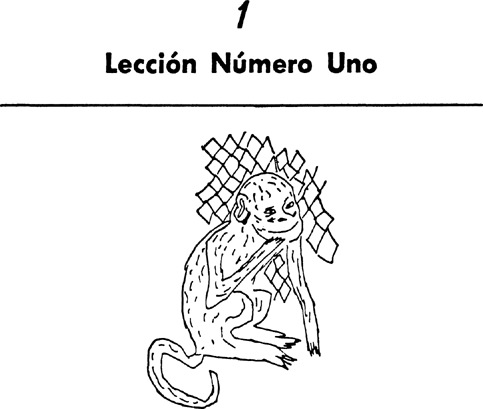
el mono (the monkey)
 t
is very easy to build a large vocabulary of Spanish words. In fact, you
already know thousands of English words that become Spanish words if you
change them very slightly. These words fall into several large
categories.
t
is very easy to build a large vocabulary of Spanish words. In fact, you
already know thousands of English words that become Spanish words if you
change them very slightly. These words fall into several large
categories.
The first and easiest category is made up of words which end in “or.” These words are often identical in Spanish and English.
Remember: “el” means “the,” “un” means “a” or “an.”
the actor = el actor; an actor = un actor
| el actor | el doctor | un tractor | interior |
| el color | el error | un profesor | exterior |
| el conducto | el favor | un inventor | superior |
NOTE: Spanish words that end in “or” are stressed on the last syllable. Example: doc-TOR. The letter “r” is trilled in Spanish.
Next there is a category of words that end in “al.” These also are often identical in Spanish and English.
the animal = el animal
| el animal | central | local | personal |
| el criminal | comercial | musical | rural |
| el canal | legal | natural | social |
NOTE: Spanish words that end in “al” are stressed on the last syllable. Example: lo-CAL.
Then comes a category of words that end in “ble.” These also are often identical in Spanish and English.
the cable = el cable
| el cable | posible | formidable | noble |
| notable | flexible | probable | horrible |
| terrible | visible | honorable | inevitable |
NOTE: Spanish words that end in “ble” are stressed on the next to the last syllable. EXAMPLE: no-TA-ble.
A fourth large category is made up from those words that end in “ic” in English. To change them into Spanish simply add the letter “o.”
IC = ICO
the public = el público
| el Atlántico | democrático | elástico |
| el público | artístico | eléctrico |
| romántico | aristocrático | automático |
NOTE: In Spanish the accent never alters the sound of letters. Whenever a letter is accented, stress the letter firmly. Example: PU-bli-co.
Another large category is made up from those words which end in “ent” or “ant.” If you simply add the letter “e” to many of these, they magically become Spanish words.
ENT = ENTE
ANT = ANTE
the president = el presidente; important = importante
| el presidente | excelente | conveniente |
| el accidente | importante | el elefante |
| el cliente | diferente | inteligente |
NOTE: Words that end in “ent” or “ant” are accented on the next to the last syllable. EXAMPLE: pre-si-DEN-te.
The letter “g” is pronounced “h” as in “hen” when it appears before “e” or “i.” EXAMPLE: “inteligente” is pronounced “intelihcnte.”
Now that you know all these words, let’s see how easy it is to put them into sentences. Just remember that:
“es” means “is” “no es” means “is not” “el” means “the” “un” means “a” or “an”
El actor es popular.
El tenor es romántico.
El presidente es diplomático.
El actor no es un animal.
El elefante es un animal.
El conductor no es insolente.
El doctor es inteligente.
El canal es importante.
El restaurante es excelente.
El criminal es terrible.
El cliente es importante.
El elefante es fantástico.
El cable es urgente.
El hotel es excelente.
NOTE: The letter “h” is always silent in Spanish: “hotel” is pronounced “otel.”
The sentences above can be made into questions by changing the word order. In Spanish you do not say, “Is the actor popular?” You must say, “Is popular the actor?”
EXAMPLES:
¿Es popular el actor? Is the actor popular?
¿Es romántico el tenor? Is the tenor romantic?
¿Es diplomático el presidente? Is the president diplomatic?
¿Es importante el canal? Is the canal important?
| el, the | el mono, the monkey | es, is |
| un, a, an | el estudiante, the student | no es, is not |
| curioso, curious | en mi opinión, in my opinion | sí, yes |
| popular, popular | ||
| ay no, oh no |
¿Es popular el actor? Is the actor popular?
Sí, el actor es popular.
¿Es terrible el profesor? Is the professor terrible?
No, el profesor no es terrible. El profesor es excelente.
¿Es romántico el tenor? Is the tenor romantic?
Sí, el tenor es romántico.
¿Es romántico el mono? Is the monkey romantic?
Ay no, el mono no es romántico.
¿Es curioso el mono? Is the monkey curious?
Sí, el mono es curioso.
¿Es inteligente el mono?
Sí, en mi opinión, el mono es inteligente.
¿Es fantástico el elefante?
Sí, en mi opiniAón, el elefante es fantástico.
¿Es inteligente el presidente?
Sí, el presidente es inteligente.
¿Es arrogante el profesor?
Ay no, el profesor no es arrogante. El profesor es tolerante.
¿Es impertinente el estudiante?
No, el estudiante no es impertinente
¿Es ignorante el estudiante?
No, el estudiante no es ignorante.
¿Es excelente el restaurante?
Sí, el restaurante es excelente.
¿Es urgente el cable?
Sí, el cable es urgente,
¿Es import ante el agente?
Sí, el agente es importante.
¿Es importante el cliente?
Sí, el cliente es importante.
“Es” means “is” and also “it is” or “it’s.”
EXAMPLES:
| Es importante. | It’s important. |
| Es terrible. | It’s terrible. |
| Es natural. | It’s natural. |
| Es personal. | It’s personal. |
Practice the following expressions:
| Es posible. | Es diferente. |
| Es probable. | Es fantástico. |
| Es romántico. | Es ideal. |
| Es legal. | Es original. |
| Es horrible. | Es conveniente. |
| Es inevitable. | Es imposible. |
| Es automático. | Es evidente. |
| Es excelente. | Es elegante. |
“No es” means “is not” and also “it is not” or “it isn’t.”
EXAMPLES:
| No es importante. | It isn’t important. |
| No es automático. | It isn’t automatic. |
| No es posible. | It isn’t possible. |
| No es urgente. | It isn’t urgent. |
You will find three columns of Spanish words below. Take words from Column 1, Column 2, and Column 3 and form complete sentences with them. For example, take “el actor” from Column 1, “es” from Column 2, and “popular” from Column 3. Put them together and they form the sentence “El actor es popular.” Other sample sentences:
El restaurante es excelente.
El cliente es importante.
El doctor no es terrible.
For practice, combine the words below in different ways to form as many sentences as you can. Just be sure to use words from each of the three columns in every sentence you form.
| 1 | 2 | 3 |
| el actor | es | popular |
| el doctor | no es | importante |
| el conductor | inteligente | |
| el profesor | excelente | |
| el inventor | competente | |
| el tenor | romántico | |
| el presidente | democrático | |
| el general | diplomático | |
| el accidente | inevitable | |
| el cable | urgente | |
| el agente | paciente | |
| el cliente | (patient) | |
| el paciente | impaciente | |
| (the patient) | (impatient) | |
| el permanente | excepcional | |
| el tractor | (exceptional) | |
| el elefante | terrible | |
| el mono | formidable | |
| el hotel | fantástico | |
| el restaurante | curioso | |
| el hospital | horrible |
Translate the following sentences into Spanish. Write out each sentence in Spanish, using the columns above as a guide. After you have written out all the sentences check with the correct translations below this exercise.
Check your sentences with the correct Spanish translations below.
Basic differences in spelling between Spanish and English.
1. In Spanish “ph” becomes “f.”
PH = F
| ENGLISH | SPANISH |
| elephant | elefante |
| telephone | teléfono |
| phonetic | fonético |
| phonograph | fonógrafo |
2. In Spanish “th” becomes “t.”
TH = T
| ENGLISH | SPANISH |
| cathedral | catedral |
| author | autor |
| authentic | auténtico |
| methodist | metodista |
| catholic | católico |
3. The only letters that are doubled in Spanish are “l” and “r.”
DOUBLE ONLY L, R
All other letters, such as “ss, pp, mm, nn, tt, ff” (except “1,” “r”), which are doubled in English, become single letters in Spanish.
EXAMPLES:
| ENGLISH | SPANISH |
| commission | comisión |
| apparent | aparente |
| annual | anual |
| attractive | atractivo |
| different | diferente |
You will find “cc” in Spanish but this is not a double “c.” Each “c” is pronounced separately since each belongs to a different syllable. The first “c” has a “k” sound and the second, an “s” sound.
correction = corrección
The two “c’s” go into separate syllables in the following way:
correc–ción
instruc–ción
construc–ción
4. In Spanish “tion” always becomes “ción.”
TION = CIÓN
| ENGLISH | SPANISH |
| convention | convención |
| conventional | convencional |
Following are long lists of words that you get free, without toil or struggle, in your very first Spanish lesson. Go through the lists reading each word aloud. These words are wonderful because you don’t have to memorize them or even study them to any extent. By the time you have read the lists aloud you will have mastered the technique of making up words in each of the five different categories. For a complete explanation of stresses and accents see this page.
Words that end in “or” are often identical in Spanish and English.
the doctor = el doctor
| actor | coautor | error | humor |
| agresor | (coauthor) | exterior | inferior |
| ardor | color | favor | inspector |
| autor | conductor | fervor | instructor |
| (author) | director | furor | interior |
| candor | doctor | honor | motor |
| censor | editor | horror | opresor |
| pastor | rumor | tractor | vapor |
| profesor | sector | tumor | (steam) |
| protector | superior | tutor | vigor |
| reflector | tenor | valor |
Some words that end in “tor” in English end in “dor” in Spanish.
TOR = DOR
the senator = el senador
| acelerador | dictador | generador | orador |
| colaborador | educador | investigador | radiador |
| creador | elevador | operador | ventilador |
Words that end in “al” are often identical in Spanish and English.
| abdominal | constitucional |
| accidental | (constitutional) |
| animal | continental |
| anual | convencional |
| arsenal | (conventional) |
| artificial | coral |
| beneficial | cordial |
| brutal | corral |
| canal | credencial |
| capital | criminal |
| cardinal | cristal |
| carnal | (crystal) |
| catedral | cultural |
| (cathedral) | decimal |
| central | dental |
| cereal | editorial |
| ceremonial | educacional |
| colonial | (educational) |
| colosal | electoral |
| (colossal) | elemental |
| comercial | emocional |
| condicional | (emotional) |
| (conditional) | episcopal |
| confidencial | esencial |
| (confidential) | (essential) |
| excepcional | imperial |
| (exceptional) | industrial |
| experimental | infernal |
| facial | informal |
| fatal | inicial |
| federal | (initial) |
| festival | instrumental |
| final | intelectual |
| formal | intencional |
| fraternal | (intentional) |
| frugal | internacional |
| fundamental | (international) |
| funeral | intestinal |
| general | irracional |
| gradual | (irrational) |
| gramatical | legal |
| (grammatical) | liberal |
| gutural | literal |
| horizontal | local |
| hospital | manual |
| ideal | material |
| ilegal | matrimonial |
| (illegal) | maternal |
| imparcial | medicinal |
| (impartial) | mental |
| metal | original |
| monumental | ornamental |
| moral | parcial |
| mortal | (partial) |
| municipal | pastoral |
| mural | paternal |
| musical | pedal |
| nacional | pedestal |
| (national) | personal |
| natural | plural |
| naval | portal |
| neutral | postal |
| normal | potencial |
| ocasional | (potential) |
| oficial | principal |
| oral | profesional |
| oriental | |
| provincial | sentimental |
| provisional | social |
| puntual | superficial |
| (punctual) | terminal |
| racial | total |
| racional | tradicional |
| (rational) | (traditional) |
| radical | trivial |
| regional | tropical |
| residencial | universal |
| (residential) | vertical |
| rival | visual |
| rural | vital |
| sensacional | vocal |
| (sensational) | jovial |
| sensual | judicial |
NOTE: The letter “j” is always pronounced “h” in Spanish.
EXAMPLE: “jovial” is pronounced “hovial.”
Some words that end in “cal” in English end in “co” in Spanish.
CAL = CO
logical = lógico
| clásico | físico | mecánico | político |
| cómico | (physical) | (mechanical) | práctico |
| economico | histérico | médico | técnico |
| ético | (hysterical) | metódico | (technical) |
| (ethical) | idéntico | (methodical) | típico |
| (typical) |
Words that end in “ble” are often identical in Spanish and English.
the cable = el cable
| abominable | adorable |
| aceptable | afable |
| (acceptable) | cable |
| adaptable | comparable |
| admirable | curable |
| deplorable | formidable |
| detestable | honorable |
| durable | ilimitable |
| explicable | imaginable |
| favorable | impenetrable |
| impregnable | intolerable |
| improbable | irreparable |
| inalterable | irreprochable |
| incalculable | irrevocable |
| incomparable | irritable |
| incurable | lamentable |
| inefable | laudable |
| inestimable | miserable |
| inevitable | navegable |
| inexplicable | noble |
| inflamable | notable |
| inimitable | presentable |
| insaciable | probable |
| inseparable | respetable |
| interminable | (respectable) |
| responsable | imperceptible |
| (responsible) | imposible |
| sociable | incompatible |
| tolerable | infalible |
| variable | intangible |
| venerable | invisible |
| vulnerable | irresistible |
| accesible | plausible |
| admisible | posible |
| compatible | preferible |
| digestible | susceptible |
| dirigible | tangible |
| flexible | terrible |
| horrible | visible |
Add the letter “o” to words that end in “ic” in English.
| académico | cromático |
| acrobático | democrático |
| acuático | diabético |
| aeronáutico | diagnóstico |
| agnóstico | dinámico |
| alegórico | diplomático |
| anémico | dogmático |
| antiséptico | drámatico |
| aristocrático | drástico |
| aromático | económico |
| arsénico | elástico |
| Atlántico | eléctrico |
| atómico | enciclopédico |
| auténtico | enigmático |
| (authentic) | erótico |
| autocrático | evangélico |
| Báltico | excéntrico |
| británico | exótico |
| burocrático | fanático |
| cáustico | fantástico |
| científico | filantrópico |
| (scientific) | filarmónico |
| cosmético | fonético |
| fotográfico | pacífico |
| gálico | paralítico |
| geográfico | patriótico |
| hipnótico | plástico |
| histórico | platónico |
| idiomático | plutocrático |
| irónico | prehistórico |
| litográfico | profético |
| mágico | prolífico |
| magnético | prosaico |
| mecánico | público |
| melodramático | romántico |
| metálico | rústico |
| metalúrgico | sarcástico |
| microscópico | sardónico |
| monástico | sinfónico |
| mosaico | teutónico |
| narcótico | tónico |
| neurótico | tópico |
| nostálgico | trágico |
| óptico | transatlántico |
| orgánico | trópico |
| ortopédico | volcánico |
Add the letter “e” to words that end in “ent” or “ant” in English.
ENT = ENTE
the agent = el agente
| accidente | eminente |
| adolescente | equivalente |
| agente | evidente |
| astringente | excelente |
| cliente | frecuente |
| competente | (frequent) |
| continente | impaciente |
| contingente | (impatient) |
| conveniente | imprudente |
| decadente | incidente |
| decente | incompetente |
| deficiente | inconsistente |
| diferente | inconveniente |
| diligente | indecente |
| eficiente | independiente |
| elocuente | (independent) |
| (eloquent) | |
| indiferente | permanente |
| indolente | potente |
| indulgente | precedente |
| inherente | presente |
| insistente | presidente |
| insolente | proficiente |
| insuficiente | prominente |
| inteligente | prudente |
| intermitente | reciente |
| irreverente | (recent) |
| negligente | suficiente |
| occidente | superintendente |
| Oriente | tangente |
| paciente | transparente |
| (patient) | urgente |
| patente | vehemente |
NOTE: Words that end in “ment” are changed into Spanish by adding the letter “o.”
MENT = MENTO
the instrument = el instrumento
| el implemento | el linimento | el temperamento |
| el monumento | el fragmento | el suplemento |
| el armamento | el testamento | el sacramento |
ANT = ANTE
the restaurant = el restaurante
| abundante | consultante | importante | lubricante |
| consonante | elefante | incesante | radiante |
| constante | elegante | instante | restaurante |
| dominante | ignorante | intolerante | significante |
Get some 3″ by 5″ cards at your stationer’s and copy the material that is shown on the sample below on one of them. Carry the card with you, in your pocket or purse, and glance at it during your spare moments (on the bus, while you are waiting for people, etc.). Each time you look at it try to make up several words in each category aside from those that are listed on the card.
I. OR (identical)
el doctor
el actor
II. AL (identical)
el animal
personal
BLE (identical)
el cable
probable
IC = ICO
el Atlántico
eléctrico
V. ENT = ENTE
ANT = ANTE
el presidente
excelente
el restaurante
importante
Throughout your study of Spanish carry cards as reminders. Glance at them once in a while and you will progress twice as fast as you would without them.
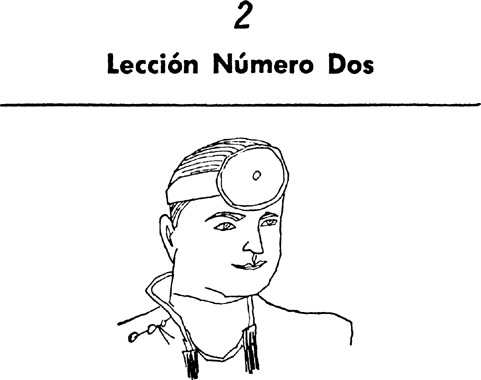
el doctor
 ou
can convert many English words that end in “ist” into Spanish words by
adding the letter “a” to them.
ou
can convert many English words that end in “ist” into Spanish words by
adding the letter “a” to them.
IST = ISTA
the pianist = el pianista
| el pianista | el oculista | un artista |
| el violinista | el capitalista | un novelista |
| el dentista | el comunista | un optimista |
You can convert many English words that end in “ous” into Spanish words by changing the “ous” to “oso.”
OUS = OSO
famous = famoso
| curioso | generoso | melodioso |
| delicioso | glorioso | religioso |
| famoso | ambicioso | pomposo |
If a word ends in “tion” in English you can convert it into Spanish simply by changing the “t” to “c.”
TION = CIÓN
the action = la acción
| la descripción | la civilización | la cooperación |
| la admiración | la circulación | la distribución |
| la anticipación | la constitución | una invitación |
| la exageración | la generación | la institución |
| el programa, the program | paciente, patient |
| el rosbif, the roast beef | interesante, interesting |
| el biftec, the beefsteak | muy, very |
| en, in; mi, my | en mi opinión, in my opinion |
¿Es popular el pianista?
Sí, el pianista es popular.
¿Es inteligente el pianista?
Sí, el pianista es inteligente.
¿Es inteligente el novelista?
Sí, el novelista es inteligente.
¿Es curioso el novelista?
Sí, el novelista es muy curioso.
¿Es curioso el dentista?
Sí, el dentista es muy curioso.
¿Es exceptional el artista?
Sí, el artista es exceptional.
¿Es famoso el presidente?
Sí, el presidente es muy famoso.
¿Es famoso el general?
Sí, el general es muy famoso.
¿Es ambicioso el pianista?
Sí, el pianista es muy ambicioso.
¿Es ambicioso el artista?
Sí, el artista es muy ambicioso.
¿Es impaciente el doctor?
Ay no, el doctor no es impaciente. El doctor es muy paciente.
¿Es impaciente el dentista?
Ay no, el dentista no es impaciente. El dentista es muy paciente.
¿Es paciente el artista?
Sí, el artista es muy paciente.
¿Es inteligente el artista?
Sí, el artista es muy inteligente.
¿Es generoso el doctor?
Sí, en mi opinión, el doctor es muy generoso.
¿Es generoso el dentista?
Sí, en mi opinión, el dentista es muy generoso.
¿Es interesante el novelista?
Sí, en mi opinión, el novelista es muy interesante.
¿Es interesante el general?
Sí, en mi opinión, el general es muy interesante.
¿Es interesante el programa?
Sí, en mi opinión, el programa es muy interesante.
¿Es delicioso el rosbif?
Sí, el rosbif es delicioso.
¿Es delicioso el biftec?
Sí, el biftec es delicioso.
For practice, combine the words in the columns below in different ways to form as many sentences as you can. Just be sure to use words from each of the three columns in every sentence you form.
| 1 | 2 | 3 |
| El dentista | es | curioso |
| El artista | no es | famoso |
| El oculista | generoso | |
| El pianista | ambicioso | |
| El violinista | pomposo | |
| El novelista | un optimista | |
| El capitalists | un pesimista | |
| El comunista | un animal | |
| El socialista | importante | |
| El optimista | inteligente | |
| El presidente | excelente | |
| El doctor | paciente | |
| El conductor | impaciente | |
| El cable | excepcional | |
| El hotel | terrible | |
| El restaurante | democrático | |
| El hospital | diplomático | |
| El rosbif | delicioso | |
| El biftec | urgente | |
| El estudiante | industrioso | |
| El programa | interesante |
Translate the following sentences into Spanish. Write out each sentence in Spanish, using the columns above as a guide. After you have written out the sentences, check with the correct translations below this exercise.
Check your sentences with the correct translations below.
In Spanish we have both masculine and feminine words. Masculine words take the articles “el” (the) or “un” (a, an).
EXAMPLES:
| el doctor, the doctor | un doctor, a doctor |
| el actor, the actor | un actor, an actor |
| el dentista, the dentist | un dentista, a dentist |
| el cable, the cable | un cable, a cable |
| el animal, the animal | un animal, an animal |
The feminine articles are “la” (the) and “una” (a, an).
Spanish words that end in “ión” are feminine and consequently take the feminine articles “la” and “una.”
EXAMPLES:
| la conversación, the conversation | una conversación, a conversation. |
| la opinión, the opinion | una opinión, an opinion |
| la celebración, the celebration | una celebración, a celebration |
Remember that if a word ends in “tion” in English, change the “t” to “c” and, presto, you have a Spanish word.
TION = CIÓN
the nation = la nación
“La” means “the”; “una” means “a, an.”
| la información | una invitación |
| la constitución | una institución |
| la operación | una indicación |
| la preparación | una composición |
| la producción | una acción, an acction |
| la construcción | una reacción |
If a word ends in “sion” in English, it ends in “sión” in Spanish also. But don’t forget that you never have a double “s” in Spanish.
SION = SIÓN
| la confusión | una comisión |
| la conclusión | una discusión |
| la confesión | una decisión |
Notice that words which end in “ión” are feminine.
The accent indicates ONLY that the accented letter should be stressed. Notice that the final “o” of every “ión” word has an accent.
Add the letter “a” to words that end in “ist” in English.
IST = ISTA
the dentist = el dentista
| el artista | el idealista |
| el capitalista | la lista |
| el comunista | el materialista |
| el dentista | el metodista |
| el economista | (methodist) |
| el evangelista | el modernista |
| el naturalista | el moralista |
| el guitarrista | la florista |
| el novelista | el publicista |
| el oculista | el pugilista |
| el oportunista | el reservista |
| el optimista | el socialista |
| el organista | el telegrafista |
| el pacifista | el turista |
| el pesimista | (tourist) |
| el pianista |
Change “ous” to “oso.”
OUS = OSO
delicious = delicioso
| ambicioso | fabuloso |
| amoroso | famoso |
| bilioso | furioso |
| ceremonioso | generoso |
| contagioso | glorioso |
| curioso | gracioso |
| delicioso | imperioso |
| impetuoso | meticuloso |
| industrioso | misterioso |
| ingenioso | (mysterious) |
| laborioso | monstruoso |
| luminoso | nebuloso |
| malicioso | nervioso |
| melodioso | (nervous) |
| numeroso | poroso |
| odioso | precioso |
| pomposo | prodigioso |
| populoso | religioso |
| supersticioso | virtuoso |
| vicioso | voluminoso |
| victorioso | voluptuoso |
| vigoroso |
Change “tion” to “ción.” In general, words which end in “ion” in English also end in “ión” in Spanish.
TION = CIÓN
SION = SIÓN
the combination = la combinación
| la abreviación | la complexión |
| la abstención | la composición |
| la abstracción | la compresión |
| la acción | la compulsión |
| la adhesión | la comunicación |
| la administración | la concentración |
| la admiración | la concepción |
| la adopción | la concesión |
| la adulación | la conclusión |
| la ambición | la condición |
| la amputación | la confesión |
| la anticipación | la confirmación |
| la asociación | la confusión |
| la atención | la congesción |
| la automación | la conglomeración |
| la aversión | la congregación |
| la aviación | la conjugación |
| la capitulación | la consideración |
| la celebración | la consolación |
| la circulación | la constelación |
| la civilización | la constitución |
| la clasificación | la construcción |
| la coagulación | la contagión |
| la colaboración | la continuación |
| la colección | la contradicción |
| la comisión | la contribución |
| la compasión | la conversión |
| la compensación | la convicción |
| la convulsión | la diversión |
| la cooperación | la división |
| la coordinación | la duplicación |
| la corrupción | la edición |
| la creación | la elección |
| la cultivación | la elevación |
| la decisión | la eliminación |
| la declaración | la emoción |
| la decoración | la evaporación |
| la dedicación | la evasión |
| la deducción | la exageración |
| la definición | la excavación |
| la degeneración | la excepción |
| la degradación | la exclamación |
| la deliberación | la exhibición |
| la depresión | la expansión |
| la descripción | la expedición |
| la desolación | la explosión |
| la determinación | la exportación |
| la devoción | la exposición |
| la dicción | la expresión |
| la digesción | la extensión |
| la dimensión | la federación |
| la dirección | la formación |
| la discreción | la generación |
| la discusión | la ilusión |
| la distinción | la ilustración |
| la distracción | la imaginación |
| la distribución | la imitación |
| la implicación | la meditación |
| la impresión | la mención |
| la inauguración | la misión |
| la inclinación | la moderación |
| la indicación | la multiplicación |
| la indigesción | la munición |
| la indiscreción | la nación |
| la infección | la navegación |
| la inflamación | la nutrición |
| la información | la obligación |
| la initiación | la observación |
| la inoculación | la obsesión |
| la inscripción | la obstrucción |
| la insinuación | la ocasión |
| la inspección | la ocupación |
| la inspiración | la operación |
| la instalación | la opinión |
| la institución | la oposición |
| la instrucción | la opresión |
| la intención | la organización |
| la intervención | la ovación |
| la introducción | la participación |
| la intuición | la pasión |
| la invasión | la penetración |
| la invención | la pensión |
| la investigación | la perfección |
| la invitación | la persecución |
| la irrigación | la persuasión |
| la irritación | la petición |
| la legión | la posesión |
| la liberación | la posición |
| la limitación | la precisión |
| la lubricación | la preocupación |
| la manipulación | la preparación |
| la mansión | la preposición |
| la presentación | la reservación |
| la preservación | la resolución |
| la pretensión | la reunión |
| la prevención | la revelación |
| la procesión | la revolución |
| la proclamación | la rotación |
| la producción | la satisfacción |
| la profesión | la saturación |
| la pronunciación | la sección |
| la propagación | la seducción |
| la proporción | la selección |
| la proposición | la sensación |
| la propulsión | la separación |
| la protección | la sesión |
| la provisión | la situación |
| la publicación | la solución |
| la radiación | la subscripción |
| la reacción | la superstición |
| la rebelión | la suposición |
| la recepción | la tensión |
| la recomendación | la tracción |
| la recreación | la tradición |
| la reducción | la transacción |
| la reelección | la transcripción |
| la reflexión | la transformación |
| la ref rigeración | la transportación |
| la región | la vacación |
| la relación | la variación |
| la religión | la vegetación |
| la remuneración | la veneración |
| la repetición | la ventilación |
| la representación | la versión |
| la reproducción | la visión |
Turn over the reminder card that you filled out in Lesson I. Copy the material that is shown on the sample below onto your first card.
Each time you look at your card try to make up several words in each of the eight categories.
VI. IST = ISTA
el dentista
el pianista
VII. OUS = OSO
delicioso
famoso
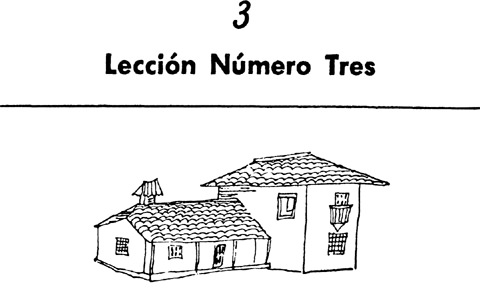
la casa
 rdinarily,
the present tense is taught first because it comes first in the order of
the language. But I feel that the past tense will be more useful to you
at this point. So, at the risk of exposing myself to that dreadful
epithet, unorthodox, I am jumping feet first with you into the past
tense. Once you have mastered it you will have the narrative language
that you use every day with your friends. You will be able to tell what
you did and saw and how it impressed you. “I did” this or that is the
beginning of a story, whereas “I do” thus and such is apt to stop you
cold. “I eat a lot” can only be followed by a few unpleasant remarks,
but “Last night I had dinner with Joe” opens up endless
possibilities.
rdinarily,
the present tense is taught first because it comes first in the order of
the language. But I feel that the past tense will be more useful to you
at this point. So, at the risk of exposing myself to that dreadful
epithet, unorthodox, I am jumping feet first with you into the past
tense. Once you have mastered it you will have the narrative language
that you use every day with your friends. You will be able to tell what
you did and saw and how it impressed you. “I did” this or that is the
beginning of a story, whereas “I do” thus and such is apt to stop you
cold. “I eat a lot” can only be followed by a few unpleasant remarks,
but “Last night I had dinner with Joe” opens up endless
possibilities.
There are over two hundred nouns that end in “ación” that can be converted into verbs if you simply remove the “ación” and add verb endings.
EXAMPLES:
| Take the noun | : | PREPARACIÓN, preparation |
| Remove the “ACIÓN” | : | PREPAR |
| Add the letter “É” | : | PREPARÉ, I prepared |
| NOUNS | REMOVE “ACIÓN” | ADD “É” |
| la preparación | (prepar) | preparé, I prepared |
| la celebración | (celebr) | celebré, I celebrated |
| la invitación | (invit) | invité, I invited |
| la combinación | (combin) | combiné, I combined |
| la conversación | (con vers) | conversé, I conversed |
| la presentación | (present) | presenté, I presented |
“Yo” is the word for “I” in Spanish, but it is frequently dropped.
| Take the noun | : | PREPARACIÓN |
| Remove the “ACIÓN” | : | PREPAR |
| Add the letter “Ó” | : | PREPARÓ, you prepared |
“Usted” means “you,” but it is frequently dropped.
| NOUNS | REMOVE “ACIÓN” | ADD “Ó” |
| la celebración | (celebr) | celebró, you celebrated |
| la invitación | (invit) | invitó, you invited |
| la combinación | (combin) | combinó, you combined |
| la conversación | (convers) | conversó, you conversed |
| la presentación | (present) | presentó, you presented |
| Usted preparó. You prepared | ¿Preparó usted? Did you prepare? |
| Usted invitó. You invited | ¿Invitó usted? Did you invite? |
| Usted presentó. You presented | ¿Presentó usted? Did you present? |
Notice that the word order is inverted in questions.
“Usted” (you) is frequently dropped, but we’ll use it in this lesson so that you will get used to the inverted order of words in questions.
PAST TENSE ENDINGS
| For the first person (I) | É |
| For the second person (you) | Ó |
| la lección, the lesson | en, in |
| la clase, the class | mi, my |
| la cena, supper, dinner | su, your |
| la casa, the house | esta mañana, this morning |
| para, for | esta tarde, this afternoon |
PREPARÉ, I prepared
NO PREPARÉ, I didn’t prepare
¿PREPARÓ USTED? Did you prepare?
¿Preparó usted la lección?
Sí, preparé la lección.
¿Preparó usted la lección esta mañana?
Sí, preparé la lección esta mañana.
¿Preparó usted la lección para la clase?
Sí, preparé la lección para la clase.
¿Preparó usted la cena?
Sí, preparé la cena.
¿Preparó usted la cena esta mañana?
No, no preparé la cena esta mañana.
¿Preparó usted la cena esta tarde?
Sí, preparé la cena esta tarde.
¿Preparó usted la cena en el club?
No, no preparé la cena en el club.
¿Preparó usted la cena en el hotel?
No, no preparé la cena en el hotel.
¿Preparé usted la cena en su casa?
Sí, preparé la cena en mi casa.
For practice, combine the words below in different ways to form as many sentences as you can. Just be sure to use words from each of the three columns in every sentence you form.
| 1 | 2 | 3 |
| ¿Preparó listed? (Did you prepare?) | la lección | esta mañana |
| Preparé (I prepared) | la cena | esta tarde |
| No preparé (I didn’t prepare) | para la clase | |
| en el club | ||
| en el hotel | ||
| en mi casa |
Translate the following sentences into Spanish. Write out each sentence in Spanish, using the columns above as a guide. After you have written out all the sentences check with the correct translations below this exercise.
Check your sentences with the correct translations below.
NOTE: In English the word “dinner” can mean either the evening meal or the noonday meal. In Spanish “cena” is ONLY the evening meal. “Cena” actually means “supper.”
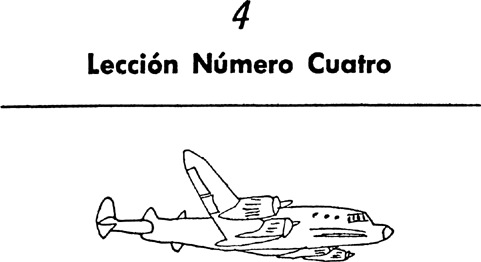
el avión
ou
can convert many English words that end in “ty” into Spanish words by
changing the “ty” to “dad.”
TY = DAD
the capacity = la capacidad
| la curiosidad | la electricidad | la prosperidad |
| la comunidad | la humanidad | la publicidad |
| la dignidad | la personalidad | la variedad |
| café, coffee | el tren, the train |
| sopa, soup | el avión, the airplane |
| una ensalada, a salad | el aeropuerto, the airport |
| una aspirina, an aspirin | la estación, the station |
| eso es ridículo, that is ridiculous | anoche, last night |
| el taxi, the taxi |
TOMÉ, I took
NO TOMÉ, I didn’t take
¿TOMÓ USTED? Did you take?
In Spanish the verb “to take” is used to express eating and drinking. We say, “I took dinner,” instead of, “I had dinner,” “I took coffee” instead of “I had coffee.”
¿Tomó usted café esta mañana? (Did you have [take] coffee this morning?)
Sí, tomé café esta mañana. (Yes, I had [took] coffee this morning.)
¿Tomó usted café en el restaurante?
Sí, tomé café en el restaurante.
¿Tomó usted la cena en el restaurante?
No, no tomé la cena en el restaurante.
¿Tomó usted rosbif?
Sí, tomé rosbif.
¿Tomó usted biftec?
No, no tomé biftec.
¿Tomó usted sopa?
Sí, tomé sopa.
¿Tomó usted una ensalada?
Sí, tomé una ensalada.
¿Tomó usted una aspirina?
Ay no, eso es ridículo, no tomé una aspirina. Tomé rosbif, sopa, una ensalada, etc. (etcétera)
¿Preparó usted la cena anoche?
Sí, preparé la cena anoche.
¿Tomó usted un taxi esta mañana?
Sí, tomé un taxi esta mañana.
¿Tomó usted un tren en la estación?
No, no tomé un tren en la estación.
¿Tomó usted un avión en el aeropuerto?
No, no tomé un avión en el aeropuerto.
For practice, combine the words below in different ways to form as many sentences as you can. Just be sure to use words from each of the three columns in every sentence you form.
| 1 | 2 | 3 |
| ¿Tomó usted | café | esta mañana |
| (Did you take?) | rosbif | esta tarde |
| No, no tomé | biftec | anoche |
| (No, I didn’t take) | la cena | en el hotel |
| Tomé | sopa | en el restaurante |
| (I took) | una ensalada | en la clase |
| una aspirina | en el club | |
| chocolate | en la estación | |
| té (tea) | en el aeropuerto | |
| una Pepsi Cola | en el tren | |
| un sandwich | en el avión | |
| el tren | ||
| el avión | ||
| untaxi |
Notice that you don’t say “at the club.” In Spanish you must never say you are “at” places. You are always “in” places, such as “in the airport, in the club,” etc.
Translate the following sentences into Spanish. Write out each sentence in Spanish, using the columns above as a guide. After you have written out all the sentences check with the correct translations below this exercise.
Remember that in Spanish you can never say, “I had coffee”; you must always say, “I took coffee.”
In the sentences below you will find the word “took” in parentheses to remind you to use “tomé” or “tomó.”
Check your sentences with the correct translations below.
Copy the following material on a card. Carry the card with you and glance at it whenever you have a chance.
|
¿Tomó usted (Did you take?) |
café la cena sopa una ensalada |
esta mañana esta tarde anoche en el hotel |
|
No, no tomé (No, I didn’t take) |
una aspirina chocolate té un sandwich un taxi |
en la clase en el club en el tren en el avión en la estación |
|
Tomé (I took) |
el tren el avión |
en el restaurante |
You have already seen how you can convert many English words that end in “ty” into Spanish words by changing the “ty” to “dad.” Some of these words are seldom used in English but are common words in Spanish. For example, the Spanish word for “speed” is “velocidad” (velocity). In the following list you will find the word “speed” under “velocidad” to show that “velocidad” is the common, everyday word for “speed” in Spanish. Whenever a common Spanish word appears among these categories that has a slightly different use from the corresponding English word, the common English word will be written under it.
EXAMPLE: debilidad (weakness)
TY = DAD
the university = la universidad
| la actividad | la debilidad | la generalidad |
| la adversidad | (weakness) | la hospitalidad |
| la afinidad | la dignidad | la hostilidad |
| la agilidad | la diversidad | la humanidad |
| la atrocidad | la divinidad | la identidad |
| la austeridad | la elasticidad | la imparcialidad |
| la autoridad | la electricidad | la inferioridad |
| (authority) | la eternidad | la imposibilidad |
| la brutalidad | la extremidad | la individualidad |
| la calamidad | la facilidad | la infidelidad |
| la capacidad | (ease) | la inmensidad |
| la caridad | la familiaridad | (immensity) |
| (charity) | la fatalidad | la inmoralidad |
| la castidad | la felicidad | (immorality) |
| (chastity) | (happiness) | la inmortalidad |
| la cavidad | la fertilidad | (immortality) |
| la celebridad | la festividad | la integridad |
| la ciudad | la fidelidad | la intensidad |
| (city) | la finalidad | la localidad |
| la claridad | la flexibilidad | la maternidad |
| la compatibilidad | la formalidad | la moralidad |
| la comunidad | la fraternidad | la infinidad |
| la cordialidad | la f rivolidad | la mortalidad |
| la crueldad | la futilidad | la municipalidad |
| la curiosidad | la frugalidad | la nacionalidad |
| la necesidad | la publicidad | la unanimidad |
| (need) | la realidad | la unidad |
| la obesidad | la regularidad | la universidad |
| la obscenidad | la responsabilidad | la utilidad |
| la obscuridad | la serenidad | la variedad |
| (darkness) | la severidad | la velocidad |
| la originalidad | la simplicidad | (speed) |
| la personalidad | la sinceridad | la veracidad |
| la perversidad | la sociabilidad | la versatilidad |
| la popularidad | la sociedad | la virilidad |
| la posibilidad | la susceptibilidad | la visibilidad |
| la profanidad | la tenacidad | la vitalidad |
| la prosperidad | la tranquilidad | la vivacidad |
| la proximidad | la trinidad |
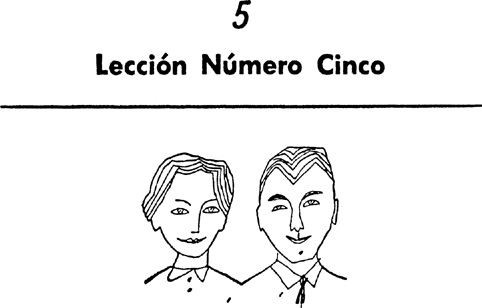
mamá y papá
ou
can convert many English words that end in “ry” into Spanish words by
changing the “ry” to “rio.”
RY = RIO
the canary = el canario
| aniversario | extraordinario | imaginario |
| contrario | literario | itinerario |
| necesario | diccionario | involuntario |
You can convert some English words that end in “em” or “am” into Spanish words by adding the letter “a.”
EM = EMA
AM = AMA
| el programa | el cablegrama | el poema |
| el telegrama | el problema | el sistema |
|
un amigo, a friend |
al, to the (masc.), a contraction of “a el” |
|
la fiesta, the party |
|
|
esta mañana, this morning |
al cine, to the movies |
|
esta tarde, this afternoon |
esta noche, tonight (this night) |
|
el cine, the movies |
Roberto, Robert |
|
el teatro, the theatre |
su mamá, your mother |
|
a, to |
a la fiesta, to the party |
|
a la, to the (fem.) |
|
| INVITÉ, I invited | VISITÉ, I visited |
| NO INVITÉ, I didn’t invite | NO VISITÉ, I didn’t visit |
| ¿ INVITÓ USTED? Did you invite? | ¿ VISITÓ USTED? Did you visit? |
Invité a Roberto. I invited Robert.
Visité a Roberto. I visited Robert.
“Invité” and “visité” are followed by the letter “a.” This “a” is called the personal “a” because it is used when PERSONS follow verbs.
¿ Invitó usted a su mamá al cine?
Si, invité a mi mamá al cine.
¿ Invitó usted a un amigo al cine?
Sí, invité a un amigo al cine esta noche.
¿ Invitó usted a un amigo al teatro?
Sí, invité a un amigo al teatro.
¿ Invitó usted a un amigo a la clase esta mañana?
Sí, invité a un amigo a la clase esta mañana.
¿ Invitó usted al profesor a su casa esta noche?
Sí, invité al profesor a mi casa esta noche.
¿ Invitó usted a Roberto a su casa?
Sí, invité a Roberto a mi casa.
¿ Invitó usted al profesor a la fiesta?
Sí, invité al profesor a la fiesta.
¿ Visitó usted al profesor esta mañana?
Sí, visité al profesor esta mañana.
¿ Visitó usted al presidente en la Casa Bianca (the White House) en Washington?
No, no visité al presidente en la Casa Blanca en Washington.
Combine the words below in different ways to form as many sentences as you can. Just be sure to use words from each of the three columns in every sentence you form.
Notice again that “visité” and “invité” are followed by the personal “a.”
A
| 1 | 2 | 3 |
| ¿ Invitó usted a | su mamá | al teatro |
| Invité a | mi mamá | al cine |
| No invité a | su papá | a la fiesta |
| mi papá | a la clase | |
| un amigo | a mi casa | |
| Roberto | esta mañana | |
| esta tarde | ||
| esta noche |
B
| 1 | 2 | 3 |
| ¿ Visité usted a | Roberto | esta mañana |
| Visité a | su mamá | esta tarde |
| No visité a | mi papá | esta noche |
Translate the following sentences into Spanish. Write out each sentence in Spanish, using the columns above as a guide. After you have written out all the sentences check with the correct translations below this exercise.
Check your sentences with the correct translations below.
In Spanish we do not say “Visité a el doctor”; instead, we say “Visité al doctor.” The word “al” is a contraction of “a” and “el.”
EXAMPLES:
| Visité al doctor. | Visité al dentista. |
| Visité al novelista. | Invité al profesor a la fiesta. |
Copy the material that is shown on the sample below onto a card. Carry the card with you and glance at it whenever you get a chance.
| ¿ Invitó usted a | su mamá | al teatro |
| (Did you invite?) | mi mamá | al cine |
| su papá | a la fiesta | |
| No invité a | mi papá | a la clase |
| (I didn’t invite) | un amigo | a mi casa |
| Roberto | esta mañana | |
| Invité a | esta tarde | |
| (I invited) | esta noche | |
| anoche | ||
| (last night) |
NOTE: “Mamá” and “papá” are informal words like “mom” and “dad.” “Madre” (mother) and “padre” (father) are more formal.
You can convert many English words that end in “ry” into Spanish words by changing the “ry” to “rio.”
RY = RIO
the canary = el canario
| adversario | emisario |
| aniversario | extraordinario |
| canario | fragmentario |
| comentario | glosario |
| (comment) | (glossary) |
| contrario | hereditario |
| culinario | imaginario |
| diario | incendiario |
| (diary, daily) | involuntario |
| diccionario | itinerario |
| dignitario | laboratorio |
| disciplinary | literario |
| mercenario | salario |
| monetario | secretario |
| necesario | secundario |
| (necessary) | seminario |
| notario | solitario |
| obituario | sumario |
| ordinario | suplementario |
| parlamentario | temporario |
| primario | tributario |
| reaccionario | veterinario |
| revolucionario | visionario |
| rosario | voluntario |
Some of the above words may be made feminine simply by changing the final “o” to “a.”
EXAMPLES:
el secretario (masc.), la secretaria (fem.)
You can convert some English words that end in “em,” “am,” “om” into Spanish words by adding the letter “a.”
| el programa | el diagrama | el sistema | el emblema |
| el telegrama | el epigrama | el poema | el idioma |
| el cablegrama | el monograma | el problema | (the language) |
Some words that end in “ma” are alike in English and Spanish: el drama, el panorama, el dilema.
“El clima” means “the climate.”
el teléfono
ou
have already learned that if you are speaking of yourself you must end
the verb in “é.”
| EXAMPLES: |
preparé, I prepared tomé, I took visité, I visited invité, I invited |
When speaking of anybody but yourself (singular), you must end verbs in the letter “ó.”
EXAMPLES:
Roberto preparó la lección. Robert prepared the lesson.
El doctor tomó un taxi. The doctor took a taxi.
El general visitó al presidente. The general visited the president.
¿ Preparó usted la cena? Did you prepare dinner?
Remember, then, that if you speak of yourself you must end the verb in “é” and if you speak of anyone else (singular) you must end the verb in “ó.” This is easy to remember if you say a kind of jingle to yourself: “É for me, Ó for others.”
In order to help you connect the letter “ó” with everything and everybody in the world (except yourself), I have devised a figure which I call the third man. Every time the third man appears before a verb, you can be sure that the verb must certainly end in the letter “ó.”
Allow me to present the third man:

The third man is really the figure of a sleeping man wearing a
sombrero. The figure has been drawn in the shape of a number 3 and will
appear in the rest of the lessons like this:  .
.
The third man is a versatile fellow. He represents EVERYTHING and EVERYBODY in the world except you. When speaking of a star, a flower, a table, Julius Caesar, or your Aunt Sarah you must use the third man form, that is, you must end the verb in the letter “ó.”
You already know hundreds and hundreds of verbs in English that are also Spanish verbs if you change them very slightly.
“Visité” and “invité” are like the English verbs “visited” and “invited” with the letter “d” dropped. There are a great many verbs in English that can be changed into Spanish in the same way.
Following is a list of these verbs that you can learn virtually at a glance. Notice the little drawing of the third man before every third man form below.
| FIRST PERSON | THIRD MAN FORM |
| usé, I used |
usó, you, he, she used |
| voté, I voted |
votó, you, he, she voted |
| inventé, I invented |
inventó, you, he, she invented |
| importé, I imported |
importó, you, he, she imported |
| copié, I copied |
copió, you, he, she copied |
| curé, I cured |
curé, you, he, she cured |
| examiné, I examined |
examinó, you, he, she examined |
| noté, I noted, noticed |
notó, you, he, she noted, noticed |
| presenté, I presented |
presentó, you, he, she presented |
| comparé, I compared |
comparó, you, he, she compared |
| combiné, I combined |
combinó, you, he, she combined |
| causé, I caused |
causó, you, he, she caused |
| deposité, I deposited |
depositó, you, he, she deposited |
| insulté, I insulted |
insultó, you, he, she insulted |
| planté, I planted |
plantó, you, he, she planted |
| patenté, I patented |
patentó, you, he, she patented |
| cancelé, I canceled |
canceló, you, he, she canceled |
| continué, I continued |
continuó, you, he, she continued |
There are other verbs that are slightly different from their English equivalents, but that are still very easy to recognize and learn.
| recomendé, I recommended |
recomendó, you, he, she recommended |
| progresé, I progressed |
progresó, you, he, she progressed |
| anticipé, I anticipated |
anticipó, you, he, she anticipated |
| acepté, I accepted |
aceptó, you, he, she accepted |
| cultivé, I cultivated |
cultivó, you, he, she cultivated |
| dicté, I dictated |
dictó, you, he, she dictated |
| expresé, I expressed |
expresó, you, he, she expressed |
| celebré, I celebrated |
celebró, you, he, she celebrated |
| estudié, I studied |
estudió, you, he, she studied |
| fotografié, I photographed |
fotografió, you, he, she photographed |
| confesé, I confessed |
confesó, you, he, she confessed |
| tosté, I toasted |
tostó, you, he, she toasted |
| pasé, I passed |
pasó, you, he, she passed |
| cooperé, I co-operated |
cooperó, you, he, she co-operated |
Then there are a great number of verbs that are rarely used in everyday speech in English but that are common, everyday words in Spanish.
| comencé, I began |
comenzó, you, he, she began |
| terminé, I finished |
terminó, you, he, she finished |
| felicité, I congratulated |
felicitó, you, he, she congratulated |
| molesté, I bothered |
molestó, you, he, she bothered |
| entré, I came in, went in, entered |
entró, you, he, she came in, went in, entered |
| estacioné, I stationed, parked (car) |
estacionó, you, he, she stationed, parked (car) |
| saludé, I greeted, said “hello” |
saludó, you, he, she greeted, said “hello” |
As you can see by all the preceding material in the book, there is a great similarity between English and Spanish. This is of tremendous advantage to you, for it will help you to learn very quickly. But you must press this advantage and give your imagination encouragement. Try to guess the meaning of every Spanish word you encounter. Make up words and sentences. In other words, let yourself go.
Now let’s see how the third man verb form is used: “I voted” is “voté.” But if you wish to say that anyone else in the world voted, you must use the third man verb form “votó.”
| El presidente votó. | Mi papá votó. |
| (The president voted.) | Mi mamá votó. |
| El doctor votó. | El profesor votó. |
| El dentista votó. | Roberto votó. |
If you wish to ask a question invert the word order.
| ¿ Votó el presidente? | ¿ Votó el actor? |
| (Did the president vote?) | ¿ Votó el profesor? |
| ¿ Votó el general? | ¿ Votó usted? |
| (Did the general vote?) | ¿ Votó el dentista? |
| y, and | el rancho, the ranch |
| de, of, from | el grupo, the group |
| el dinero, the money | el drama, the drama |
| el banco, the bank | el teléfono, the telephone |
| el pan, the bread | el vocabulario, the vocabulary |
| el automóvil, the automobile | el radio, the radio |
| espárragos, asparagus | en, in, on, into |
| María, Mary | Juan, John |
Below, I have written some sentences for you to translate into English. If you come upon a sentence which you feel you can’t translate, study it and make a wild stab at a translation. You will find that you are almost invariably right in your guess. After you have written out all the sentences in English check with the correct translation below the exercise.
You will find a personal “a” after verbs which are followed by persons.
Roberto visitó a un amigo en Cuba.
Mamá preparó la cena anoche.
El presidente aceptó la invitación.
María estudió la lección esta mañana.
Roberto tomó la cena en un restaurante.
El doctor tomó una aspirina.
Alexander Graham Bell inventó el teléfono.
Don Ameche no inventó el teléfono.
Marconi inventó el radio.
El profesor tomó una Pepsi Cola.
El agente importó perfume de Francia.
Mi mamá visitó a un amigo en el hospital.
Mi padre recomendó a su amigo.
El general entró en la capital.
El ministro preparó el sermón para la congregación.
Mi diente importó café de Costa Rica.
Juan entró en el hotel y saludó a su amigo.
El mecánico lubricó el automóvil en el garage.
Mi amigo cultivó café en el rancho.
El grupo presentó un drama.
El profesor felicitó al estudiante.
¿ Votó usted esta mañana?
El doctor curó al paciente.
¿ Copió usted la composición?
¿ Estudió usted la lección para la clase?
¿ Aceptó usted la invitación?
Mi padre invitó a Juan al cine.
Juan aceptó la invitación.
Edison inventó el fonógrafo.Check your sentences with the translation below.
Now, if you feel ambitious and want to try your hand at a more difficult task, translate the English sentences back into Spanish. I will say to you what the señorita said when Pedro told her he loved her so much that he would swim the Atlantic for her. She said, “Eef you can do eet, I kees you!”
You have learned forty new verbs in this lesson. Use them and enjoy them. You will find that you can make up hundreds of sentences with them.
Use the following nouns to fill in the blanks in the sentences below:
| María (Mary)a | mi papá | el doctor | el presidente |
| Juan (John) | mi mamá | el pianista | el actor |
1.
 aceptó la invitación.
(accepted the invitation)
2.
tomó la cena en el club.
(had dinner at the club)
3.
depositó dinero en el banco.
(deposited money in the bank)
4.
visitó a un amigo.
(visited a friend)
5.
invitó a Roberto a la fiesta.
(invited Robert to the party)
los sombreros
You can convert some English words that end in “ce” into Spanish words by changing “ce” to “cia.”
CE = CIA
the distance = la distancia
| la conveniencia | la justicia |
| la experiencia | la significancia |
| la importancia | Francia |
| la independencia | Alicia |
You can convert some English words that end in “cy” into Spanish words by changing the “cy” to “cia.”
CY = CIA
the agency =la agencia
| la aristocracia | la emergencia |
| la democracia | la tendencia |
| la diplomacia | la urgencia |
| coctel de frutas, fruit cocktail | que, what |
| papas, potatoes | su, your, his, her |
| el sombrero, the hat (man’s or woman’s) | durante, during |
| la crema, the cream | de, of, from, about |
| la carne, the meat |
del, of the, from the, about the (contraction of “de
el”)
con, with (chile con carne, pepper with meat)
HABLÉ, I talked
NO HABLÉ, I didn’t talk
¿ HABLÓ USTED? Did you talk?
hablé con, I talked with
Hablé por teléfono. I talked on the phone, I called up.
Maria habló. Mary talked.
hable de, I talked about
Remember that when you ask a question the verb goes before the noun.
EXAMPLES:
¿ Habló María? Did Mary talk?
¿ Aceptó María? Did Mary accept?
¿ Habló usted por teléfono? Did you talk on the phone? Did you call
up?
¿ Habló usted por teléfono esta mañana?
Sí, esta mañana hablé por teléfono con María.
¿ Invitó usted a María a su casa?
Sí, invité a María a mi casa.
¿ Aceptó María la invitación?
Sí, María aceptó la invitación.
¿ Tomó María la cena en su casa?
Sí, María tomó la cena en mi casa.
¿ Qué tomó María?
María tomó un coctel de frutas, sopa, papas, espárragos y una ensalada.
¿ Tomó María carne?
Sí, María tomó rosbif.
¿ Tomó María café?
Sí, María tomó café con crema.
¿ Tomó usted chocolate?
No, no tomé chocolate, tomé café con crema.
¿ Habló usted con María durante la cena?
Sí, hablé mucho con María durante la cena.
¿ Habló usted del teatro con María?
Sí, hablé del teatro con María.
¿ Habló María de su (her) permanente?
Sí, María habló de su permanente y de su sombrero.
¿ Habló María con su mamá?
Sí, María, habló con mi mamá y con mi papá.
Combine the phrases in Column 1 and Column 2 to form as many sentences as you can. Just be sure to use words from each of the columns in every sentence you form.
| 1 | 2 |
| Hablé (I talked) | por teléfono |
| No hablé (I didn’t talk) | con María |
|
¿ Habló usted? (Did you talk?) |
con el doctor |
|
María habló (Mary talked) |
con Juan |
|
Roberto habló (Robert talked) |
con Alberto |
|
El doctor habló (The doctor talked) |
de la clase |
|
¿ Habló María (Did Mary talk?) |
de México |
|
¿ Habló Roberto (Did Robert talk?) |
del accidente |
|
¿ Habló el doctor |
del teatro |
|
¿ Habló mamá |
en la clase |
| esta mañana |
Translate the following sentences into Spanish. The above columns can be used as a translation guide. After you have written out all the sentences check with the correct translations below this exercise.
Check your sentences with the correct translations below.
Use the following nouns to fill in the blanks in the sentences below:
| el doctor | el profesor | María |
| el dentista | mi mamá | Roberto |
| el oculista | el general | Alberto |
1. Hablé con
(I talked with)
2.
Roberto habló con (Robert talked with)
3. Hablé por teléfono con
(I called up)
4.
El doctor habló por teléfono con
(The doctor called up)
| Hablé | por teléfono |
| (I talked) | con Roberto |
| con María | |
|
¿ Habló usted? |
con su mamá |
| (Did you talk?) | de México |
| de la clase | |
| No hablé | del cine |
| (I didn’t talk) | del teatro |
| en la clase | |
| mucho (much, a lot) |
Copy the above material onto a card. Carry the card with you and glance at it whenever you get a chance.
Remember that you can convert some English words that end in “ce” into Spanish words by changing the “ce” to “cia.” These words are feminine and take the articles “la” (the) and “una” (a, an).
CE = CIA
the distance = la distancia
| abstinencia | circunstancia | difidencia | frecuencia |
| abundancia | coherencia | diligencia | gracia |
| adolescencia | coincidencia | distancia | impaciencia |
| Alicia | conciencia | efervescencia | impertinencia |
| ambulancia | confercncia | elegancia | importancia |
| arrogancia | (lecture) | elocuencia | incidencia |
| asistencia | consecuencia | esencia | independencia |
| ausencia | convalecencia | evidencia | indiferencia |
| (absence) | conveniencia | excelencia | indolencia |
| benevolencia | decadencia | experiencia | indulgencia |
| ciencia | desobediencia | exuberancia | inocencia |
| circunferencia | diferencia | Francia | insignificancia |
| insistencia | malicia | persistencia | temperancia |
| insolencia | obediencia | precedencia | tolerancia |
| instancia | ocurrencia | preferencia | turbulencia |
| inteligencia | opulencia | preponderancia | vehemencia |
| intolerancia | paciencia | repugnancia | vigilancia |
| justicia | permanencia | rcsonancia | violencia |
| licencia | perseverancia | significancia | virulencia |
A few words that end in “ce” in English are masculine in Spanish.
| el servicio, the service | el edificio, the building |
| el vicio, the vice | el prefacio, the preface |
| el divorcio, the divorce | el palacio, the palace |
Remember that you can convert some English words that end in “cy” into Spanish words by changing the “cy” to “cia.” These words are feminine and take the articles “la” (the) and “una” (a, an).
CY = CIA
the agency = la agencia
| la aristocracia | la discrepancia | la emergencia |
| la burocracia | la eficacia | la decencia |
| la democracia | la farmacia | la tendencia |
| la diplomacia | la agencia | la urgencia |
Another basic difference in spelling between Spanish and English: when an English word begins with “s” and is followed by a consonant you must put an “e” before the “s” in Spanish.
SP = ESP
| especial, special | esposo, husband, spouse |
| espiritual, spiritual | esposa, wife |
| esplendor, splendor | estación, station |
| estable, stable (adj.) | estudiante, student |
| establidad, stability | estúpido, stupid |
| especialista, specialist | especialidad, specialty |
| España, Spain | el español, Spanish |
el fonógrafo
 he
best way to learn Spanish is through large concepts and ideas, not
through memorizing little isolated words. One idea well established in
your mind will give you two hundred verbs forever. And every time you
use one of these two hundred verbs you become more automatic in the use
of the other hundred ninety-nine!
he
best way to learn Spanish is through large concepts and ideas, not
through memorizing little isolated words. One idea well established in
your mind will give you two hundred verbs forever. And every time you
use one of these two hundred verbs you become more automatic in the use
of the other hundred ninety-nine!
Memorizing is dull and ineffectual. When you learn twenty verbs by rote you are apt to forget most of them and be bored by all of them. You are annoyed by the fact that you have to sit down and toil over them, and they become your enemies. But when you invent a verb it is your creation; you have made it, and you will always like it.
You are probably saying, “How can I invent a verb? Where do I start?”
Start with words that end in “tion” in English.
1. invitation
2. preparation
3. co-operation
4. imitation
5. continuation
6. recitation
Convert them into Spanish nouns by changing “t” to “c” as you learned in Lesson 2.
1. invitación
2. preparación
3. cooperación
4. imitación
5. continuación
6. recitación
Then remove “ación.”
1. invit — ación
2. prepar — ación
3. cooper — ación
4. imit — ación
5. continu — ación
6. recit — ación
Add “é” for me, “ó” for anybody else (third man).
1. invité,
invitó
2. preparé,
preparó
3. cooperé,
cooperó
4. imité,
imitó
5. continué,
continuó
6. recité,
recitó
Never let a word lie fallow in your mind. The minute you have learned it, try to use it. The mental process of using the word makes it stay with you. Now, let’s take the above words and put them into sentences.
Translate into Spanish:
1. I invited Mary to the party.
2. I prepared dinner last night.
3.
The general co-operated with the president.
4.
The monkey imitated Mary.
5.
Robert recited a poem (un poema) in the class.
Check your sentences with those below to see if they are correct.
1. Invité a María a la fiesta.
2. Preparé la cena anoche.
3.
El general cooperó con el presidente.
4.
El mono imitó a María.
5.
Roberto recitó un poema en la clase.
Following is a list of nouns converted into verbs.
NOUNS CONVERTED INTO VERBS PAST TENSE (PRETERITE)
| NOUNS | FIRST PERSON | THIRD MAN | |
| la acumulación | acumulé |
acumuló |
accumulated |
| la acusación | acusé |
acusó |
accused |
| la administración | administré |
administró |
administrated |
| la admiración | admiré |
admiró |
admired |
| la adoración | adoré |
adoró |
adored |
| la afirmación | afirmé |
afirmó |
affirmed |
| la agitación | agité |
agitó |
agitated |
| la animación | animé |
animó |
animated |
| la anticipación | anticipé |
anticipó |
anticipated |
| la apreciación | aprecié |
apreció |
appreciated |
| la aproximación | aproximé |
aproximó |
approximated |
| la asociación | asocié |
asoció |
associated |
| la aspiración | aspiré |
aspiró |
aspired |
| la calculación | calculé |
calculó |
calculated |
| la celebración | celebré |
celebró |
celebrated |
| la circulación | circulé |
circuló |
circulated |
| la coagulación | coagulé |
coaguló |
coagulated |
| la colaboración | colaboré |
colaboró |
collaborated |
| la combinación | combiné |
combinó |
combined |
| la compensación | compensé |
compensó |
compensated |
| la compilación | compilé |
compiló |
compiled |
| la concentración | concentré |
concentró |
concentrated |
| la condensación | condensé |
condensó |
condensed |
| la confirmación | confirmé |
confirmó |
confirmed |
| la congratulación | congratulé |
congratuló |
congratulated |
| la conservación | conservé |
conservó |
conserved |
| la consideración | consideré |
consideró |
considered |
| la consolación | consolé |
consoló |
consoled |
| la consolidación | consolidé |
consolidó |
consolidated |
| la contaminación | contaminé |
contaminó |
contaminated |
| la contemplación | contemplé |
contempló |
contemplated |
| la continuación | continué |
continuó |
continued |
| la conversación | conversé |
conversó |
conversed |
| la cooperación | cooperé |
cooperó |
co-operated |
| la coordinación | coordiné |
coordinó |
co-ordinated |
| la culminación | culminé |
culminó |
culminated |
| la cultivación | cultivé |
cu vó |
cultivated |
| la declaración | declaré |
declaró |
declared |
| la decoración | decoré |
decoró |
decorated |
| la deliberación | deliberé |
deliberó |
deliberated |
| la denunciación | denuncié |
denunció |
denounced |
| la deterioración | deterioré |
deterioró |
deteriorated |
| la determinación | determiné |
determinó |
determined |
| la detestación | detesté |
detestó |
detested |
| la dominación | dominé |
dominó |
dominated |
| la estimulación | estimulé |
estimuló |
stimulated |
| la estrangulación | estrangulé |
estranguló |
strangled |
| la evaporación | evaporé |
evaporó |
evaporated |
| la exageración | exageré |
exageró |
exaggerated |
| la exasperación | exasperé |
exasperó |
exasperated |
| la excavación | excavé |
excavó |
excavated |
| la excitación | excité |
excitó |
excited |
| la exclamación | exclamé |
exclamó |
exclaimed |
| la experimentación | experimenté |
experimentó |
experimented |
| la exploración | exploré |
exploró |
explored |
| la exportación | exporté |
exportó |
exported |
| la exterminación | exterminé |
exterminó |
exterminated |
| la fascinación | fasciné |
fascinó |
fascinated |
| la fermentación | fermenté |
fermentó |
fermented |
| la fluctuación | fluctué |
fluctuó |
fluctuated |
| la formación | formé |
formó |
formed |
| la formulación | formulé |
formuló |
formulated |
| la graduación | gradué |
graduó |
graduated |
| la imaginación | imaginé |
imaginó |
imagined |
| la imitación | imité |
imitó |
imitated |
| la imploración | imploré |
imploró |
implored |
| la improvisación | improvisé |
improvisó |
improvised |
| la inauguración | inauguré |
inauguró |
inaugurated |
| la inflación | inflé |
infló |
inflated |
| la información | informé |
informó |
informed |
| la initiación | inicié |
inició |
initiated |
| la inoculación | inoculé |
inoculó |
inoculated |
| la insinuación | insinué |
insinuó |
insinuated |
| la inspiración | inspiré |
inspiró |
inspired |
| la instalación | instalé |
instaló |
installed |
| la interpretación | interpreté |
interpretó |
interpreted |
| la invitación | invité |
invitó |
invited |
| la irritación | irrité |
irritó |
irritated |
| la laceración | laceré |
laceró |
lacerated |
| la lamentación | lamenté |
lamentó |
lamented |
| la limitación | limité |
limitó |
limited |
| la manifestación | manifesté |
manifestó |
manifested |
| la manipulación | manipulé |
manipuló |
manipulated |
| la matriculación | matriculé |
matriculó |
matriculated |
| la meditación | medité |
meditó |
meditated |
| la observación | observé |
observó |
observed |
| la ocupación | ocupé |
ocupó |
occupied |
| la operación | operé |
operó |
operated |
| la orientación | orienté |
orientó |
oriented |
| la participación | participé |
participó |
participated |
| la penetración | penetré |
penetró |
penetrated |
| la perforación | perforé |
perforó |
perforated |
| la precipitación | precipité |
precipitó |
precipitated |
| la predominación | predominé |
predominó |
predominated |
| la premeditación | premedité |
premeditó |
premeditated |
| la preocupación | preocupé |
preocupó |
worried (preoccupied) |
| la preparación | preparé |
preparó |
prepared |
| la presentación | presenté |
presentó |
presented |
| la preservación | preservé |
preservó |
preserved |
| la proclamación | proclamé |
proclamó |
proclaimed |
| la protestación | protesté |
protestó |
protested |
| la recitación | recité |
recitó |
recited |
| la reclamación | reclamé |
reclamó |
reclaimed |
| la recomendación | recomendé |
recomendó |
recommended |
| la recuperación | recuperé |
recuperó |
recuperated |
| la reformación | reformé |
reformó |
reformed |
| la regeneración | regeneré |
regeneró |
regenerated |
| la registración | registré |
registró |
registered |
| la reparación | reparé |
reparó |
repaired |
| la representación | representé |
representó |
represented |
| la salvación | salvé |
salvó |
saved |
| la saturación | saturé |
saturó |
saturated |
| la separación | separé |
separó |
separated |
| la situación | situé |
situó |
situated |
| la toleración | toleré |
toleró |
tolerated |
| la transformación | transformé |
transformó |
transformed |
| la transportación | transporté |
transportó |
transported |
| la vacilación | vacilé |
vacuó |
vacillated |
| la variación | varié |
varió |
varied |
| la ventilación | ventilé |
ventiló |
ventilated |
| la vibración | vibré |
vibró |
vibrated |
Now that you know the technique of changing “ación” nouns into verbs you are ready to begin working with speed. You can get the most advantage out of these verbs if you learn to form them in the flick of an eyelash.
The best way to learn to change these nouns into verbs quickly is to look at the noun, remove “ación,” and add the letter “é” in one quick mental process. Do not read the noun aloud. Just look at it, change it as quickly as you can, and repeat the verb aloud. As you read the list of nouns, change each into a verb as quickly as you can. You will find that by the time you have reached the end of the list you can change a noun into a verb in a split second.
Cover the right-hand column and translate the expressions on the left.
| 1. Did you vote? |
¿ Votó usted? |
| 2. Did you continue? |
¿ Continuó usted? |
| 3. Did you co-operate? |
¿ Cooperó usted? |
| 4. Did you exaggerate? |
¿ Exageró usted? |
| 5. Did you exclaim? |
¿ Exclamó usted? |
| 6. Did you participate? |
¿ Participó usted? |
| 7. Did you protest? |
¿ Protestó usted? |
| 8. Did you recite? |
¿ Recitó usted? |
| 9. Did you go in? |
¿ Entró usted? |
| 10. Did Robert vote? |
¿ Votó Roberto? |
| 11. Did Robert co-operate? |
¿ Cooperó Roberto? |
| 12. Did Robert protest? |
¿ Protestó Roberto? |
| 13. Did Mary recite? |
¿ Recitó María? |
| 14. Did Mary go in? |
¿ Entró María? |
| 15. Did the doctor co-operate? |
¿ Cooperó el doctor? |
| 16. Did the doctor go in? |
¿ Entró el doctor? |
| 17. Did the doctor come in? |
¿ Entró el doctor? |
| 18. Did Albert come in? |
¿ Entró Alberto? |
| 19. Did Albert go in? |
¿ Entró Alberto? |
| 20. Did the general co-operate? |
¿ Cooperó el general? |
| 21. Did Robert install the radio? |
¿ Instaló Roberto el radio? |
| ESTACIONE |
ESTACIONÓ, parked (car) |
| ENTRÉ |
ENTRÓ, went in, came in |
| DEPOSITÉ |
DEPOSITÓ, deposited |
| INSTALÉ |
INSTALÓ, installed, set up |
| PREOCUPÉ |
PREOCUPÓ, worried |
|
el dinero, the money |
dónde, where |
|
el fonógrafo, the phonograph |
quién, who |
|
la antena, the antenna |
en frente de, in front of |
|
su, your, his, her |
|
¿ Quien entró? Who came in?
¿ Dónde estacionó usted su automóvil? (Where did you park your car?)
Estacioné mi auto en frente del banco.
¿ Entró usted en el banco?
Sí, entré en el banco.
¿ Depositó usted dinero en el banco?
Sí, deposité dinero en el banco.
¿ Quién habló por teléfono esta mañana?
Roberto habló por teléfono esta mañana.
¿ Invitó usted a Roberto a su casa?
Sí, invité a Roberto a mi casa.
¿ Dónde estacionó Roberto su auto?
Roberto estacionó su auto en frente de mi casa.
¿ Entró Roberto a su casa?
Sí, Roberto entró a mi casa.
¿ Quién instaló el radio en su casa?
Roberto instaló el radio en mi casa.
¿ Instaló Roberto la antena para el radio?
Sí, Roberto instaló la antena para el radio.
¿ Instaló Roberto el fonógrafo?
Sí, Roberto instaló una combinación radio fonógrafo.
¿ Inventó Roberto el radio?
Ay no, eso es ridículo. Roberto no inventó el radio.
¿ Quién inventó el radio?
Marconi inventó el radio.
¿ Tomó Roberto la cena en su casa?
Sí, Roberto tomó la cena en mi casa.
¿ Qué tomó Roberto para la cena?
Roberto tomó un coctel de frutas, sopa, rosbif, espárragos y una ensalada.
¿ Tomó Roberto café?
Sí, Roberto tomó café con crema.
¿ Quién preparó la cena?
Mamá preparó la cena.
¿ Quién preocupó a mamá?
Roberto preocupó a mamá.
Combine the words below in different ways to form as many sentences as you can. Just be sure to use words from each of the three columns in every sentence you form.
These verbs are followed by persons, so the personal “a” is required. Notice the personal “a” before each person in the third column.
| 1 | 2 | 3 |
|
¿ Quién (who) |
recomendó | a Juan |
|
Roberto |
visitó | a mi padre |
|
María |
invitó | a Roberto |
|
El doctor |
operó | al paciente |
|
El paciente |
preocupó (worried) | al doctor |
|
El conductor |
acusó | al criminal |
|
El general |
salvó (saved) | a su amigo |
These verbs are not followed by persons and therefore do not require the personal “a.”
| 1 | 2 | 3 |
|
El novelista |
acumuló | una fortuna |
|
Roberto |
depositó | el dinero en el banco |
|
El presidente |
inauguró | el monumento |
|
María |
estudió | la lección |
|
¿ Quién |
instaló | el fonógrafo |
|
El estudiante |
usó | el vocabulario |
|
Alberto |
terminó (finished) | la composición |
|
Mi mamá |
preparó | la cena |
|
El doctor |
estacionó | el auto |
|
Juan |
copió (copied) | el vocabulario |
|
Mi papá |
tomó | una ensalada |
|
El dentista |
habló | por teléfono |
Translate the following sentences into Spanish. Write out each sentence in Spanish, using the columns above as a guide. After you have written all the sentences check with the correct translations given below this exercise.
Check your sentences with the correct translations below.
el diablo
here
are two verbs in Spanish that mean is: “es” and “está.”
“ESTÁ” IS USED TO SAY WHERE THINGS ARE OR TO ASK WHERE THINGS ARE.
DÓNDE (where)
¿ Dónde está María? Where is Mary?
¿ Dónde está la estación? Where is the station?
Mi papá está en Cuba. My father is in Cuba.
“ESTÁ” IS ALSO USED TO SAY HOW PEOPLE ARE OR TO ASK HOW PEOPLE ARE.
CÓMO (how)
¿ Cómo está su mamá? How is your mother?
¿ Cómo está usted? How are you?
Mi papá está bien. My father is well.
Mi mamá está muy bien. My mother is very well.
Let’s reduce this to a short rule: “Dónde” (where) and “cómo” (how) take “está.”
The following dialogue is repeated millions of times every day in the Spanish-speaking world.
—¿ Cómo está usted? How are you?
—¿ Bien, gracias, y usted? Well, thank you, and you?
—Muy bien, gracias. Very well, thank you.
| el diablo, the devil | pero, but |
| el infierno, hell | gracias, thank you |
| la oficina, the office | bien, well |
| un hombre, a man | en la casa, in the house |
| una mujer, a woman | en casa, at home |
| la crema, the cream | en el refrigerador, in the refrigerator |
| el club de tenis, the tennis club | |
| ¿ Cómo está usted? How are you? | en el sofá, on the sofa |
¿ Cómo está usted?
Bien, gracias, y usted?
Muy bien, gracias.
¿ Cómo está su mamá?
Mamá está muy bien, gracias.
¿ Cómo está su papá?
Papá está bien, gracias.
¿ Cómo está Roberto?
Roberto está muy bien, gracias.
¿ Dónde está Roberto?
Roberto está en el club de tenis.
¿ Dónde está su mamá?
Mamá está en casa.
¿ Dónde está su papá?
Papá está en la oficina.
¿ Dónde está la crema?
La crema está en el refrigerador.
¿ Dónde está el conductor?
El conductor está en el tren.
¿ Dónde está el presidente?
El presidente está en la Casa Bianca.
¿ Dónde está el doctor?
El doctor está en su oficina.
¿ Dónde está el diablo?
El diablo está en el infierno.
¿ Es Roberto un diablo?
Ay no, Roberto no es un diablo. Roberto es terrible, pero no es un diablo.
¿ Es un ángel Roberto? Ay no, Roberto no es un ángel.
¿ Qué es Roberto? Roberto es un hombre.
¿ Es María un hombre?
Ay no, eso es ridículo, María no es un hombre, María es una mujer.
Combine the words in the columns below in different ways to form as many sentences as you can. Just be sure to use words from each of the columns in every sentence you form.
| 1. | 2. | |
|
¿ Dónde está (Where is?) |
el restaurante? | |
| la estación? | ||
| el banco? | ||
| el hospital? | ||
| el auto? | ||
| el dinero? | ||
| el teléfono? | ||
| su papá? | ||
| su mamá? | ||
| su sombrero? | ||
| la crema? |
| 1 | 2 | 3 |
| El doctor |
está (is) |
en el hotel |
| El mecánico |
no está (isn’t) |
en el garage |
| El teléfono | en la oficina | |
| El profesor | en casa | |
| El tren | en el club | |
| Su sombrero | en la estación | |
| El dinero | en el sofá | |
| La crema | en el banco | |
| Roberto | en el refrigerador |
| 1 | 2 | |
|
¿ Cómo está (How is, how are you?) |
su mamá? | |
| su papá? | ||
| usted? | ||
| Roberto? | ||
| el profesor? | ||
| su amigo? |
| 1 | 2 | 3 |
| Mi amigo |
está (is) |
bien |
| El paciente |
no está (isn’t) |
bien, gracias |
| El doctor | muy bien, gracias | |
| El profesor | mejor (better) | |
| Mi papá | mejor, gracias | |
| Mi mamá |
Translate the following sentences into Spanish. Write out each sentence in Spanish, using the columns above as a guide. After you have written out all the sentences check with the correct translations below this exercise.
Check your sentences with the correct translations below.
NOTE: Pronouns are frequently dropped in Spanish. People often drop the “usted” in “¿ Cómo está usted?” and simply say, “¿ Cómo está?” This means “How are you?” and is absolutely complete and correct.
“Está” is a third man form and is used with anybody but yourself.
Está bien.
You are well.
He is well.
She is well.
It’s O.K.
It’s fine.
It’s all right.
¿ Está bien?
Are you well?
Is he well?
Is she well?
Is it O.K.?
No está.
You aren’t here.
He isn’t here.
She isn’t here.
It isn’t here.
You don’t need to say the word “here” in Spanish. You can just say, “No está.”
Está en casa.
You’re at home.
He’s at home.
She’s at home.
|
¿ Dónde está (Where is)
|
el banco? su papá? Roberto? la crema? el dinero? mi sombrero? la estación? el teléfono? |
|
¿ Cómo está (How are you, how is?)
|
usted? Roberto? su mamá? su papá? |
| Bien, gracias (Well, thank you) |
Copy the above material onto a card. Carry the card with you and glance at it whenever you get a chance.
las frutas
 emember
that you can convert many English words that end in “ce” into
Spanish if you change the “ce” to “cia.”
emember
that you can convert many English words that end in “ce” into
Spanish if you change the “ce” to “cia.”
CE = CIA
| la ambulancia, the ambulance | la coincidencia, the coincidence |
| la distancia, the distance | la experiencia, the experience |
| Alicia, Alice | la independencia, the independence |
| Francia, France | la diferencia, the difference |
| la conveniencia, the convenience |
You can convert many English words that end in “cy” into Spanish if you change the “cy” to “cia.”
CY = CIA
| la democracia, democracy |
| la agencia, the agency |
| urgencia, urgency |
| la aristocracia, the aristocracy |
| la emergencia, the emergency |
Some words that end in “ine” in English end in “ina” in Spanish.
INE = INA
the sardine = la sardina
| la gasolina | la gabardina |
| la mediana | la quinina |
| una blusa, a blouse | cuándo, when |
| un suéter, a sweater | qué, what |
| una tienda, a store | bonito, pretty |
| el pan, the bread | chocolate, chocolate (drink) |
| la carne, the meat | chocolates, chocolates (candy) |
| la farmacia, the drugstore | Marta, Martha |
| el automóvil, the automobile | frutas, fruits |
| la agenda de automóviles, the automobile agency | rosas, roses |
la semana pasada, last week (literally, the week past)
COMPRÉ, I bought
NO COMPRÉ, I didn’t buy
3 ¿ COMPRÓ USTED? did you buy?
¿ Dónde compró usted? Where did you buy?
¿ Cuándo compró usted? When did you buy?
¿ Qué compró usted? What did you buy?
¿ Qué compró Alicia? What did Alice buy?
¿ Qué compró su mamá? What did your mother buy?
¿ Compró listed una ambulancia?
Ay no, eso es ridículo, no compré una ambulancia. Compré un automóvil.
¿ Dondé compró usted el auto?
Compré el auto en la agencia de automóviles.
¿ Cuándo compró usted el auto?
Compré el auto la semana pasada.
¿ Qué compró Alicia en Francia?
Alicia compró perfume en Francia.
¿ Es París la capital de Francia?
Sí, París es la capital de Francia.
¿ Compró Alicia un sombrero en París?
Sí, Alicia compró un sombrero en París.
¿ Es bonito el sombrero?
Sí, el sombrero es muy bonito.
¿ Es elegante el sombrero?
Sí, el sombrero es muy elegante.
¿ Compró usted un sombrero la semana pasada?
Sí, compré un sombrero la semana pasada.
¿ Compró usted una blusa la semana pasada?
Sí, compré una blusa la semana pasada.
¿ Dónde compró usted la blusa?
Compré la blusa en una tienda.
¿ Qué compró su mamá esta mañana?
Mamá compró un suéter para mi papá esta mañana.
¿ Dónde compró su mamá el suéter?
Mamá compró el suéter en la tienda.
¿ Qué compró Marta está mañana?
Marta compró carne, pan, café, espárragos, y chocolate esta mañana.
¿ Qué compró Alicia esta tarde?
Alicia compró frutas esta tarde.
¿ Compró usted chocolates para su mamá?
Sí, compré chocolates para mi mamá.
¿ Qué compró usted en la farmacia?
Compré alcohol en la farmacia.
¿ Compró usted aspirinas en la farmacia?
Sí, compré aspirinas en la farmacia.
¿ Qué compró el doctor?
El doctor compró rosas para una señorita.
Combine the words in the columns below in different ways to form as many sentences as you can. Again, be sure to use words from each of the columns in every sentence you form.
A
| 1 | 2 | 3 |
|
¿ Compró usted (Did you buy?) |
carne | en una tienda |
| pan | para mi mamá | |
| No compré (I didn’t buy) | café | para mi papá |
| espárragos | para su mamá | |
| Compré (I bought) | chocolate | para su papá |
|
Compró Roberto (Did Robert buy?) |
chocolates | para Marta |
| aspirinas | en Francia | |
|
¿ Compró Marta |
alcohol | la semana pasada |
|
¿ Compró su mamá |
un sombrero | esta mañana |
|
¿ Compró Alicia |
una blusa | esta tarde |
|
Alicia compró |
el auto | esta noche |
|
Alicia no compró |
perfume | en París |
|
Marta compró |
frutas | en la agencia de automóviles |
|
Marta no compró |
un suéter | |
| rosas |
B
| 1 | 2 |
|
¿ Qué compró Alicia (What did Alice buy?) |
en la tienda? |
|
¿ Qué compró usted (What did you buy?) |
en París? |
|
¿ Qué compró Roberto |
esta mañana? |
|
¿ Qué compró Marta |
esta tarde? |
|
¿ Qué compró su papá |
en la farmacia? |
C
| 1 | 2 |
|
¿ Cuándo compró usted |
la casa |
| (When did you buy?) | el auto |
| el tractor | |
|
¿ Cuandó compró Marta |
el suéter |
| (When did Martha buy?) | la blusa |
Translate the following sentences into Spanish. Write out each sentence in Spanish, using the columns above as a guide. Check your sentences with the correct translations below this exercise.
Check your sentences with the correct translations below.
Some words that end in “in” or “ine” in English end in “ina” in Spanish.
IN = INA
INE = INA
the medicine = la medicina
| la medicina | la vaselina | la vitamina |
| la quinina | la gelatina | la aspirina |
| la penicilina | la parafina | la cafeína |
| la cocaína | la glicerina | la nicotina |
| la aureomicina | la sardina | la doctrina |
| la disciplina | la gasolina | la rutina |
| la heroína | la gabardina | la marina |
| la mina | (the navy) | |
| (the mine) |
|
¿ Qué compró usted |
esta mañana? |
| (What did you buy?) | esta tarde? |
|
¿ Qué compró María |
en la farmacia? |
| (What did Mary buy?) | en la tienda? |
|
¿ Dónde compró usted |
la casa? |
| (Where did you buy?) | el auto? |
| el tractor? | |
|
¿ Cuándo compró usted |
la blusa? |
| (When did you buy?) | el sombrero? |
| caro, expensive | el abogado, the lawyer |
| barato, cheap | el ingeniero, the engineer |
| el precio, the price | joven, young |
| la bolsa, the purse | viejo (masc.), old |
| agradable, nice, agreeable | vieja (fem.), old |
el tren
 isitar”
means “to visit” and is the infinitive of the verb. It is called the
infinitive because it is infinite; it doesn’t say who visited or when
anyone visited. It goes on forever with no person or time attached to
it.
isitar”
means “to visit” and is the infinitive of the verb. It is called the
infinitive because it is infinite; it doesn’t say who visited or when
anyone visited. It goes on forever with no person or time attached to
it.
You can form the infinitive of all the verbs you have learned thus far by removing the “é” of the past tense, first person and adding “ar.”
EXAMPLES:
| invité, I invited | invitar, to invite |
| hablé, I talked | hablar, to talk |
| compré, I bought | comprar, to buy |
The infinitive is a very handy form of the verb because in combination with “Voy a” (I’m going to) it expresses future action.
EXAMPLES:
| Voy a visitar. | I’m going to visit. |
| Voy a comprar. | I’m going to buy. |
| Voy a hablar. | I’m going to talk. |
| Voy a terminar. | I’m going to finish. |
| Voy a tomar la cena. | I’m going to have dinner. |
| Voy a estar en casa. | I’m going to be at home. |
(Here you use “estar” because you say WHERE you’re going tobe.)
“Va a” means:
| you are going to | are you going to? |
| he is going to | is he going to? |
| she is going to | is she going to? |
| it is going to | is it going to? |
EXAMPLES:
|
¿ Va a San Francisco? |
Are you going to San Francisco? |
|
¿ Va a Cuba? |
Are you going to Cuba? |
|
¿ Va a la clase? |
Are you going to the class? |
|
¿ Va a comprar una casa? |
Are you going to buy a house? |
|
¿ Va a visitar a María? |
Are you going to visit Mary? |
| QUESTIONS | ANSWERS |
|
¿ Va a tomar el tren? (Are you going to take the train?) |
Sí, voy a tomar el tren. (Yes, I’m going to take the train.) |
|
¿ Va a estudiar? (Are you going to study?) |
Sí, voy a estudiar. (Yes, I’m going to study.) |
|
¿ Va a terminar? (Are you going to finish?) |
Sí, voy a terminar. (Yes, I’m going to finish.) |
|
¿ Va a estar en Cuba manana? (Are you going to be in Cuba
tomorrow?) |
Sí, voy a estar en Cuba mañana. (Yes, I’m going to be in Cuba tomorrow.) |
|
¿ Va al cine? (Are you going to the movies?) |
Sí, voy al cine. (Yes, I’m going to the movies.) |
| un boleto, a ticket | naturalmente, naturally |
| en avión, by plane | probablemente, probably |
| en tren, by train | mañana, tomorrow |
| quien, who |
| BESÉ, | I kissed |
| NO BESÉ, | I didn’t kiss |
|
BESÓ, |
you, he, she kissed |
| VOY A, | I’m going to |
| NO VOY A, | I’m not going to |
|
VA A, |
| you are going to | are you going to? |
| he, she is going to | is he, she going to? |
| it is going to | is it going to? |
“Va a estudiar” means:
| you are going to study | are you going to study? |
| he is going to study | is he going to study? |
| she is going to study | is she going to study? |
Don’t forget that the third man form stands for everybody (singular) in the world except yourself.
¿ Va a visitar a María en San Francisco? (Are you going to visit Mary in San Francisco?)
Sí, voy a visitar a María en San Francisco.
¿ Va a San Francisco en avión? (Are you going to San Francisco by plane?)
No, no voy a San Francisco en avión.
¿ Va a San Francisco en tren?
Sí, voy a San Francisco en tren.
¿ Va a comprar un boleto?
Sí, voy a comprar un boleto.
¿ Dónde va a comprar el boleto?
Voy a comprar el boleto en la estación.
¿ Dónde va a tomar el tren?
Voy a tomar el tren en la estación.
¿ Quién va a tomar su boleto en el tren?
El conductor va a tomar mi boleto en el tren.
¿ Va a hablar con el conductor?
Sí, voy a hablar con el conductor.
¿ Va a besar al conductor?
Ay no, eso es ridículo, no voy a besar al conductor.
¿ Va a tomar la cena en el tren?
Sí, voy a tomar la cena en el tren.
¿ Va a hablar con una señorita en el tren?
Sí, probablemente voy a hablar con una señorita en el tren.
¿ Va a estudiar en el tren?
Sí, voy a estudiar en el tren.
¿ Va a terminar la composición para la clase en el tren?
Sí, voy a terminar la composición para la clase en el tren.
¿ Va a besar a María en la estación en San Francisco?
Sí, voy a besar a María en la estación.
¿ Va a estacionar su auto en frente de la casa de María?
No, no voy a estacionar mi auto en frente de la casa de María. Mi auto no está en San Francisco.
¿ Dónde está su auto?
Mi auto está en casa.
¿ Va a tomar un taxi en frente de la estación con María?
Sí, voy a tomar un taxi en frente de la estación con María.
¿ Va a fotografiar a María?
Sí, voy a fotografiar a Maríacon mi cámara.
¿ Va a invitar a María al cine en San Francisco?
Sí, voy a invitar a María al cine.
¿ Va a comprar los boletos para el cine?
Sí, naturalmente, voy a comprar los boletos para el cine.
¿ Va a estar en San Francisco mañana?
No, no voy a estar en San Francisco mañana.
Combine the words below in different ways to form as many sentences as you can. Be sure to use words from each of the columns in every sentence you form.
| 1 | 2 | 3 | 4 |
| Voy a (I’m going to) | estudiar terminar estar (to be) estacionar | la lección la composición en casa (at home) | está tarde mañana esta mañana esta noche |
|
¿ Va a (Are you going to?) |
hablar con comprar besar a fotografiar a visitar a invitar a tomar Cuba la clase | su auto el doctor un sombrero María Roberto su mamá Alicia la cena un taxi el tren | a la fiesta (to the party) |
Translate the following sentences into Spanish. Write out each sentence in Spanish, using the columns above as a guide. Check your sentences with the correct translations below this exercise.
Check your sentences with the correct translations below.
You can convert many English words that end in “ive” into Spanish by changing the “ive” to “ivo.”
IVE = IVO
active = activo
the explosive = el explosivo
| abusivo | destructivo |
| activo | digestivo |
| adhesivo | efectivo |
| adjetivo | evasivo |
| (adjective) | excesivo |
| agresivo | exclusivo |
| alternativo | expansivo |
| atractivo | explosivo |
| colectivo | expresivo |
| comparativo | fugitivo |
| consecutivo | furtivo |
| conservative | imaginativo |
| creativo | imperativo |
| decisivo | impulsivo |
| defectivo | incentivo |
| defensivo | incisivo |
| definitivo | indicativo |
| derivativo | infinitivo |
| descriptivo | informativo |
| instintivo | perceptivo |
| (instinctive) | posesivo |
| instructivo | positivo |
| interrogativo | primitivo |
| intransitivo | productivo |
| intuitivo | progresivo |
| inventivo | provocativo |
| legislativo | receptivo |
| lucrativo | reflexivo |
| motivo | relativo |
| narrativo | repulsivo |
| nativo | respectivo |
| negativo | retroactivo |
| nutritivo | sedativo |
| objetivo | subversivo |
| (objective) | superlativo |
| ofensivo | transitivo |
| opresivo | |
| pasivo |
POR is used with communications and time.
| EXAMPLES: | por radio, on the radio |
| por una hora, for an hour |
PARA is used with people and occasions.
| EXAMPLES: | para mi mamá, for my mother |
| para la fiesta, for the party |
| POR (communications, time) | PARA (people, occasions) |
| por cable, by cable | para mi mamá, for my mother |
| por teléfono, on the phone | para Roberto, for Robert |
| por radio, on the radio | para mí, for me |
| por televisión, on television | para el doctor, for the doctor |
| por una hora, for an hour | para la clase, for the class |
| por una semana, for a week | para la fiesta, for the party |
| Voy a | comprar | una casa |
| (I’m going to) | visitar a | María |
| estar (to be) | en casa | |
|
¿ Va a |
estudiar | la lección |
| (Are you going to?) | Cuba | esta noche |
| la clase | mañana | |
|
Va a |
tomar | la cena |
| (You are going to) | un taxi | |
| el avión | ||
| el tren |

 ow
that you have completed eleven lessons this is a good place to pause and
see what you have learned. The following test is chosen from the
categories of words that you should know at this point. Let’s see how
well you have learned them.
ow
that you have completed eleven lessons this is a good place to pause and
see what you have learned. The following test is chosen from the
categories of words that you should know at this point. Let’s see how
well you have learned them.
Fill in the blanks with the Spanish equivalents of the following English words. You should be able to complete this test in fifteen minutes.
That was a fair test. Each word illustrated something you have learned by now if you have read the lessons seriously.
Now check your words with the correct answers below. If you have made no more than six errors you are doing superior work. Continue to read the lessons as carefully as you have before.
If you have not written more than twenty-five words correctly, you are only hitting the high spots. I suggest that you review the categories before you go on to the next lesson.
This test will show you how well you have learned the verbs. Fill in the blanks with the Spanish equivalents of the following English words. You should be able to complete this test in ten minutes.
This test is not easy. If you have 15 or more correct answers your work is superior. If you have less than 10 correct answers you should review the verbs before you go on to the next lesson.
Check your verbs with the correct answers below.
The following test will show you how well you can understand Spanish sentences written on the subjects you have learned. Write the English equivalents of the following Spanish sentences. You should be able to complete this test in ten minutes.
This was an easy test. If you have eighteen or more correct answers you are doing superior work. If you have less than twelve correct answers you are not reading the lessons carefully enough. Try to do better on the next lessons.
Check your sentences with the correct translations below.
la fábrica
a
a comprar” is a third man form and means:
| you are going to buy | are you going to buy? |
| he is going to buy | is he going to buy? |
| she is going to buy | is she going to buy? |
In fact, it refers to anybody (singular) in the world except yourself.
When pupils reach this point they often ask, “How do you know who’s going to buy, if it can mean so many different persons?” The answer is that people always know the subject of their conversation. If they are talking about Charles, it obviously means that Charles is going to buy. If they are talking about Mary, it means that Mary is going to buy, and so on.
In Spanish you always establish the subject of conversation and continue to talk in the third man form indefinitely. Everyone knows that if you are talking about Charles, everything you say is about Charles, although you don’t mention him again. Then, when you want to change the subject, you mention somebody else. For example, “Is Mary going to San Francisco too?” This starts a whole conversation about Mary.
One day, one of my pupils asked a Mexican visitor, “How do you know what you’re talking about?” The Mexican smiled and answered, “Señorita, Mexicans always know what they’re talking about, don’t Americans?”
Notice that the two questions above are identical except that the words “su papá” have been added to the second. This word order is used when asking about a third person in the future.
EXAMPLES:
| la universidad, the university | mañana, tomorrow |
| la fábrica, the factory | cudndo, when |
| Carlos, Charles | probablemente, probably |
| que, what |
TRABAJAR, to work TRABAJÉ, I worked
NO TRABAJÉ, I didn’t work
¿ TRABAJÓ USTED? Did you work?
Voy a trabajar. I’m going to work
¿ Va a trabajar Carlos? Is Charles going to work?
¿ Va a trabajar mañana?
Sí, voy a trabajar mañana.
¿ Dónde va a trabajar?
Voy a trabajar en la universidad.
¿ Va a trabajar mañana el profesor?
Sí, el profesor va a trabajar mañana.
¿ Dónde va a trabajar el profesor?
El profesor va a trabajar en la universidad.
¿ Va a trabajar mañana su papá?
Sí, papá va a trabajar mañana.
¿ Dónde va a trabajar su papá?
Papá va a trabajar en la oficina.
¿ Va a trabajar está tarde el doctor?
Sí, el doctor va a trabajar esta tarde.
¿ Dónde va a trabajar el doctor?
El doctor va a trabajar en el hospital.
¿ Va a trabajar mañana Carlos?
Sí, Carlos va a trabajar mañana.
¿ Dónde va a trabajar Carlos?
Carlos va a trabajar en la fábrica.
¿ Dónde va a trabajar María?
María va a trabajar en casa.
¿ Va a comprar una casa su papá?
Sí, papá va a comprar una casa.
¿ Va a comprar una casa en San Francisco?
No, no va a comprar una casa en San Francisco.
¿ Dónde va a comprar la casa?
Va a comprar la casa en Santa Barbara.
¿ Cuándo va a comprar la casa?
Va a comprar la casa mañana.
¿ Va a comprar una casa su mamá?
No, no va a comprar una casa.
¿ Qué va a comprar su mamá?
Va a comprar un sombrero y un suéter para papá.
¿ Va a comprar una blusa?
Sí, probablemente va a comprar una blusa.
| ¿ Compró usted un radio? | ¿ Compró usted una blusa? |
| No, no compré un radio. | No, no compré una blusa. |
¿ Va a comprar un radio?
Sí, probablemente va a comprar un radio.
Combine the words below in different ways to form as many sentences as you can. Just be sure to use words from each of the columns in every sentence you form.
A
| 1 | 2 | 3 | 4 |
|
¿ Va a |
comprar | una casa | Roberto? |
| trabajar | mañana | María? | |
| tomar | la cena | Carlos? | |
| hablar | por teléfono | Alicia? | |
| estacionar | el auto | el doctor? | |
| estudiar | la leccion | su mamá? | |
| preparar | el radio | su papá? | |
| instalar | un taxi | Marta? |
B
| 1 | 2 | 3 | 4 |
| María | va a | exportar | café |
| Carlas | (is going to) | importar | perfume |
| Alicia | recitar | un poema | |
| Marta | votar | mañana | |
| Roberto | copiar | la lección | |
| El doctor | visitar | al paciente | |
| Mi mamá | aceptar | la invitación | |
| Mi papá | trabajar | esta tarde | |
| tomar | la cena | ||
| un taxi |
Translate the following sentences into Spanish. Write out each sentence in Spanish, using the columns above as a guide. Check your sentences with the correct translations below this exercise.
Check your sentences with the correct translations below.
The plural of “voy a” and “va a” is “vamos a” (we are going to) and “van a” (they are going to).
IR, to go
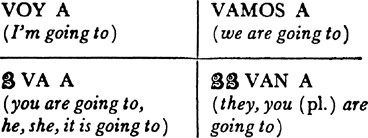
Notice that there are two third man figures before the plural third man form. The plural third man form of the verbs will be indicated by two third man figures throughout the book.
| SINGULAR | PLURAL |
| Voy a trabajar. I’m going to work. | Vamos a trabajar. We are going to work. |
|
Va a trabajar. You are going to work. |
Van a trabajar. They are going to work. |
Fill in the blanks below with the following words:
| trabajar | visitar a María |
| estudiar | invitar a Carlos |
| votar | tomar la cena |
| hablar por teléfono | comprar una casa |
Voy a
(I’m going to)
Va a
(You are going to)
Vamos a
(We are going to)
Van a
(They are going to)
Carlos va a
(Charles is going to)
“Vamos a” means “we are going to” and also “let’s” or “let’s go” (to a place).
Vamos al cine. Let’s go to the movies.
Vamos al parque. Let’s go to the park.
Vamos a la fiesta. Let’s go to the party.
Vamos a terminar. Let’s finish.
| Voy a | tomar la cena |
| (I’m going to) | tomar un taxi |
| hablar por teléfono | |
|
Va a |
comprar una blusa |
| (You are going to) | trabajar mañana |
| Vamos a | votar |
| (We are going to,) | a la fiesta |
| (let’s go let’s) | al cine |
| a la clase | |
|
Van a |
|
| (They are going to) |
el sábado, Saturday, on Saturday
el domingo, Sunday, on Sunday
el lunes, Monday, on Monday
el martes, Tuesday, on Tuesday
el miércoles, Wednesday, on Wednesday
el jueves, Thursday, on Thursday
el viernes, Friday, on Friday
I’m going to a party on Saturday. Voy a una fiesta el sábado.
In Spanish you NEVER say “on Saturday” but simply “the Saturday.”
There is a future tense in Spanish which is not frequently used in conversation. You will find it used more often in written Spanish.
Add the following endings to the complete infinitive.
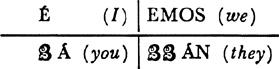
COMPRAR, to buy
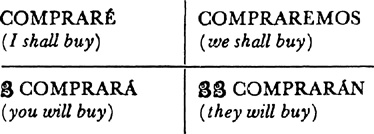
VENDER, to sell
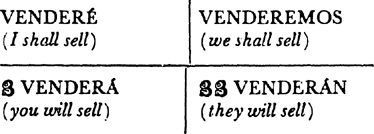
ESCRIBIR, to write
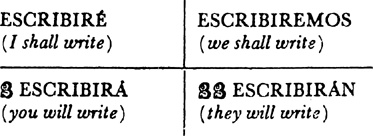
You needn’t learn this tense now. Just look it over and remember that it exists.
el calendario
 ll
the verbs you have learned thus far end in “ar” in the infinitive.
However, there are two other kinds of verbs in Spanish, which end in
“er” or in “ir” in the infinitive.
ll
the verbs you have learned thus far end in “ar” in the infinitive.
However, there are two other kinds of verbs in Spanish, which end in
“er” or in “ir” in the infinitive.
EXAMPLES:
| RECIBIR, to receive | DESCRIBIR, to describe |
| ESCRIBIR, to write | COMPRENDER, to understand |
| SERVIR, to serve | VENDER, to sell |
Voy a recibir. I’m going to receive.
¿ Va a servir café? Are you going to serve coffee?
|
el diccionario, the dictionary |
un diario, a diary |
|
el calendario, the calendar |
por favor, please |
|
el dormitorio, the bedroom |
absolutamente, absolutely |
|
discreto, discreet |
una carta, a letter |
|
la secretaria, the secretary (fem.) |
muchas (fem.), many |
|
el notario público, the notary public |
muchos teléfonos, many telephones |
|
el obituario, the obituary |
muchas cartas, many letters |
|
es terrible, it’s terrible, is it terrible? |
|
|
eso es terrible, that is terrible |
|
|
es necesario, it’s necessary, is it necessary? |
|
|
es necesario escribir, it is necessary to write, is it necessary to write? |
|
|
el directorio de teléfono, the telephone directory |
|
|
hay, there is, there are, is there? are there? |
|
|
el despacho, the office |
|
NOTE: “Despacho” and “oficina” both mean “office.” In some countries “despacho” is more common, in others, “oficina.” It’s good to know both.
¿ Va a recibir muchas cartas esta mañana?
Sí, voy a recibir muchas cartas esta mañana.
¿ Va a escribir muchas cartas esta mañana?
Sí, voy a escribir muchas cartas esta mañana.
¿ Va a escribir el directorio de teléfono?
Ay no, eso es absolutamente ridículo. No voy a escribir el directorio de teléfono.
¿ Va a escribir un obituario?
Por favor, profesor, eso es terrible. No voy a escribir un obituario.
¿ Va a escribir un diario en el despacho?
No, no voy a escribir un diario en el despacho. No es discreto.
¿ Va a escribir un poema en el despacho?
No, no voy a escribir un poema en el despacho.
¿ Va a recibir muchas cartas su papá?
Sí, papá va a recibir muchas cartas.
¿ Va a recibir muchas cartas la secretaria?
Sí, la secretaria va a recibir muchas cartas.
¿ Va a escribir muchas cartas la secretaria?
Sí, la secretaria va a escribir muchas cartas.
¿ Va a hablar con el notario su papá?
Sí, papá va a hablar con el notario público.
¿ Hay un diccionario en su despacho?
No, es terrible, pero no hay un diccionario en mi despacho.
¿ Va a comprar un diccionario la secretaria?
Sí, la secretaria va a comprar un diccionario.
¿ Es necesario comprar un diccionario para el despacho?
Sí, es necesario comprar un diccionario para el despacho.
¿ Es necesario escribir cartas en el despacho?
Sí, es necesario escribir muchas cartas en el despacho.
¿ Hay muchos teléfonos en el despacho?
Sí, hay muchos teléfonos en el despacho.
¿ Hay un calendario en el despacho?
Sí, hay un calendario en el despacho.
¿ Hay un canario en el despacho?
No, no hay un canario en el despacho.
¿ Hay un dormitorio en el despacho?
Ay no, no hay un dormitorio en el despacho.
¿ Hay un dormitorio en su casa?
Sí, hay un dormitorio en mi casa.
¿ Va a servir café la secretaria?
Sí, la secretaria va a servir café en el despacho.
¿ Va a servir sandwiches la secretaria?
No, la secretaria no va a servir sandwiches.
¿ Va a vender sandwiches la secretaria?
No, eso es ridículo, la secretaria no va a vender sandwiches.
¿ Va a vender automóviles la secretaria?
No, la secretaria no va a vender automóviles.
¿ Quien va a vender automóviles?
El agente de automóviles va a vender automóviles.
¿ Va a hablar con la secretaria Carlos?
Sí, Carlos va a hablar con la secretaria.
¿ Va a comprender la conversación Carlos?
Sí, naturalmente, Carlos va a comprender la conversación.
¿ Va a recibir muchas cartas Carlos?
Sí, Carlos va a recibir muchas cartas.
¿ Va a comprender las cartas Carlos?
Sí. Carlos va a comprender las cartas.
Combine the words below in different ways to form as many sentences as you can. Just be sure to use words from each of the columns in every sentence you form.
A
| 1 | 2 | 3 | 4 |
| ¿ Va a | recibir | la carta | Carlos? |
| servir | sandwiches | María? | |
| escribir | un poema | Roberto? | |
| comprender | la lección | el estudiante? | |
| vender | la casa | su papá? | |
| el radio | Alicia? | ||
| café | Marta? | ||
| el cable | su secretaria? | ||
| el telegrama |
B
| 1 | 2 | 3 | 4 |
| Carlos | va a | recibir | el cable |
| María | (is going to) | escribir | una carta |
| Roberto | servir | café | |
| El estudiante | comprender | la conversación | |
| Mi mamá | vender | el fonógrafo | |
| Mi papá | describir | el accidente | |
| La secretaria | una composición |
Translate the following sentences into Spanish. Write out each sentence in Spanish, using the columns above as a guide. Check your sentences with the correct translations below this exercise.
Check your sentences with the correct translations below.
| la pluma, the pen | el escritorio, the desk |
| el lápiz, the pencil | el correo, the post office |
| la tinta, the ink | correo aéreo, air mail |
| el paquete, the package | la estampilla, the stamp |
| el sobre, the envelope | el buzón, the mailbox |
| el papel, the paper | el cartero, the mailman |
| mi jefe, my boss (my chief) |
In some cases if you add “ly” to English adjectives, they become adverbs.
EXAMPLE:
constant + ly = constantly
If you add “mente” to Spanish adjectives, they become adverbs.
EXAMPLE:
constante + mente = constantemente (constantly)
LY = MENTE
SPANISH ENGLISH
principalmente, principally
personalmente, personally
generalmente, generally
naturalmente, naturally
posiblemente, possibly
probablemente, probably
normalmente, normally
finalmente, finally
If a Spanish adjective ends in “o,” change the “o” to “a” and add “mente.”
| ADJECTIVES | ADVERBS |
| completo, complete | completamente, completely |
| rápido, rapid | rápidamente, rapidly |
| público, public | públicamente, publicly |
| íntimo, intimate | íntimamente, intimately |
| comparativo, comparative | comparativamente, comparatively |
| absoluto, absolute | absolutamente, absolutely |
la guitarra
 he
past tense endings of “ar” verbs are “é” for the first person, “ó” for
anybody else (singular).
he
past tense endings of “ar” verbs are “é” for the first person, “ó” for
anybody else (singular).
EXAMPLE:
| comprar, to buy | compré, I bought |
compró, anybody else bought |
The past tense of “er” and “ir” verbs is formed by removing the “er” or the “ir” and adding “í” for the first person singular and “ió” for anybody else (singular).
EXAMPLE:
| recibir, to receive | recibi, I received |
recibió, anybody else re-received |
| escribir to write | escribí, I wrote |
escribió, anybody else wrote |
| vender, to sell | vendí, I sold |
vendio, anybody else sold |
| comprender, to understand | comprendí, I understood |
comprendió, anybody else understood |
| idescribir, to describe | describí, I described |
describió, anybody else described |
Following is a list of “er” and “ir” infinitives converted into the past tense.
| INFINITIVES | I | YOU, HE, SHE, IT |
| asistir, to attend | asistí |
asistió |
| batir, to beat (eggs) | batí |
batió |
| confundir, to confuse | confundí |
confundió |
| consistir, to consist | consistí |
consistió |
| decidir, to decide | decidí |
decidió |
| describir, to describe | describí |
describió |
| descubrir, to discover | descubrí |
descubrió |
| discutir, to discuss | discutí |
discutió |
| dividir, to divide | dividí |
dividió |
| escribir, to write | escribí |
escribió |
| evadir, to evade | evadí |
evadió |
| exhibir, to exhibit | exhibí |
exhibió |
| existir, to exist | existí |
existió |
| interrumpir, to interrupt | interrumpí |
interrumpió |
| invadir, to invade | invadí |
invadió |
| ocurrir, to happen | ocurrí |
ocurrió |
| permitir, to allow | permití |
permitió |
| persuadir, to persuade | persuadí |
persuadió |
| prohibir, to prohibit | prohibí |
prohibió |
| recibir, to receive | recibí |
recibió |
| resistir, to resist | resistí |
resistió |
| sufrir, to suffer | sufrí |
sufrió |
| vivir, to live | viví |
vivió |
| absorber, to absorb | absorbí |
absorbió |
| aprehender, to arrest | aprehendí |
aprehendió |
| cometer, to commit | cometí |
cometió |
| comprender, to understand | comprendí |
comprendió |
| conmover, to move emotionally | conmoví |
conmovió |
| convencer, to convince | convencí |
convenció |
| depender, to depend | dependí |
dependió |
| disolver, to dissolve | disolví |
disolvió |
| exceder, to exceed | excedí |
excedió |
| extender, to extend | extendí |
extendió |
| favorecer, to favor | favorecí |
favoreció |
| mover, to move | moví |
movió |
| ofender, to offend | ofendí |
ofendió |
| ofrecer, to offer | ofrecí |
ofreció |
| proceder, to proceed | procedí |
procedió |
| resolver, to solve, resolve | resolví |
resolvió |
| suspender, to suspend | suspendí |
suspendió |
| vender, to sell | vendí |
vendió |
Lord Melbourne said, “Wealth is so much the greatest good that Fortune has to bestow that in the Latin and English languages it has usurped her name.”
The use of the word “fortune” to mean both wealth and good luck may indicate that in the eyes of the Romans no one could accumulate a fortune without help from Fortuna, the goddess of chance. Therefore, wealth came from good luck and not necessarily good luck from wealth. Be that as it may, Spanish is a daughter of the Latin language and accepts the relationship between the two words. “Fortuna” means both wealth and good luck in Spanish. “Por fortuna” means fortunately, and “afortunado,” fortunate.
|
por fortuna, fortunately |
la guitarra, the guitar |
|
la música, the music |
la persona, the person |
|
español, Spanish |
sus experiencias, his experiences |
|
el parque, the park |
magnifica, magnificent (used very much) |
|
especialmente, specially |
muy bien, very well |
|
de, of, from, about |
|
|
las tiendas, the stores |
|
|
una carta interesante, an interesting letter |
|
Notice that “interesante” follows “carta.” The adjective usually follows the noun in Spanish.
| ESCRIBIR, to write | RECIBIR, to receive |
| ESCRIBÍ, I wrote | RECIBÍ, I received |
|
¿ ESCRIBIÓ USTED? did you write? |
RECIBIÓ USTED? did you receive? |
| COMPRENDER, to understand | VENDER, to sell |
| COMPRENDÍ, I understood | VENDÍ, I sold |
|
¿ COMPRENDIÓ USTED? did you understand? |
¿ VENDIÓ USTED? did you sell? |
¿ Escribió usted una carta está mañana?
No, esta mañana no escribí una carta.
¿ Recibió usted una carta esta mañana?
Sí, esta mañana recibí una carta en español.
¿ Comprendió usted la carta?
Sí, por fortuna comprendí la carta muy bien.
¿ Recibió usted la carta de México?
No, no recibí la carta de México. Recibí la carta de un amigo en Colombia.
¿ Escribió su amigo en español?
Sí, mi amigo escribió en español.
¿ Escribió su amigo una carta interesante?
Sí, mi amigo escribió una carta muy interesante.
¿ Escribió su amigo de sus experiencias en Colombia?
Sí, mi amigo escribió de muchas experiencias interesantes en Colombia.
¿ Habló su amigo con muchas personas en Bogotá?
Sí, mi amigo habló con muchas personas en Bogotá.
¿ Entró su amigo a muchas tiendas en Bogotá?
Sí, mi amigo entró a muchas tiendas en Bogotá.
¿ Compró su amigo una guitarra en Colombia?
Sí, mi amigo compró una guitarra magnífica en Colombia.
¿ Fotografió su amigo a muchas personas en Colombia?
Sí, mi amigo fotografió a las señoritas, a los actores, a los guitarristas y a muchas personas en general.
¿ Describió su amigo las fiestas?
Sí, mi amigo describió las fiestas. Escribió mucho de la música, especialmente de la música de guitarra.
¿ Vendió su amigo muchos automóviles en Bogotá?
Sí, mi amigo vendió muchos autos en Bogotá. Mi amigo es agente de automóviles.
¿ Vendió su amigo sombreros en Colombia?
Ay no, mi amigo no vendió sombreros. Vendió tractores y automóviles.
¿ Vendió usted tractores y automóviles en Colombia?
No, no vendí tractores y automóviles en Colombia.
¿ Vendió usted blusas en Colombia?
No, no vendí blusas en Colombia.
¿ Vendió usted rosas en el parque?
Ay no, eso es absolutamente ridículo. No vendí rosas en el parque.
¿ Vendió usted su honor?
Por favor, profesor, eso es terrible. No vendí mi honor.
Combine the words below in different ways to form as many sentences as you can. Just be sure to use words from each of the three columns in every sentence you form.
A
| 1 | 2 | 3 |
|
¿ Recibió usted |
una carta | de México |
| (Did you receive?) | muchas cartas | de Carlos |
| Recibí (I received) | un telegrama | de mi papá |
|
¿ Escribió usted |
un cable | está mañana |
| (Did you write?) | un paquete | en el despacho |
| Escribí (I wrote) | (a package) | anoche (last night) |
| un poema | en la clase | |
| una composición |
B
| 1 | 2 | 3 |
|
¿ Vendió usted |
la casa | la semana pasada |
| (Did you sell?) | el radio | (last week) |
| Vendí (I sold) | el fonógrafo | esta mañana |
|
¿ Compró usted |
un rancho | esta tarde |
| (Did you buy?) | el auto | esta noche |
| Compré (I bought) | la guitarra | en Colombia |
| el tractor | en México | |
| un diccionario | en la tienda |
Translate the following sentences into Spanish. Write out each sentence in Spanish, using the columns above as a guide. Check your sentences with the correct translations below this exercise.
Check your sentences with the correct translations below.
If a noun ends in a vowel, add the letter “s” to form the plural.
| SINGULAR | PLURAL |
| la casa, the house | las casas, the houses |
| la guitarra, the guitar | las guitarras, the guitars |
| la fábrica, the factory | las fábricas, the factories |
| la planta, the plant | las plantas, the plants |
| la vitamina, the vitamin | las vitaminas, the vitamins |
| el sombrero, the hat | los sombreros, the hats |
| el auto, the car | los autos, the cars |
| el radio, the radio | los radios, the radios |
| el artículo, the article | los artículos, the articles |
If a noun ends in a consonant, add “es” to form the plural.
| SINGULAR | PLURAL |
| el doctor | los doctores |
| cl tractor | los tractores |
| el motor | los motores |
| el color | los colores |
| el animal | los animales |
| el metal | los metales |
| la universidad | las universidades |
| la ciudad (the city) | las ciudades (the cities) |
| la nación | las naciones |
Adjectives usually follow nouns in Spanish.
la clase interesante, the interesting class
el programa interesante, the interesting program
la casa grande, the big house
la casa blanca, the white house
el río grande, the big river
un restaurante excelente, an excellent restaurant
|
¿ Recibió usted |
una carta |
| (Did you receive?) | muchas cartas |
| Recibí | un cable |
| (I received) | un telegrama |
|
¿ Escribió usted |
un paquete |
| (Did you write?) | (a package) |
| cribí | un poema |
| (I wrote) | una composición |
Copy the above material onto a card. Carry the card with you and glance at it whenever you get a chance.
| la ciudad, the city | la escuela, the school |
| el país, the country (nation) | la maestra, the teacher |
| el banco, the bank | el museo, the museum |
| la biblioteca, the library | la cárcel, the jail |
| la librería, the bookstore | la farmacia, the drugstore |
| el edificio, the building | la botica, the drugstore |
un programa de televisión
| TRABAJAR, to work, to act | VER, to see |
| TRABAJÉ, I worked, acted | VÍ, I saw |
|
¿ TRABAJÓ USTED? did you work, act? |
¿ VIÓ USTED? did you see? |
| VOY A TRABAJAR, I’m going to work, act | VOY A VER, I’m going to see |
| FELICITAR, to congratulate | APLAUDIR, to applaud |
| FELICITÉ, I congratulated | APLAUDÍ, I applauded |
|
¿ FELICITÓ USTED? did you congratulate? |
¿ APLAUDIÓ USTED? did you applaud? |
| Voy a felicitar. I’m going to congratulate. | Voy a aplaudir. I’m going to applaud. |
|
¡ Caramba! Gee whiz! |
francamente, frankly |
|
al contrario, on the contrary |
¿ Por qué? Why? |
|
una comedia, a play, a comedy |
porque, because |
|
otra comedia, another play |
después de, after |
|
el papel, the paper, the role in a play |
|
|
un programa de televisión, a television program |
|
|
la semana pasada, last week |
|
|
un poco eccéntrico, a little eccentric |
|
|
trabajó muy bien, he (she) acted very well |
|
|
romántico (masc.), romantic (for a man) |
|
|
romántica (fem.), romantic (for a woman) |
|
|
Ví una comedia, I saw a play |
|
|
¿ Va a ver una comedia? Are you going to see a play? |
|
|
¿ Por qué aplaudió usted? Why did you applaud? |
|
|
¿ Vió usted? Did you see? |
|
¿ Vió usted una comedia la semana pasada?
Sí, la semana pasada ví “Romeo y Julieta.”
¿ Quién escribió “Romeo y Julieta”?
Shakespeare escribió “Romeo y Julieta.”
¿ Es romántico Romeo?
Sí, Romeo es romántico.
¿ Es romántica Julieta?
Ay sí, Julieta es romántica.
¿ Trabajó bien Carlos en “Romeo y Julieta”? Did Charles act well in “Romeo and Juliet”?
Sí, Carlos trabajó muy bien en el papel de Romeo.
¿ Es eccéntrico Carlos?
Sí, francamente Carlos es un poco eccéntrico.
¿ Es sarcástico Carlos?
No, Carlos no es sarcástico.
¿ Qué drama vió usted anoche?
Anoche ví “Hamlet.”
¿ Es cómico “Hamlet”?
No, al contrario, “Hamlet” es trágico.
¿ Es dramático “Hamlet”?
Sí, “Hamlet” es muy dramático.
¿ Quién escribió “Hamlet”?
Shakespeare escribió “Hamlet.”
¿ Aplaudió mucho el público anoche?
Sí, el público aplaudió mucho anoche.
¿ Aplaudió usted mucho?
Sí, aplaudí mucho.
¿ Por qué aplaudió usted mucho?
Aplaudí mucho porque Carlos es mi amigo y trabajó muy bien anoche.
¿ Vió usted a Carlos está mañana?
Sí, esta mañana ví a Carlos.
¿ Habló usted con Carlos?
Sí, hablé del teatro con Carlos.
¿ Felicitó usted a Carlos?
Sí, felicité a Carlos porque trabajó muy bien en “Hamlet.”
¿ Va a ver otra comedia esta noche?
Sí, esta noche voy a ver otra comedia.
¿ Dónde va a comprar el boleto?
Voy a comprar el boleto en el teatro.
¿ Vió usted un programa de televisión esta tarde?
Sí, está tarde ví un programa de televisión.
¿ Vió usted una operación en el hospital esta mañana?
Sí, esta mañana ví una operación en el hospital.
¿ Aplaudió el paciente después de la operación?
Caramba, profesor, eso es ridículo, el paciente no aplaudió después de la operación.
Combine the words below in different ways to form as many sentences as you can. Just be sure to use words from each of the three columns in every sentence you form.
| 1 | 2 | 3 |
|
¿ Vió usted |
a Antonio | anoche |
| (Did you see?) | (Anthony) | la semana pasada |
| Ví | una comedia | de televisión |
| (I saw) | un programa | esta mañana |
| Voy a ver | a Carlos | mañana (tomorrow) |
| (I’m going to see) | a Marta | esta tarde |
|
¿ Va a ver |
a Roberto | esta noche |
| (Are you going to see?) | al doctor | en Cuba |
| Vamos a ver | a su papá | en México |
| (We are going to see) | al general | |
| a su secretaria |
Translate the following sentences into Spanish. Write out each sentence in Spanish, using the columns above as a guide. Check your sentences with the correct translations below this exercise.
Check your sentences with the correct translations below.
In Spanish the “o” is a masculine letter and the “a” is a feminine letter. A great many words end in the letter “o” in the masculine and in the letter “a” in the feminine.
When adjectives modify a masculine word they nearly always end in “o.”
EXAMPLE: el hombre romántico, the romantic man
When adjectives modify a feminine word they nearly always end in “a.”
EXAMPLE: la mujer romántica, the romantic woman
Plural nouns must be followed by plural adjectives.
| EXAMPLES: | los hombres románticos, the romantic men las mujeres románticas, the romantic women |
Adjectives agree with nouns in number and gender.
| MASCULINE SINGULAR | MASCULINE PLURAL |
| el actor famoso | los actores famosos |
| (the famous actor) | (the famous actors) |
| el hombre generoso | los hombres generosos |
| (the generous man) | (the generous men) |
| el actor romántico | los actores románticos |
| (the romantic actor) | (the romantic actors) |
| el doctor ambicioso | los doctores ambiciosos |
| (the ambitious doctor) | (the ambitious doctors) |
| el sombrero bonito | los sombreros bonitos |
| (the pretty hat) | (the pretty hats) |
| el sombrero blanco | los sombreros blancos |
| (the white hat) | (the white hats) |
| la mujer famosa | las mujeres famosas |
| (the famous woman) | (the famous women) |
| la mujer bonita | las mujeres bonitas |
| (the pretty woman) | (the pretty women) |
| la casa blanca | las casas blancas |
| (the white house) | (the white houses) |
| la blusa negra | las blusas negras |
| (the black blouse) | (the black blouses) |
If an adjective ends in “e,” it can modify singular masculine and feminine words without change. It stays as it is.
| el hombre interesante | la mujer interesante |
| (the interesting man) | (the interesting woman) |
| el sombrero grande | la casa grande |
| (the big hat) | (the big house) |
To form the plural of adjectives that end in “e,” add the letter “s.”
los hombres interesantes, the interesting men
las mujeres interesantes, the interesting women
|
¿ Vió usted |
a Antonio | anoche |
| (Did you see?) | un programa | de televisión |
| Ví | una comedia | en el teatro |
| (I saw) | a Carlos | esta mañana |
|
¿ Va a ver |
a Roberto | esta tarde |
| (Are you going to see?) | a María | esta noche |
| Voy a ver | mañana | |
| (I’m going to see) | (tomorrow) |
Copy the above material onto a card. Carry the card with you and glance at it whenever you get a chance.
| amarillo, yellow | gris, gray |
| rojo, red | azul, blue |
| Colorado, red | color café, brown |
| verde, green | pardo, brown |
una flor
THE VERB “LEER,” to read
Many English words that end in a consonant and the letter “y” can be converted into Spanish words by changing the “y” to “ía.”
Y = ÍA
the economy, la economía
| la geometría | la biografía | la geología | la filosofía |
| la melodía | la anatomía | la energía | la ironía |
|
una novela, a novel |
la columna, the column |
|
el periódico, the newspaper |
la frase, the sentence |
|
el periodista, the journalist |
la revista, the magazine |
|
un artículo, an article |
el libro, the book |
|
un actor de eine, a movie actor |
la flor, the flower |
|
la biografía, the biography |
las flores, the flowers |
|
la fotografía, the photograph (this can be shortened to “la foto”) |
|
|
las fotografías bonitas, the pretty photographs |
|
|
sus cartas de amor, your love letters |
|
|
varios (masc.), varias (fem.), several |
|
|
no hay, there is not, there are not |
|
|
la semana pasada, last week |
|
|
quién, who |
|
LEER, to read
VOY A LEER, I’m going to read
LEÍ, I read (past)
¿ LEYÓ USTED? did you read?
¿ Va a leer el periódico? Are you going to read the newspaper?
Notice that the “i” is changed to “y” in “leyó.”
¿ Leyó usted una novela la semana pasada?
Sí, leí una novela muy interesante la semana pasada.
¿ Leyó usted Don Quixote la semana pasada?
No, no leí Don Quixote la semana pasada.
¿ Quién escribió Don Quixote?
Cervantes escribió Don Quixote.
¿ Leyó usted el periódico esta mañana?
Sí, leí el periódico esta mañana. Esta mañana tomé café y leí el periódico en mi casa.
¿ Leyo usted un artículo interesante en el periódico?
Sí, leí un artículo muy interesante de las experiencias de Goya en Madrid.
¿ Quién escribió el artículo?
Un periodista mexicano escribió el artículo.
¿ Vió usted fotografías interesantes en el periódico?
Sí, ví varias fotografías muy interesantes: una fotografía del presidente en frente de la Casa Bianca, una fotografía de un actor de cine, y una foto de un gorila fantástico.
¿ Leyó usted un editorial en el periódico?
Sí, leí un editorial muy interesante.
¿ Leyó usted una columna de Hollywood?
Sí, leí una columna de Hollywood con descripciones de varios actores y con fotografías en color.
¿ Leyó usted el periódico en la clase?
No, eso es terrible, no leí el periódico en la clase. Leí una composición en la clase.
¿ Preparó usted frases para la clase?
Sí, preparé frases para la clase.
¿ Leyó usted las frases en la clase?
Sí, leí las frases en la clase.
¿ Leyó usted un poema romántico en la clase?
No, no leí un poema romántico en la clase. Leí un poema romántico en mi casa anoche.
¿ Leyó usted sus cartas de amor en la clase?
Caramba, profesor, eso es terrible. No leí mis cartas de amor en la clase.
¿ Leyó usted una revista anoche?
Sí, anoche leí una revista muy interesante.
¿ Vió usted fotografías bonitas en la revista?
Sí, ví varias fotografías de flores. Ví fotografías de camelias, gardenias, dalias, y begonias.
¿ Leyó usted un libro interesante la semana pasada?
Sí, la semana pasada leí un libro muy interesante. Leí una biografía de Simón Bolívar.
¿ Leyó usted el menú en el restaurante?
Sí, leí el menú en el restaurante.
¿ Leyó usted el menú en la clase?
Ay no, no leí el menú en la clase. No hay menú en la clase.
¿ Va a leer el periódico esta noqhe?
Sí, esta noche voy a leer el periódico.
¿ Va a leer el periódico su papá?
Sí, papá va a leer el periódico.
Combine the words below in different ways to form as many sentences as you can. Just be sure to use words from each of the columns in every sentence you form.
| 1 | 2 | 3 |
| ¿ Leyó usted (Did you read?) |
el periódico una novela |
esta mañana la semana pasada |
| Leí (I read) |
un artículo un editorial |
en el periódico esta tarde |
| Va a leer (Are you going to read?) |
un poema las frases una columna |
esta noche en la clase anoche |
| Voy a leer (I’m going to read) |
la carta la revista |
en el despacho en el tren |
| ¿ Leyó Roberto (Did Robert read?) |
un libro la biografía |
en el avión en Cuba |
| El periodista escribió (The journalist wrote) |
muchas cartas las fotografías |
en una revista en su casa |
| ¿ Vió usted (Did you see?) |
las flores las camelias |
en el parque (in the park) |
| Ví (I saw) | a Roberto | en el club |
Translate the following sentences into Spanish. Write out each sentence in Spanish, using the columns above as a guide. Check your sentences with the correct translations below this exercise.
Check your sentences with the correct translations below.
Many English words that end in a consonant and the letter “y” can be converted into Spanish words by changing the “y” to “ía.”
Y = ÍA
| ny = nía | gy = gía | my = mía | py = pía |
| sy = sía | dy = día | try = tría | phy = fía |
la economía, the economy energiá, energy
| agonía | cortesía | geología | patología |
| analogía | (courtesy) | geometría | (pathology) |
| anatomía | economía | garantía | pleuresía |
| antología | espía | (guarantee) | profesía |
| (anthology) | (spy) | hipocresía | psicología |
| arqueología | filosofía | (hypocrisy) | sinfonía |
| (archeology) | fisiología | ideología | sociología |
| astronomía | fotografía | ironía | trigonometría |
| biografía | geografía | monotonía | zoología |
The word “vista” (view) has some interesting combinations in Spanish.
la vista, the view
la revista, the review, magazine
la entrevista, the interview
entrevistar, to interview
Voy a entrevistar. I’m going to interview
Entrevisté. I interviewed
Entrevistó. Anybody else interviewed
|
¿ Leyó usted |
el periódico |
| (Did you read?) | una novela |
| Leí | un artículo |
| (I read) | la revista |
|
¿ Va a leer |
un libro |
| (Are you going to read?) | la biografía |
| Voy a leer | la carta |
| (I’m going to read) |
Copy the above material onto a card. Carry the card with you and glance at it whenever you get a chance.
| la palabra, the word | durante, during |
| el argumento, the plot | mientras, while |
| el estilo, the style | despacio, slowly |
| me gusta, I like it | aprisa, fast |
| me gustó, I liked it | interesantisimo, most interesting |
Words that end in “cle” in English:
| el artículo, article | el semicírculo, semicircle |
| el obstáculo, obstacle | el músculo, muscle |
| el vehículo, vehicle | el espectáculo, spectacle |
| el círculo, circle |
el tomate
 ow
that you have mastered “é” for me, “ó” for anybody else, you have come
to the exciting moment when you can learn the plurals. Up to this time
you have been talking about half the world, the singular world. Now,
with the plural, you will be able to talk about everything under the
living sun.
ow
that you have mastered “é” for me, “ó” for anybody else, you have come
to the exciting moment when you can learn the plurals. Up to this time
you have been talking about half the world, the singular world. Now,
with the plural, you will be able to talk about everything under the
living sun.
The plural endings of “ar” verbs are “amos” for we and “aron” for anybody else (plural).
SINGULAR
TRABAJÉ, I worked
TRABAJÓ, you, he, she worked
did you, he, she work?
PLURAL
TRABAJAMOS, we worked
 TRABAJARON, you (pl.) worked, they worked
did you (pl.) work?
did they work?
Notice that there are two third man figures before the plural third man form. The plural third man form of the verbs will be indicated by two third man figures throughout the book.
Trabajé mucho. I worked a lot.
Mi amigo trabajó mucho. My friend worked a lot.
Trabajamos mucho. We worked a lot.
Mis amigos trabajaron mucho. My friends worked a lot.
Trabajaron mucho. They worked a lot. You (pl.) worked a
lot.
¿ Trabajaron mucho? Did they work a lot? did you (pl.) work
a lot?
Following is a list of infinitives converted into the plural past tense.
| INFINITIVES | WE | THEY, YOU (PL.) |
| tomar, to take | tomamos |
tomaron |
| visitar, to visit | visitamos |
visitaron |
| invitar, to invite | invitamos |
invitaron |
| comprar, to buy | compramos |
compraron |
| trabajar, to work | trabajamos |
trabajaron |
| hablar, to talk | hablamos |
hablaron |
| preparar, to prepare | preparamos |
prepararon |
| cultivar, to cultivate | cultivamos |
cultivaron |
| votar, to vote | votamos |
votaron |
| inventar, to invent | inventamos |
inventaron |
| importar, to import | importamos |
importaron |
| exportar, to export | exportamos |
exportaron |
| copiar, to copy | copiamos |
copiaron |
| depositar, to deposit | depositamos |
depositaron |
| progresar, to progress | progresamos |
progresaron |
| aceptar, to accept | aceptamos |
aceptaron |
| estudiar, to study | estudiamos |
estudiaron |
| terminar, to finish | terminamos |
terminaron |
| comenzar, to begin | comenzamos |
comenzaron |
| entrar, to go in, come in | entramos |
entraron |
| estacionar, to park | estacionamos |
estacionaron |
| recomendar, to recommend | recomendamos |
recomendaron |
| instalar, to install | instalamos |
instalaron |
| ventilar, to ventilate | ventilamos |
ventilaron |
| una semana, a week | el jardín, the garden |
| el fin de semana, the week end | las papas, the potatoes |
| el campo, the country | las mentas, the mints, peppermints |
| la coliflor, the cauliflower | |
| el tomate, the tomato | yo, I |
| ¡ Qué cena! What a dinner! | Carlos y yo, Charles and I |
| usted (sing.), you | el éxito, the success |
| ustedes (pl.), you |
durante, during pero, but |
delicioso (masc.), deliciosa (fem.), delicious
simpático (masc.), simpática (fem.), charming
perfecto (masc.), perfecta (fem.), perfect
la lección de español, the Spanish lesson (the lesson of Spanish)
un coctel de frutas, a fruit cocktail (a cocktail of fruits)
la casa de Roberto, Robert’s house (the house of Robert)
PASAR, to pass, to spend (time), to happen
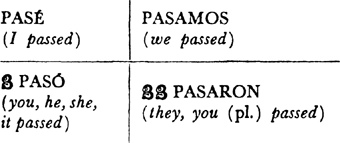
ACEPTAR, to accept
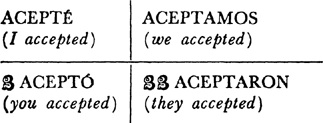
TOMAR, to take
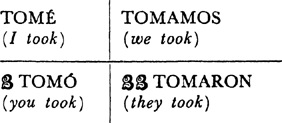
¿ Qué pasó? What happened?
¿ Hablaron ustedes? Did you (pl.) talk?
¿ Trabajaron ustedes? Did you (pl.) work?
¿ Aceptaron ustedes? Did you (pl.) accept?
You can leave off the “ustedes” in the above sentences and simply say, “aceptaron,” “trabajaron,” and “hablaron.”
¿ Aceptaron ustedes la invitación de Roberto?
Sí, aceptamos la invitación de Roberto.
¿ Pasaron ustedes el fin de semana con Roberto?
Sí, Carlos y yo pasamos el fin de semana con Roberto.
¿ Pasaron el fin de semana en el campo?
Sí, la casa de Roberto está en el campo. Pasamos el fin de semana en la casa de Roberto.
¿ Tomaron la cena en la casa de Roberto?
Sí, tomamos una cena deliciosa en la casa de Roberto.
¿ Qué tomaron para la cena?
Tomamos un coctel de frutas, sopa, rosbif, papas, espárragos, coliflor, tomates, una ensalada deliciosa, frutas, café y mentas. ¡ Caramba, qué cena!
¿ Hablaron mucho durante la cena?
Sí, hablamos mucho durante la cena. Hablamos de Carlos y de su éxito en el papel de Romeo en el teatro la semana pasada. Trabajó muy bien. Hablamos de Romeo y de Carlos. Carlos ea muy romántico y es un Romeo perfecto.
¿ Es simpático Carlos?
Sí, Carlos es muy simpático.
¿ Es popular Carlos?
Sí, Carlos es muy popular, especialmente con las señoritas.
¿ Felicitaron a Carlos por su éxito en el teatro?
Sí, felicitamos a Carlos por su éxito en el teatro.
¿ Estudiaron la lección de español con Roberto?
Sí, Carlos y yo estudiamos la lección de español con Roberto.
¿ Prepararon una composición para la clase?
Sí, preparamos una composición fantástica para la clase.
¿ Hablaron con la mamá de Roberto?
Sí, hablamos mucho con la mamá de Roberto.
¿ Es simpática la mamá de Roberto?
Sí, la mamá de Roberto es muy simpática.
¿ Pasaron la noche en un hotel?
No, no pasamos la noche en un hotel. Pasamos la noche en la casa de Roberto.
¿ Pasaron una semana en la casa de Roberto?
Ay no, no pasamos una semana en la casa de Roberto. Pasamos el fin de semana en la casa de Roberto.
¿ Trabajaron en el jardín de Roberto?
Sí, trabajamos mucho en el jardín de Roberto.
¿ Hay dalias en el jardín de Roberto?
Sí, hay dalias muy bonitas en el jardín de Roberto.
¿ Trabajó Roberto en el jardín?
Ay no, Roberto no trabajó en el jardín. Carlos y yo trabajamos en el jardín y Roberto habló mucho pero no trabajó. Roberto habló mucho, tomó una Pepsi Cola, y leyó un artículo en el periódico. Roberto es terrible.
Combine the words below in different ways to form as many sentences as you can. Just be sure to use words from each of the columns in every sentence you form.
A
| 1 | 2 | 3 |
|
¿ Tomaron |
la cena | en el restaurante |
| (Did they take?) | rosbif | para la cena |
|
¿ Visitaron |
a María | en el hospital |
| (Did they visit?) | a Carlos | en Cuba |
|
¿ Invitaron |
a Roberto | a la fiesta |
| (Did they invite?) | a Juan | al cine |
|
Compraron |
una casa | en el campo |
| (They bought) | un suéter | para Carlos |
|
Copiaron |
la lección | en la clase |
| (They copied) | las frases | para la clase |
|
Pasaron |
la noche | en San Francisco |
| (They spent) | una semana (a week) | en Cuba |
B
| 1 | 2 | 3 |
| Carlos y yo | visitamos | a Roberto |
| (Charles and I) | invitamos | a María |
| El doctor y yo | tomamos | un taxi |
| Mi mamá y yo | compramos | un auto |
| Juan y yo | estudiamos | la leccion |
C
| 1 | 2 | 3 |
| Carlos y María |
estudiaron |
la lección |
| Los doctores |
examinaron |
al paciente |
| Los actores |
trabajaron (acted) |
muy bien |
| Mis clientes |
hablaron |
con el agente |
| Los estudiantes |
prepararon |
una composición |
Translate the following sentences into Spanish. Write out each sentence in Spanish using the columns above as a guide. Check your sentences with the correct translations below this exercise.
Check your sentences with the translations below.
The letters that receive the accent or the stress of the voice have been set in heavy type below in order to help you get the swing and rhythm of these verbs.
Read the verbs below aloud, stressing very firmly the letters in heavy type.
| INFINITIVES | WE | THEY, YOU (PL.) |
| tomar, to take | tomamos |
tomaron |
| visitar, to visit | visitamos |
visitaron |
| invitar, to invite | invitamos |
invitaron |
| comprar, to buy | compramos |
compraron |
| trabajar, to work | trabajamos |
trabajaron |
| hablar, to talk | hablamos |
hablaron |
| preparar, to prepare | preparamos |
prepararon |
| cultivar, to cultivate | cultivamos |
cultivaron |
| votar, to vote | votamos |
votaron |
| inventar, to invent | inventamos |
inventaron |
| importar, to import | importamos |
importaron |
| exportar, to export | exportamos |
exportaron |
| copiar, to copy | copiamos |
copiaron |
| depositar, to deposit | depositamos |
depositaron |
| progresar, to progress | progresamos |
progresaron |
| aceptar, to accept | aceptamos |
aceptaron |
| estudiar, to study | estudiamos |
estudiaron |
| terminar, to finish | terminamos |
terminaron |
| comenzar, to begin | comenzamos |
comenzaron |
| entrar, to go in, come in | entramos |
entraron |
| estacionar, to park | estacionamos |
estacionaron |
| recomendar, to recommend | recomendamos |
recomendaron |
| el comedor, the dining room | las cortinas, the curtains, drapes |
| la sala, the living room | |
| la cocina, the kitchen | las sábanas, the sheets |
| la cocinera, the cook | la silla, the chair |
| la criada, the maid | la cama, the bed |
| la escalera, the staircase, ladder | la lámpara, the lamp |
| la almohada, the pillow | la alfombra, the rug |
| la mesa, the table |
tarjeta postal
he
plural endings for “er” and “ir” verbs are “imos” for “we” and “ieron”
for “they.”
SINGULAR
ESCRIBÍ, I wrote
ESCRIBIÓ, you, he, she wrote
did you, he, she write?
PLURAL
ESCRIBIMOS, we wrote
ESCRIBIERON, you (pl.) wrote, they wrote
did you (pl.)
write? did they write?
Escribí una carta. I wrote a letter.
Mi amigo escribió una carta. My friend wrote a letter.
Escribimos muchas cartas. We wrote many letters.
Mis amigos escribieron muchas cartas. My friends wrote many letters.
Escribieron muchas cartas. They wrote many letters.
Following is a list of infinitives converted into the plural past tense.
| INFINITIVES | WE | THEY, YOU (PL.) |
| comprender, to understand | comprendimos |
comprendieron |
| vender, to sell | vendimos |
vendieron |
| ver, to see | vimos |
vieron |
| convencer, to convince | convencimos |
convencieron |
| ofender, to offend | ofendimos |
ofendieron |
| extender, to extend | extendimos |
extendieron |
| escribir, to write | escribimos |
escribieron |
| aplaudir, to applaud | aplaudimos |
aplaudieron |
| describir, to describe | describimos |
describieron |
| recibir, to receive | recibimos |
recibieron |
| asistir, to attend | asistimos |
asistieron |
| discutir, to discuss | discutimos |
discutieron |
| dividir, to divide | dividimos |
dividieron |
| sufrir, to suffer | sufrimos |
sufrieron |
| permitir, to allow | permitimos |
permitieron |
| existir, to exist | existimos |
existieron |
The letter “i” is awkward between two vowels. It is changed to “y” in “leyó” (you read) and “leyeron” (they read).
| el mes, the month | el mercado, the market |
| el mes de mayo, the month of May | la playa, the beach |
| las tarjetas postales, the post cards | español, Spanish |
| entusiasmo, enthusiasm | las playas famosas, the famous beaches |
| el efecto, the effect | Roberto y yo, Robert and I |
| para, in order to | guapos (pl.), handsome |
| para comprender, in order to understand | hombres guapos, handsome men |
| guapo, (sing.), handsome | una película, a film |
NOTE: Notice that “famosas” is feminine plural to modify “playas” which is feminine plural.
| vimos, we saw | comprendimos, we understood |
| ¿vieron? did you (pl.) see? | ¿comprendieron? did you (pl.) understand? |
| recibimos, we received | escribimos, we wrote |
| ¿recibieron? did you (pl.) receive? | ¿escribieron? did you (pl.) write? |
| visitamos, we visited | hablamos, we talked |
| ¿visitaron? did you (pl.) visit? | ¿hablaron? did you (pl.) talk? |
¿Pasaron el mes de mayo en México? (Did you (pl.) spend the month of May in Mexico?)
Sí, Roberto y yo pasamos el mes de mayo en México.
¿Visitaron a Luis en Acapulco?
Sí, visitamos a Luis en Acapulco.
¿Vieron las playas famosas de Acapulco?
Sí, vimos las playas famosas de Acapulco.
¿Vieron a muchas señoritas bonitas en Acapulco?
Sí, vimos a muchas señoritas bonitas en Acapulco.
¿Vieron a muchos hombres guapos en Acapulco?
Sí, vimos a muchos hombres guapos en Acapulco.
¿Hablaron español con los mexicanos?
Sí, hablamos español con los mexicanos.
¿Comprendieron a los mexicanos?
¡Naturalmente! Comprendimos a los mexicanos muy bien.
¿Recibieron mi carta en Acapulco?
Sí, recibimos su carta en Acapulco. Gracias.
¿Recibieron un cable en Acapulco?
Sí, recibimos un cable de mamá en Acapulco.
¿Escribieron muchas cartas en Acapulco?
No, no escribimos muchas cartas en Acapulco; escribimos muchas tarjetas postales.
¿Leyeron los periódicos en México?
Sí, leímos los periódicos en México.
¿Comprendieron los artículos en español?
Sí, comprendimos los artículos muy bien.
¿Comprendieron las fotografías?
¡Eso es ridículo! No es necesario hablar español para comprender las fotografías.
¿Vieron mercados interesantes en México?
Sí, vimos mercados muy interesantes en México.
¿Vendieron sombreros en el mercado?
Ay no, no vendimos sombreros en el mercado. Roberto y yo compramos sombreros en el mercado.
¿Compraron flores en el mercado?
Sí, compramos muchas flores en el mercado.
¿Vieron una película mexicana?
Vimos varias películas mexicanas. Vimos una comedia excelente y un drama extraordinario.
¿Vieron una comedia en el teatro?
Sí, vimos una comedia excelente. Un actor famoso representó el papel principal y trabajó muy bien.
¿Hablaron en español los actores?
Sí, los actores hablaron en español.
¿Comprendieron ustedes la comedia?
Sí, comprendimos la comedia muy bien.
¿Aplaudieron mucho en el teatro?
Sí, aplaudimos mucho en el teatro.
¿Vieron a muchas personas interesantes en México?
Sí, vimos a muchas personas interesantes en México.
¿Leyeron el diccionario en México?
No, eso es ridículo, no leímos el diccionario en México. Leímos periódicos mexicanos y revistas mexicanas.
¿Hablaron de México en la clase de español?
Sí, hablamos de México en la clase con un efecto fantástico.
¿Aplaudieron mucho los estudiantes?
Sí, los estudiantes aplaudieron con mucho entusiasmo.
¿Vieron los estudiantes las fotografías de México?
Sí, los estudiantes vieron las fotografías dc México.
Combine the words below in different ways to form as many sentences as you can. Just be sure to use words from each of the columns in every sentence you form.
A
| 1 | 2 | 3 |
|
¿Escribieron (Did you (pl.) write? Did they write?
|
muchas cartas tarjetas postales (post cards) |
en México? esta mañana? |
|
¿Aplaudieron
|
mucho | en el teatro? |
|
¿Hablaron de
|
sus experiencias | en la clase? |
|
¿Vendieron
|
lacasa | ayer (yesterday)? |
|
¿Comprendieron
|
la conversación | en la clase? |
|
¿Recibieron
|
el cable | esta tarde? |
|
¿Vieron
|
a Luis | en Acapulco? |
|
¿Leyeron
|
el artículo | en el periódico? |
|
¿Compraron
|
una casa | en el campo? |
|
¿Tomaron
|
sopa | anoche (last night)? |
B
| 1 | 2 | 3 |
| Mamá y yo | vimos | el accidente |
| (Mother and I) | (saw) | |
| Carlos y yo | trabajamos | mucho |
| Roberto y yo | comprendimos | la lección |
| Marta y yo | escribimos | muchas cartas |
| Luis y yo | leímos | el artículo |
| María y yo | tomamos | un taxi |
| Juan y yo | aplaudimos | en el teatro |
C
| 1 | 2 | 3 |
| Carlos y María | vieron (saw) | al profesor |
| Roberto y María | describieron | lacasa |
| Los actores | leyeron | el artículo |
| Mis clientes | escribieron | muchas cartas |
| Los estudiantes | comprendieron | la lección |
| Los mexicanos | aplaudieron | con entusiasmo |
Translate the following sentences into Spanish. Write out each sentence in Spanish, using the columns above as a guide. Check your sentences with the correct translations below this exercise.
Check your sentences with the correct translations below.
Use the following adjectives to fill in the blanks in the sentences below. Remember that adjectives agree with nouns in gender and number.
| MASCULINE SINGULAR | MASCULINE PLURAL |
| (For nouns that take “el”) | (For nouns that take “los”) |
| curioso | curiosos |
| famoso | famosos |
| ambicioso | ambiciosos |
| generoso | generosos |
| guapo | guapos |
| interesante | interesantes |
| FEMININE SINGULAR | FEMININE PLURAL |
| (For nouns that take “la”) | (For nouns that take “las”) |
| curiosa | curiosas |
| bonita | bonitas |
| deliciosa | deliciosas |
| famosa | famosas |
| generosa | generosas |
| interesante | interesantes |
1. El actor es
2. El hombre es
(The man is)
3. La señorita es
4. Mi madre es
(My mother is)
5. La conversación es
6. Los actores son
(The actors are)
7. Los mexicanos son
(Mexican men are)
8. Las mexicanas son
Mexican women are)
9. Las playas son
The beaches are)
10. Las mentas son
The mints are)
11. Las composiciones son
The compositions are)
THE MONTHS OF THE YEAR
| enero, January | mayo, May | septiembre, September |
| febrero, February | junio, June | octubre, October |
| marzo, March | julio, July | noviembre, November |
| abril, April | agosto, August | diciembre, December |
| uno, one | cinco, five | nueve, nine |
| dos, two | seis, six | diez, ten |
| tres, three | siete, seven | once, eleven |
| cuatro, four | ocho, eight | doce, twelve |
el cinco de mayo, the fifth of May (the five of May)
el diez de abril, the tenth of April (the ten of April)
el cuatro de julio, the fourth of July (the four of July)
In Spanish the first of January is “el primero de enero.” The second of January is “el dos de enero” (the two of January). This applies to every month of the year. After the first you simply say the two, the three, the four, etc.
el primero de septiembre, the first of September
el dos de septiembre, the “two” of September
el tres de septiembre, the “three” of September
And so on for all the days of the month.
|
¿Compraron
|
una casa | en el campo |
| (Did you (pl.) buy? Did they buy?) |
un auto aspirinas |
ayer (yesterday) en la farmacia |
|
Compramos (We bought) |
una blusa | en la tienda |
|
¿Recibieron
|
el cable | esta tarde |
| (Did you (pl.) receive Did they receive?) |
muchas cartas un telegrama |
ayer esta mañana |
| Recibimos | una tarjeta postal | de María |
| (We received) | (a post card) |
Copy the above material onto a card. Carry the card with you and glance at it whenever you get a chance.
la luz de la luna
ou
can convert many English words that end in “ct” into Spanish words by
adding the letter “o” to them.
CT = CTO
the product = el producto
| el conflicto | el insecto | correcto |
| el acto | perfecto | contacto |
| el defecto | directo | extracto |
CANTAR, to sing
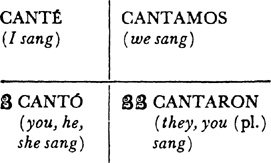
Voy a cantar. I’m going to sing.
¿Va a cantar? Are you going to sing?
VER, to see
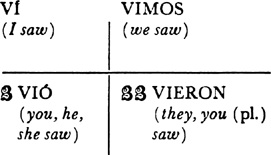
Voy a ver. I’m going to see.
¿Va a ver? Are you going to see?
LEÍ (I read)
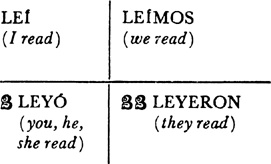
Voy a leer, I’m going to read.
¿Va a leer? Are you going to read?
OÍR, to hear
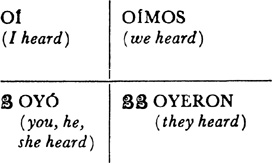
Voy a oír. I’m going to hear.
¿Va a oír? Are you going to hear?
Notice that in “oír” and “leer” each “i” that appears between vowels has been changed to “y.” Whenever an “i” changes to “y” in a verb it changes only in the third man form, singular and plural.
| las noticias, the news | la luna, the moon |
| el noticiario, the newsreel | la luz, the light |
| la terraza, the terrace | el concierto, the concert |
| la canción, the song | el discurso, the speech |
| ¡Qué romántico! How romantic! |
la música, the music por qué, why |
| ¡Qué terrible! How terrible! | porque, because |
| ¿Cantó Roberto? Did Robert sing? |
por radio, on the radio muy mal, very badly |
| Oí. I heard (accent the “i” firmly). |
¿Oyó usted? Did you hear? ¿Leyó usted? Did you read? |
| Leí. I read. | ¿Vió usted? Did you see? |
| Ví. I saw. | ver, to see |
a la luz de la luna, by the light of the moon
con un efecto desastroso, with a desastrous effect
¿Leyé usted las noticias en el periódico esta mañana?
Sí, leí las noticias en el periódico esta mañana.
¿Oyó usted las noticias por radio esta mañana?
Sí, oí las noticias por radio esta mañana.
¿ Vió usted un noticiario en el cine anoche?
Sí, ví un noticiario en el cine anoche.
¿Oyó usted las composiciones de los estudiantes en la clase esta tarde?
Sí, oí las composiciones de los estudiantes en la clase esta tarde.
¿Oyó usted una conversación interesante en la clase esta tarde?
Sí, oí una conversación muy interesante en la clase esta tarde.
¿Oyó usted el discurso del presidente por radio?
Sí, oí el discurso del presidente por radio.
¿Oyó usted im concierto esta mañana?
Sí, oí un concierto excelente esta mañana.
¿Oyó usted a un violinista famoso esta mañana?
Sí, oí a un violinista muy famoso esta mañana.
¿Oyeron el concierto su papá y su mamá?
Sí, mi papá y mi mamá oyeron el concierto.
¿Oyeron las noticias su papá y su mamá?
No, mi papá y mi mamá no oyeron las noticias esta mañana. Mi papá y mi mamá leyeron las noticias en el periódico.
¿Oyó usted una explosión esta mañana?
No, por fortuna no oí una explosión esta mañana.
¿Oyó usted un programa de radio interesante esta mañana?
Sí, esta mañana oí un programa de radio muy interesante.
¿Oyó usted música de la América Latina en el programa?
Sí, oí música de la América Latina en el programa.
¿Oyó usted música de guitarra en el programa?
No, no oí música de guitarra en el programa, pero oí mucha música de guitarra en Acapulco. Oí a un trío de guitarristas magníficos en el hotel Pacífico. Cantaron en la terraza del hotel a la luz de la luna.
¡Qué romántico!
Sí, muy romántico.
¿Vió usted la luna en Acapulco?
Sí, ví la luna en Acapulco. Es muy romántico ver la luna en una noche tropical.
¿Cantaron un tango los guitarristas?
Sí, los guitarristas cantaron un tango.
¿Cantó Roberto?
Sí. ¡Qué terrible! Roberto cantó con el trío con un efecto desastroso.
¿Por qué cantó Roberto?
Roberto cantó porque es muy indiscreto.
¿Aplaudió usted cuando Roberto cantó?
No, naturalmente no aplaudí cuando Roberto cantó porque cantó muy mal.
¿Cantaron los mexicanos en la playa?
Sí, invité al trío de guitarristas a la playa y cantaron canciones mexicanas a la luz de la luna.
¿Cantaron en español?
Sí, cantaron en español.
¿Comprendió usted las canciones?
Sí, comprendí las canciones muy bien.
¿Cantó usted en la playa?
No, no canté en la playa.
¿Cantó Roberto en la playa?
Sí. ¡Qué terrible! Roberto cantó en la playa.
Combine the words below in different ways to form as many sentences as you can. Be sure to use words from each of the columns in every sentence you form.
A
| 1 | 2 | 3 |
| Canté (I sang) | una canción | en la clase |
|
Roberto cantó |
un tango | en la playa |
|
¿Cantó Roberto |
muy mal | anoche |
| Cantamos (We sang) | muybien (very well) | esta noche |
|
Cantaron (They sang) |
muchas canciones | por radio |
| Voy a cantar | en la clase | esta tarde |
B
| 1 | 2 | 3 |
| Ví (I saw) | una película | anoche |
|
¿Vió usted (Did you see?)
|
(a film) | en el cine |
|
Marta vió
|
un noticiario | esta tarde |
| Vimos (We saw) | a su mamá | ayer (yesterday) |
|
Mis amigos vieron (My friends saw)
|
a Luis una comedia un programma las fotografías |
la semana pasada de televisión en el periódico |
C
| 1 | 2 | 3 |
| Leí (I read) | una novela | esta semana |
|
¿Leyó usted (Did you read?)
|
un artículo el periódico |
(this week) esta noche |
|
Luis leyó
|
las noticias | esta mañana |
| Leímos | la carta | en el periódico |
|
Mis amigos leyeron (My friends read)
|
la revista las frases |
anoche en el tren |
| Oí (I heard) | el concierto | en la clase |
|
¿Oyó usted (Did you heard?)
|
al pianista el discurso |
por radio en el concierto |
| Oímos (We heard) | las canciones | ayer (yesterday) |
|
Mis amigos oyeron (My friends heard)
|
la conversación la explosión |
anoche en la clase esta mañana |
Translate the following sentences into Spanish. Write out each sentence in Spanish, using the columns above as a guide. Check your sentences with the correct translations below this exercise.
Check your sentences with the correct translations below.
CT = CTO
the product = el producto
| abstracto | compacto | electo | intelecto |
| acto | contacto | exacto | perfecto |
| arquitecto | correcto | extracto | predilecto |
| (architect) | defecto | imperfecto | proyecto |
| aspecto | dialecto | incorrecto | (project) |
| circunspecto | directo | indirecto | tacto |
| (circumspect) | efecto | insecto |
In a few words that belong to this category the letter “c” is dropped.
| el distrito, the district | instinto, instinct |
| distinto, distinct, different | el contrato, the contract |
| es distinto, it’s different |
Other basic differences in spelling between Spanish and English:
The letter “j” in English words sometimes becomes a “y” in the corresponding Spanish words.
| el proyecto, the project | la inyección, the injection |
| el mayor, the major, the eldest | la mayoría, the majority |
| (el alcalde, the mayor) | proyectar, to project |
| la pantalla, the movie screen | la actriz, the actress |
| el talón, the ticket stub | el fin, the end |
| la taquilla, the box office | al fin, at last |
| la película, the film | finalmente, finally |
NOTE: In Spanish a noun cannot be used to modify another noun. Instead, the two nouns are separated by the word “de,” as below:
| programa de radio, radio program | programa de televisión, television program |
| música de guitarra, guitar music | trío de guitarra, guitar trio |
| coctel de frutas, fruit cocktail | |
| clase de español, Spanish class | sopa de tomate, tomato soup |
| jugo de naranja, orange juice |
el radio
ESTAR, to be (where, how)
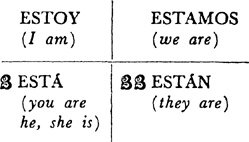
Voy a estar. I’m going to be.
|
masculine (for men) |
feminine (for women) |
| Estoy contento. I’m happy. | Estoy contenta. I’m happy. |
| Estoy solo. I’m alone. | Estoy sola. I’m alone. |
| Estoy cansado. I’m tired. | Estoy cansada. I’m tired. |
|
¿Está listo? Are you ready?
|
¿Está lista? Are you ready?
|
|
¿Está listo Roberto? Is Robert ready?
|
¿Está lista María? Is Mary ready?
|
|
¿Está ocupado? Are you busy?
|
¿Está ocupada? Are you busy?
|
|
¿Está preocupado? Are you worried?
|
¿Está preocupada? Are you worried?
|
| Estoy enfermo. I’m sick (masc). |
Está enferma. She’s sick (fem.).
|
Remember that if a man says that he is happy he must use the masculine adjective. He must say, “Estoy contento.” If a woman says that she is happy, she must use the feminine adjective. She must say, “Estoy contenta.”
Estoy triste. I’m sad (both masc. and fem.). Adjectives that end in “e” are both masculine and feminine.
Estoy preocupada por Carlos. I’m worried over (by) Charles.
Está muy enfermo. You are (he is) very sick.
| buenas noticias, good news | nunca, never |
| pobre Carlos, poor Charles | pronto, soon |
| en cinco minutos, in five minutes |
cuándo, when también, also |
| en una hora, in an hour | mejor, better |
|
¿Leyé Roberto? Did Robert read?
|
Está muy enfermo. He’s very sick. |
| dictar, to dictate |
¿Cómo está usted?
Bien, gracias, ¿y usted?
Bien, gracias.
¿Está cansado?
No, por fortuna no estoy cansado.
¿Está contento?
Sí, estoy muy contento esta mañana porque recibí una carta con buenas noticias.
¿Está triste?
Ay no, no estoy triste. Estoy muy contento.
¿Cómo está María?
María está bien, gracias.
¿Dónde está María?
María está con Roberto.
¿Está sola María?
No, María no está sola. María está con Roberto.
¿Está solo Roberto?
No, Roberto no está solo. Roberto está con María y está muy contento.
¿Cómo está Alberto?
Alberto está bien, gracias.
¿Dónde está Alberto?
Alberto está en el despacho. Está muy ocupado esta mañana.
¿Recibió Alberto muchas cartas?
Sí, Alberto recibió muchas cartas.
¿Dictó Alberto muchas cartas esta mañana?
Sí, Alberto dictó muchas cartas esta mañana.
¿Está ocupado Alberto?
Sí, Alberto está muy ocupado.
¿Está ocupada María?
Sí, María está muy ocupada también.
¿Está cansada María?
Sí, María está cansada porque trabajó mucho esta mañana.
¿Está preocupada María?
Sí, María está muy preocupada por Carlos. Carlos está en el hospital.
¡Pobre Carlos!
¿Está preocupado Alberto?
Sí, Alberto está preocupado también.
¿Por qué está preocupado Alberto?
Alberto está preocupado por Carlos.
¿Está ocupado Roberto?
No, Roberto no está ocupado. Roberto nunca está ocupado.
¿Invitó usted a Roberto a la fiesta?
Sí, invité a Roberto a la fiesta.
¿Está listo Roberto?
No, Roberto no está listo. Roberto nunca está listo.
¿Va a estar listo en cinco minutos?
No, Roberto no va a estar listo en cinco minutos.
¿Va a estar listo pronto?
No, no va a estar listo pronto.
¿Cuándo va a estar listo?
Va a estar listo en una hora.
Combine the words below in different ways to form as many sentences as you can. Be sure to use words from each of the columns in every sentence you form.
A (HOW)
| 1 | 2 | 3 |
| MASCULINE | FEMININE | |
| Estoy (I am) | contento | contenta |
|
¿Está usted (Are you?)
|
solo | sola |
| Voy a estar (I’m going to be) |
listo ocupado |
lista ocupada |
|
Eduardo va a estar (Edward is going to be)
|
triste preocupado |
triste preocupada |
|
Alicia está
|
enfermo (sick) | enferma (sick) |
|
Juan está
|
bien (well) | bien |
| mejor (better) | mejor |
B (HOW)
| 1 | 2 | 3 |
| MASCULINE PLURAL | MEMININE PLURAL | |
| Estamos (We are) | contentos | contentas |
|
Están (They are. Are they?)
|
solos cansados |
solas cansadas |
| listos | listas | |
| ocupados | ocupadas | |
| preocupados | preocupadas | |
| tristes | tristes | |
| enfermos (sick) | enfermas (sick) | |
| bien (well) | bien |
C (WHERE)
| 1 | 2 |
| Estoy (I am) | en la clase |
|
¿Está usted (Are you?) |
en el despacho |
|
Eduardo está (Edward is) |
en Cuba |
| Estamos (We are) | en casa |
|
Alberto y María están |
en el hospital |
|
Están (They are) |
en el club |
|
Mi sombrero está |
en el sofá |
Translate the following sentences into Spanish. Write out each sentence in Spanish, using the columns above as a guide. Check your sentences with the correct translations below this exercise.
Check your sentences with the correct translations below.
| el comedor, the dining room | la sala, the living room |
| el baño, the bathroom | la cocina, the kitchen |
| el corredor, the hall | el cuarto, the room |
Está en la cocina. It’s in the kitchen. He, she is in the
kitchen.
Está en la sala. It’s in the living room. He, she is in the living
room.
Está en el baño. It’s in the bathroom.
Está en el comedor. It’s in the dining room.
|
Está furioso. He is furious. |
Está enojado. He is angry. |
|
Está furiosa. She is furious. |
Está enojada. She is angry. |
Remember that “where” and “how” take “está.”
Always use “es” with a noun or a characteristic (permanent quality).
NOUN: El elefante es un animal. The elephant is an
animal.
(Since “animal” is a noun you must use “es.”)
CHARACTERISTIC: El elefante es grande. The elephant is
big.
(Since being big is a characteristic [permanent quality] of an
elephant, you must use “es.”)
El doctor es inteligente. The doctor is intelligent.
(Since being intelligent is a characteristic [permanent quality] you must use “es.”)
Es rico. He is rich. (characteristic)
Es alto. He is tall. (characteristic)
URE = URA
the literature = la literatura
| la agricultura | la escultura | la literatura |
| la arquitectura | (sculpture) | la manufactura |
| la aventura | la estatura | la miniatura obscura |
| (adventure) | (stature) | (dark) |
| la caricatura | la estructura | (masc., obscuro) |
| (cartoon, caricature) | (structure) | prematura |
| la criatura | la figura | (masc., prematuro) |
| (creature, child) | la fractura | pura |
| la cultura | futura | (masc., puro) |
| la tortura | (masc, futuro) | la temperatura |
| la horticultura |
UTE = UTO
the minute = el minuto
| absoluto | diminuto | el substituto |
| astuto | el instituto | el tributo |
| el atributo | irresoluto | |
| el bruto | el minuto |
ow
that you have completed twenty lessons let’s try another test to see how
well you are grasping the lessons.
Fill in the blanks below with the plural of the following words. You should be able to complete this test in five minutes.
1. lacasa
2. la planta
3. el sombrero
4. laguitarra
5. el radio
6. el hombre guapo
7. la señorita bonita
8. el doctor
9. el animal
10. el color
11. la nación
12. la ciudad
13. la novela interesante
14. el artista famoso
Check your answers with the words below. If you have twelve or more correct answers, you have learned how to form the plurals very well. If you have fewer than eight correct answers, you are not reading the lessons carefully enough. Try to do better next time.
This is an important test because it will show you how thoroughly you have learned the verbs. I hope that you will get a high score on this one.
Fill in the blanks with the Spanish equivalents of the following English words. You should be able to complete this test in ten minutes.
1. We worked.
2. They bought.
3. I sang.
4. We talked.
5. They are going to buy.
6. We are going to invite.
7. Did they finish?
8. I passed.
9. We invited.
10. I received.
11. We saw.
12. I heard.
13. We read (past tense).
14. They are going to see.
15. They sang.
16. How is Mary?
17. They saw.
18. Who saw?
19. We wrote.
20. I served.
21. They understood.
22. We bought.
23. They worked.
24. I understood.
25. We received.
26. Who wrote?
27. Did you sell?
28. I saw.
29. I read (past tense).
30. We understood.
31. They heard.
32. I am going to sell.
33. We heard.
34. Mary is happy.
35. They sold.
36. Robert saw.
This was a difficult test. If you have thirty or more correct answers you are doing extremely well. Read the next lessons at the same speed. Try to keep up the high caliber of your work. If you have no more than eighteen correct answers, you had better review the verbs before you go on to the next lessons. Check your results with the correct answers below.
Now let’s see how well you can convert adjectives into adverbs. Fill in the blanks below with the adverbs which correspond to the following adjectives. The first answer has been solved for you so that you can be sure how this test should be done. You should be able to complete this test in five minutes.
1. natural, naturalmente
2. personal
3. general
4. principal
5. posible
6. probable
7. normal
8. final
9. completo
10. absoluto
11. público
12. comparativo
If only one or two of your answers are wrong you have learned how to form adverbs very well. If you have made more than five mistakes, however, you are not reading the lessons carefully enough. Check your adverbs with the following list.
las pipas
FUMAR, to smoke
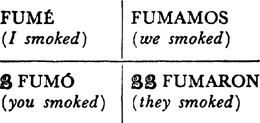
ING = ANDO (for “ar” verbs)
PRESENT PARTICIPLES
| visitando, visiting | hablando, talking |
| compando, buying | trabajando, working |
ING = IENDO (for “er” and “ir” verbs)
PRESENT PARTICIPLES
| escribiendo, writing | recibiendo, receiving |
| viendo, seeing | comprendiendo, understanding |
Following is a list of infinitives converted into present participles.
|
INFINITIVE |
|
|
hablar |
to speak |
|
comprar |
to buy |
|
tomar |
to take |
|
votar |
to vote |
|
exportar |
to export |
|
fumar |
to smoke |
|
estudiar |
to study |
|
preparar |
to prepare |
|
copiar |
to copy |
|
dictar |
to dictate |
|
recitar |
to recite |
|
demandar |
to sue |
|
flotar |
to float |
|
marchar |
to march |
|
murmurar |
to murmur |
|
conversar |
to converse |
|
anticipar |
to anticipate |
|
celebrar |
to celebrate |
|
acumular |
to accumulate |
|
cooperar |
to co-operate |
|
cultivar |
to cultivate |
|
trabajar |
to work |
|
PRESENT PARTICIPLE |
|
|
hablando |
speaking |
|
comprando |
buying |
|
tomando |
taking |
|
votando |
voting |
|
exportando |
exporting |
|
fumando |
smoking |
|
estudiando |
studying |
|
preparando |
preparing |
|
copiando |
copying |
|
dictando |
dictating |
|
recitando |
reciting |
|
demandando |
suing |
|
flotando |
floating |
|
marchando |
marching |
|
murmurando |
murmuring |
|
conversando |
conversing |
|
anticipando |
anticipating |
|
celebrando |
celebrating |
|
acumulando |
accumulating |
|
cooperando |
co-operating |
|
cultivando |
cultivating |
|
trabajando |
working |
|
INFINITIVE |
|
|
escribir |
to write |
|
vivir |
to live |
|
aplaudir |
to applaud |
|
recibir |
to receive |
|
decidir |
to decide |
|
asistir |
to attend |
|
insistir |
to insist |
|
describir |
to describe |
|
dividir |
to divide |
|
persuadir |
to persuade |
|
sufrir |
to suffer |
|
ver |
to see |
|
comprender |
to understand |
|
vender |
to sell |
|
absorber |
to absorb |
|
convencer |
to convince |
|
extender |
to extend |
|
mover |
to move |
|
ofender |
to offend |
|
ofrecer |
to offer |
|
leer |
to read |
|
oir |
to hear |
|
PRESENT PARTICIPLE |
|
|
escribiendo |
writing |
|
viviendo |
living |
|
aplaudiendo |
applauding |
|
recibiendo |
receiving |
|
decidiendo |
deciding |
|
asistiendo |
attending |
|
insistiendo |
insisting |
|
describiendo |
describing |
|
dividiendo |
dividing |
|
persuadiendo |
persuading |
|
sufriendo |
suffering |
|
viendo |
seeing |
|
comprendiendo |
understanding |
|
vendiendo |
selling |
|
absorbiendo |
absorbing |
|
convenciendo |
convincing |
|
extendiendo |
extending |
|
moviendo |
moving |
|
ofendiendo |
offending |
|
ofreciendo |
offering |
|
leyendo |
reading |
|
oyendo |
hearing |
Notice that the “iendo” has been changed to “yendo” in “leyendo” and “oyendo.” When the letter “i” appears between two vowels it is changed to “y.”
HOW TO USE THE PRESENT PARTICIPLE
| Estoy estudiando (I am studying) | Estámos estudiando (We are studying) |
|
Está estudiando (You are studying) |
Están estudiando (They are studying) |
AR VERBS, ANDO
| I am buying. | Estoy comprando. |
| You are working. |
Está trabajando. |
| We are preparing. | Estamos preparando. |
| They are copying. |
Están copiando. |
| I am studying. | Estoy estudiando. |
| He is progressing. |
Está progresando. |
| We are smoking. | Estamos fumando. |
| He is dictating. |
Está dictando. |
| She is reciting, |
Está recitando. |
ER AND IR VERBS, IENDO
| I am writing. | Estoy escribiendo. |
| She is selling. |
Está vendiendo. |
| We are seeing. | Estamos viendo. |
| They are understanding |
Están comprendiendo. |
| I am reading. | Estoy leyendo. |
| He is living. |
Está vi viendo. |
| They are applauding. |
Están aplaudiendo. |
Notice that the “i” in leyendo is changed to “y” because it appears between two vowels.
| la frase, the sentence | un cigarrillo, a cigarette |
| perezoso (masc.), lazy | ¡Qué idea! What an idea! |
| perezosa (fem.), lazy | un puro, a cigar |
| una pipa, a pipe | mi abuelo, my grandfather |
| un cigarro, a cigarette | mi abuela, my grandmother |
| ¿Está estudiando? Are you studying? |
¿Está estudiando la lección?
Sí, estoy estudiando la lección.
¿Está preparando una composición para la clase?
No, no estoy preparando una composición para la clase.
¿Está recitando un poema?
No, no estoy recitando un poema.
¿Está hablando italiano?
No, no estoy hablando italiano. Estoy hablando español.
¿Está escribiendo una carta?
No, no estoy escribiendo una carta.
¿Está escribiendo un poema?
No, no estoy escribiendo un poema.
¿Está leyendo una novela en la clase?
Ay no, eso es ridículo, no estoy leyendo una novela en la clase.
¿Está leyendo el periódico en la clase?
No, eso es absolutamente ridículo. No estoy leyendo el periódico
en la clase. Estoy hablando español en la clase.
¿Están progresando los estudiantes en la clase?
Sí, los estudiantes están progresando mucho en la clase.
¿Está dictando frases el profesor?
No, el profesor no está dictando frases.
¿Está trabajando Roberto?
Ay no, Roberto no está trabajando.
¿Está estudiando Roberto?
Ay no, Roberto no está estudiando. Roberto es muy perezoso.
¿Es perezosa María?
No, María no es perezosa. María es muy industriosa.
¿Es industrioso Roberto?
¡Caramba, profesor, qué idea! Roberto no es industrioso. Roberto es muy perezoso.
¿Está fumando Roberto?
No, Roberto no está fumando.
¿Está fumando una pipa el profesor?
No, el profesor no está fumando una pipa.
¿Está fumando un cigarro el profesor?
No, el profesor no está fumando un cigarro.
¿Está fumando un puro su abuelo?
Sí, mi abuelo está fumando un puro.
¿Está leyendo una novela su abuela?
Sí, mi abuela está leyendo una novela.
¿Está fumando una pipa su abuela?
Ay no, eso es absolutamente ridículo. Mi abuela no está fumando una pipa.
Combine the words below in different ways to form as many sentences as you can. Be sure to use words from each of the columns in every sentence you form.
A
| 1 | 2 | 3 |
| Estoy (I am) | trabajando | en el despacho |
|
¿Está (Are you? Is he? Is she?)
|
preparando copiando |
la cena las frases |
| Estámos (We are) | fumando | un puro |
|
Están (They are)
|
dictando | una carta |
|
Mi abuelo está (My grand father is)
|
escribiendo leyendo |
un artículo una novela |
B
| 1 | 2 | 3 |
|
¿Está (Is?) |
cstudiando | Roberto? |
| leyendo | su abuela? | |
| fumando | su abuelo? | |
| trabajando | su papá |
Translate the following sentences into Spanish. Write out each sentence in Spanish, using the columns above as a guide. Check your sentences with the correct translations below this exercise.
Check your sentences with the correct translations below.
| MASCULINE | FEMININE |
| mi hermano, my brother | mi hermana, my sister |
| mi primo, my cousin (man) | mi prima, my cousin (woman) |
| mi suegro, my father-in-law | mi suegra, my mother-in-law |
| mi tío, my uncle | mi tía, my aunt |
| mi cuñado, my brother-in-law | mi cuñada, my sister-in-law |
| mi sobrino, my nephew | mi sobrina, my niece |
| mi nieto, my grandson | mi nieta, my granddaughter |
| mi hijo, my son | mi hija, my daughter |
| mi esposo, my husband | mi esposa, my wife |
| mis padres, my parents | la familia, the family |
| mis parientes, my relatives | la gente, the people |
| Estoy | trabajando |
| (I am) | estudiando |
|
¿Está |
hablando |
| (Are you? Is he, she?) | escribiendo |
| Estamos | sufriendo |
| (We are) | (suffering) |
|
Están |
ING = ANDO (for “ar” verbs) |
| (They are) | ING = IENDO (for “er, ir” verbs) |
Copy the above material on a card. Carry the card with you and glance at it whenever you get a chance.
el pan y un huevo
“Ar,” “er,” and “ir” verbs end in “o” in the first person of the present tense.
EXAMPLES:
| hablo, I speak | compro I buy |
| vendo, I sell | escribo, I write |
Following is a list of infinitives converted into the first person, present tense.
| INFINITIVE | FIRST PERSON | TRANSLATION |
| tomar | tomo | I take |
| comprar | compro | I buy |
| hablar | hablo | I speak |
| trabajar | trabajo | I work |
| estudiar | estudio | I study |
| terminar | termino | I finish |
| bailar | bailo | I dance |
| invitar | invito | I invite |
| visitar | visito | I visit |
| comprender | comprendo | I understand |
| vender | vendo | I sell |
| leer | leo | I read |
| aprender | aprendo | I learn |
| escribir | escribo | I write |
| vivir | vivo | I live |
| recibir | recibo | I receive |
| insistir | insisto | I insist |
| describir | describo | I describe |
| decidir | decido | I decide |
| sufrir | sufro | I suffer |
Notice that you stress the next to the last syllable in the present tense. Stress this syllable very firmly.
“Ar” verbs end in “a” in the third man form, that is, when speaking of anybody but yourself.
| EXAMPLES: |
habla, |
you speak | do you speak? |
| he speaks | does he speak? | ||
| she speaks | does she speak? |
Alberto trabaja mucho. Albert works a lot.
María habla español. Mary speaks Spanish.
¿Habla usted español? Do you speak Spanish?
¿Estudia usted mucho? Do you study a lot?
Roberto no estudia. Robert doesn’t study.
Roberto baila muy bien. Robert dances very well.
Following is a list of “ar” infinitives converted into the present tense, third man form.
| INFINITIVE | THIRD MAN FORM | TRANSLATION |
| comprar |
compra |
you buy, he, she buys |
| hablar |
habla |
you speak, he, she speaks |
| tomar |
toma |
you take, he, she takes |
| trabajar |
trabaja |
you work, he, she works |
| estudiar |
estudia |
you study, he, she studies |
| terminar |
termina |
you finish, he, she finishes |
| bailar |
baila |
you dance, he, she dances |
| votar |
vota |
you vote, he, she votes |
| visitar |
visita |
you visit, he, she visits |
| invitar |
invita |
you invite, he, she invites |
| preparar |
prepara |
you prepare, he, she prepares |
| importar |
importa |
you import, he, she imports |
| exportar |
exporta |
you export, he, she exports |
| depositar |
deposita |
you deposit, he, she deposits |
| aceptar |
acepta |
you accept, he, she accepts |
| entrar |
entra |
you go in, he, she goes in |
| estacionar |
estaciona |
you park, he, she parks (car) |
| dictar |
dicta |
you dictate, he, she dictates |
| pasar |
pasa |
you pass, he, she passes |
| usar |
usa |
you use, he, she uses |
| copiar |
copia |
you copy, he, she copies |
ESPERAR, to hope, to wait for, to expect
ESPERO, I hope
ESPERO HABLAR, I hope to speak
ESPERA
| you hope | do you hope? |
| he hopes | does he hope? |
| she hopes | does she hope? |
CANTA
| you sing | do you sing? |
| he sings | does he sing? |
| she sings | does she sing? |
BAILA
| you dance | do you dance? |
| he dances | does he dance? |
| she dances | does she dance? |
| HABLO, I speak |
¿HABLA? do you speak? |
| CANTO, I sing |
¿CANTA? do you sing? |
| BAILO, I dance |
¿BAILA? do you dance? |
¿Fuma su abuelo? Does your grandfather smoke?
| nunca, never | nunca bailo, I never dance |
| el desayuno, breakfast | para el desayuno, for breakfast |
| el almuerzo, lunch | para el almuerzo, for lunch |
| después de, after | después de la cena, after dinner |
| el jugo, the juice | |
| la leche, the milk | jugo de naranja, orange juice |
| el té, the tea | jugo de tomate, tomato juice |
| el pan, the bread | jugo de piña, pineapple juice |
| inglés, English | pan tostado, toast |
| unas veces, sometimes | Estoy estudiando. I am studying. |
| un huevo, an egg | en las fiestas, at parties |
| un huevo frito, a fried egg | bien, well |
| huevos revueltos, scrambled eggs | pronto, soon |
| huevos pasados por agua, soft-boiled eggs (literally, eggs passed through water) | cuando, when |
The letters that must be stressed in the verbs are not in bold face below. You must remember to stress the next to the last syllable of every verb. You’re on your own now.
¿Habla usted español?
Sí, hablo español.
¿Habla bien?
No, no hablo bien, pero estoy estudiando y espero hablar bien muy pronto.
¿Habla español en la clase?
Sí, hablo español en la clase.
Habla español en casa?
No, en casa hablo inglés.
¿Habla usted mucho?
No, no hablo mucho.
¿Habla mucho Roberto?
Sí, Roberto habla constantemente y cuando no habla, canta.
¿Canta usted en la clase de español?
Sí, canto en la clase de español.
¿Baila usted en la clase de español?
No, eso es absolutamente ridículo. No bailo en la clase. Bailo mucho en las fiestas pero nunca bailo en la clase.
¿Baila su abuelo?
Sí, mi abuelo baila muy bien. Mi abuelo baila el vals y el tango con mucho entusiasmo.
¿Fuma su abuelo?
Sí, mi abuelo fuma mucho. Mi abuelo fuma su pipa después de la cena.
¿Toma usted café para el desayuno?
Sí, tomo café en la mañana para el desayuno y en la noche después de la cena.
¿Toma usted un huevo frito para el desayuno?
Sí, generalmente tomo un huevo frito para el desayuno?
¿Toma usted huevos revueltos?
Sí, unas veces tomo huevos revueltos, pero generalmente tomo un huevo frito para el desayuno.
¿Toma usted pan tostado para el desayuno?
Sí, tomo pan tostado para el desayuno.
¿Toma usted huevos pasados por agua para el desayuno?
No, generalmente no tomo huevos pasados por agua. Generalmente tomo un huevo frito con pan tostado para el desayuno.
¿Toma usted jugo de naranja para el desayuno?
Sí, tomo jugo de naranja para el desayuno.
¿Toma usted jugo de tomate para el desayuno?
No, no tomo jugo de tomate para el desayuno. Tomo jugo de tomate para el almuerzo.
¿Toma usted jugo de piña para el desayuno?
No, no tomo jugo de piña para el desayuno. Unas veces tomo jugo de piña para el almuerzo.
¿Toma usted leche para el almuerzo?
No, no tomo leche para el almuerzo. Generalmente tomo té para el almuerzo.
¿Toma usted pan para el almuerzo?
Sí, tomo pan para el almuerzo.
Combine the words below in different ways to form as many sentences as you can. Just be sure to use words from each of the columns in every sentence you form.
A
| 1 | 2 | 3 |
| Hablo (I speak) | español | en la clase |
| Comprendo (I understand) |
la situación el periódico |
muy bien en la mañana |
| Compro (I buy) | con Roberto | en la tienda |
| Trabajo (I work) | la lección | después de la cena |
| Estudio (I study) | mucho | en las fiestas |
| Bailo (I dance) | las revistas | en el tren |
| Leo (I read) | huevos | para el desayuno |
| Tomo (I take) | té | para el almuerzo |
|
jugo de naranja jugo de piña huevos revueltos |
para la cena |
B
| 1 | 2 | 3 |
| Roberto |
habla español |
muy bien |
| Luis |
estudia |
mucho |
| Alberto |
baila |
el tango |
| María |
trabaja |
en el banco |
| Alicia |
toma |
mucho café |
| Marta |
prepara |
la cena |
| Mi abuelo |
fuma |
después de la cena |
| Mi abuela |
no fuma |
una pipa |
C
In this exercise you can either use the “usted” or drop it. Both forms are absolutely correct and complete. The “usted” is frequently dropped in conversation.
| 1 | 2 |
|
¿Habla (usted) (Do you speak?)
|
español (Spanish)? italiano (Italian)? |
|
¿Estudia (usted) (Do you study?)
|
en la universidad? mucho café (a lot of coffee)? |
|
¿Trabaja (usted) (Do you work?)
|
una pipa (a pipe)? cigarros (cigarettes)? |
|
¿Toma (usted) (Do you take?)
|
mucho (a lot)? después de la cena (after supper)? |
|
Fuma (usted) per)? (Do you smoke?)
|
en el banco (in the bank)? |
Notice that in questions you use the third man form of the verb.
Translate the following sentences into Spanish. Write out each sentence in Spanish, using the columns above as a guide. Check your sentences with the correct translations below this exercise.
Check your sentences with the correct translations below.
NOTE: “Espero” means “I hope” and is followed by the infinitive.
Espero ver la película. I hope to see the film.
Espero comprender. I hope to understand.
Espero bailar mucho. I hope to dance a lot.
Espero trabajar mucho. I hope to work a lot.
Espero vender la casa. I hope to sell the house.
Espero comprar un auto. I hope to buy a car.
Espero que sí. I hope so.
Espero que no. I hope not.
| una vez, one time, once | muchas veces, many times, often |
| dos veces, two times, twice | |
| tres veces, three times | unas veces, sometimes |
| otra vez, again (another time) | un vaso de agua, a glass of water |
| tal vez, maybe | |
| una servilleta, a napkin | una taza, a cup |
| un mantel, a tablecloth | una taza de café, a cup of coffee |
| el plato, the plate, the dish | |
| los platos, the dishes | azúcar, sugar |
| el vaso, the glass | una propina, a tip |
| un vaso de leche, a glass of milk |
| Hablo (I speak) | español |
|
¿Habla (Do you speak?) |
italiano |
| Trabajo (I work) | en el banco |
|
¿Trabaja (Do you work?) |
en la tienda (in the store) |
| Estudio (I study) | después de la cena (after dinner) |
Copy the above material onto a card. Carry the card with you and glance at it whenever you get a chance.
la máquina de escribir
he
present tense of “er” and “ir” verbs is formed by removing the “er” or
the “ir” and adding “o” for the first person and “e” for anybody else
(singular).
| ESCRIBIR, to write | ESCRIBO, I write |
ESCRIBE, you write he, she writes |
| RECIBIR, to receive | RECIBO, I receive |
RECIBE, you receive he, she receives |
| COMPRENDER, to understand | COMPRENDO, I understand |
COMPRENDE, you understand he, she understands |
| VENDER, to sell | VENDO, I sell |
VENDE, you sell he, she sells |
| APRENDER, to learn | APRENDO, I learn |
APRENDE, you learn he, she learns |
| LEER, to read | LEO, I read |
LEE, you read he, she reads |
| VIVIR, to live | VIVO, I live |
VIVE, you live he, she lives |
| COMER, to eat | COMO, I eat |
COME, you eat he, she eats |
| BEBER, to drink | BEBO, I drink |
BEBE, you drink he, she drinks |
Following is a list of infinitives converted into the present tense.
| 1 | 2 | 3 | 4 | 5 |
| escribir | escribo | I write |
escribe |
you write (he, she writes) |
| recibir | recibo | I receive |
recibe |
you receive |
| vivir | vivo | I live |
vive |
you live |
| comprender | comprendo | I understand |
comprende |
you understand |
| vender | vendo | I sell |
vende |
you sell |
| aprender | aprendo | I learn |
aprende |
you learn |
| leer | leo | I read |
lee |
you read |
| describir | describo | I describe |
describe |
you describe |
| decidir | deci | I decide |
decide |
you decide |
| sufrir | sufr | I suffer |
sufre |
you suffer |
| dividir | div | I divide |
divide |
you divide |
| permitir | permtio | I allow |
permite |
you allow |
| persuadir | persuado | I persuade |
persuade |
you persuade |
| resistir | resisto | I resist |
resiste |
you resist |
| comer | como | I eat |
come |
you eat |
| beber | bebo | I drink |
bebe |
you drink |
Remember that in the present tense you stress the next to the last syllable.
| nuevo (masc.), nueva (fem.), new |
la familia, the family la avenida, the avenue |
| Nueva York, New York | la ciudad, the city |
| solo (masc), sola (fem.), alone |
o, either, or un departamento, an apartment |
| muchos (masc), muchas (fem.), many | la palabra, the word |
| unos (masc.), unas (fem.), some | los Estádos Unidos, the United States |
| unas cartas, some letters | la máquina, the machine |
| todo (masc), toda (fem.), all | la máquina de escribir, the typewriter |
| todos (masc), todas (fem.), all, every | el día, the day |
| todos los días, every day (all the days) | el otro día, the other day |
| todas las mañanas, every morning (all the mornings) | un día, one day (NEVER say “una día”) |
| otro (masc), otra (fem.), another (NEVER say “un otro”) | hay, there is, there are, is there? are there? |
| otros (masc.), otras (fem.), other, others |
¿Lee usted? Do you read?
¿Aprende usted? Do you learn?
|
¿Está us ted leyendo? Are you reading?
¿Dóndevive usted? Where do you live?
¿Dónde vive usted?
Vivo en Nueva York.
¿Vive usted solo (sola)?
No, no vivo solo (sola). Vivo con mi familia.
¿Dónde vive el presidente de los list ados Unidos?
El presidente de los Estádos Unidos vive en la Casa Bianca en Washington.
¿Dónde vive Roberto?
Roberto vive en la Avenida de la Reforma.
¿Dónde vive María?
María vive en un departamento en la Avenida de las Américas.
¿Dónde vive Luis?
Luis vive en la Ciudad de México.
¿Dónde vive Carlos?
Carlos vive en la Ciudad de México también.
¿Escribe Carlos muchas cartas?
No, Carlos no escribe muchas cartas.
¿ Escribe usted muchas cartas?
Sí, escribo muchas cartas.
¿Escribe las cartas en inglés o en español?
Escribo unas cartas en inglés y otras en español.
¿Escribe usted las cartas en máquina?
Sí, escribo las cartas en máquina.
¿Hay muchas máquinas de escribir en su despacho?
Sí, hay muchas máquinas en mi despacho.
¿Está usted leyendo la lección en el libro de español?
Sí, estoy leyendo la lección en el libro de español.
¿Comprende usted la lección?
Sí, comprendo la lección muy bien.
¿Comprende usted la conversación en la clase?
Sí, comprendo la conversación en la clase perfectamente.
¿Aprende usted mucho en la clase?
Sí, aprendo mucho en la clase.
¿Aprende usted muchas palabras en la clase?
Sí, aprendo muchas palabras en la clase.
¿Lee usted la lección en la clase?
Sí, leo la lección en la clase.
¿Lee usted el periódico todos los días?
Sí, leo el periódico todos los días.
¿Lee usted muchos libros?
Sí, leo muchos libros.
¿ Lee muchos libros Tómas?
No, Tomás no lee muchos libros. Tomás nunca lee. Tomás es muy ignorante.
¿Es ignorante Roberto?
No, Roberto es muy perezoso pero no es ignorante.
Combine the words below in different ways to form as many sentences as you can. Be sure to use words from each of the columns in every sentence you form.
A
| 1 | 2 | 3 |
| Vivo | en un departamento | en Nueva York |
| Leo | el periódico | todas las mañanas |
| Recibo | muchas cartas | (every morning) |
| Escribo | un artículo | en el despacho |
| Comprendo | la lección | todas las tardes |
| Aprendo | mucho (a lot) |
muy bien en la clase |
B
Questions usually require the third man form of the verb. You generally ask someone else what he did or does.
| 1 | 2 | 3 |
|
¿Lee usted (Do you read?) |
el periódico | todas las mañanas? (every morning) |
|
¿Recibe usted |
muchas cartas | todos los días? (every day) |
|
¿Escribe usted |
las frases | en su casa? |
|
¿Aprende usted |
el vocabulario | en la clase? |
|
¿Vive usted |
en una casa | o en un departamento? (or in an apartment) |
|
¿Vende usted |
muchos tractores | en la agencia? |
C
| 1 | 2 | 3 |
| Carlos |
vende |
muchos autos |
| María |
escribe |
artículos interesantes |
| Mamá |
recibe |
muchas cartas |
| Luis |
comprende |
la conversación |
| Roberto |
come (eats) |
mucho |
Translate the following sentences into Spanish. Write out each sentence in Spanish, using the columns above as a guide. Check your sentences with the correct translations below this exercise.
Check your sentences with the correct translations below.
| la calle, the street | la esquina, the corner |
| el chofer, the driver (taxi) | el ómnibus, the bus |
| a la derecha, to the right, on the right | el camión, the truck (the bus, in Mexico) |
| a la izquierda, to the left, on the left | el elevador, the elevator |
la Primera Avenida, First Avenue
la Segunda Avenida, Second Avenue
la Tercera Avenida, Third Avenue
la Cuarta Avenida, Fourth Avenue
la Quinta Avenida, Fifth Avenue
la acera, the sidewalk
NOTE I: “Creo” actually means “I believe,” but in common usage it means “I think.”
Creo que es interesante. I think that it’s interesting.
Creo que es terrible. I think it’s terrible.
Creo que es bueno. I think it’s good.
Creo que es simpático. I think that he (she) is charming.
¿Qué cree usted? What do you think?
Creo que sí. I think so.
Creo que no. I think not. I don’t think so.
CREER, to think, to believe
CREO, I think
CREE, you think he, she thinks
NOTE II: Remember that adjectives agree with nouns in gender and number. Masculine adjectives modify masculine nouns and feminine adjectives modify feminine nouns.
| The “o” is a masculine letter. | The “a” is a feminine letter. |
| MASCULINE | FEMININE |
| muchos hombres (many men) | muchas mujeres (many women) |
| muchos sombreros (many hats) | muchas blusas (many blouses) |
| todos los hombres (all the men) | todas las mujeres (all the women) |
| todos los muchachos (all the boys) | todas las mañanas (every morning, all the mornings) |
| el otro caballero | (the other gentleman) |
| otro hombre (another man) | todas las noches (every night, all the nights) |
| otro amigo (another friend) | otra amiga (another friend, fem.) |
| unos amigos (some friends) | unas amigas (some friends, fem.) |
| un sombrero nuevo (a new hat) | una blusa nueva (a new blouse) |
Adjectives usually follow nouns in Spanish.
EXCEPTION: Adjectives of quantity or number go before the nouns.
| QUANTITY | NUMBER |
| mucho café | cinco sombreros, five hats |
| mucha leche | tres meses, three months |
|
¿Vive usted (Do you live?) |
en el campo |
| Vivo (I live) | en un departamento |
|
¿Escribe usted (Do you write?) |
solo, sola |
| Escribo (I write) | muchas cartas |
|
¿Dónde vive usted? |
(Where do you live?) |
Copy the above material onto a card. Carry the card with you and glance at it whenever you have a chance.
las canastas
 ithout
exception, EVERY first person plural of EVERY verb in EVERY tense ends
in “MOS.”
ithout
exception, EVERY first person plural of EVERY verb in EVERY tense ends
in “MOS.”
The present tense endings for the first person plural are:
AMOS for AR verbs
EMOS for ER verbs
IMOS for IR verbs
| HABLAR, to speak | HABLAMOS, we speak |
| VENDER, to sell | VENDEMOS, we sell |
| VIVIR, to live | VIVIMOS, we live |
| “AR” VERBS | FIRST PERSON PLURAL | TRANSLATION |
| comprar | compramos | we buy |
| hablar | hablamos | we speak |
| tomar | tomamos | we take |
| estudiar | estudiamos | we study |
| trabajar | trabajamos | we work |
| cantar | cantamos | we sing |
| terminar | terminamos | we finish |
| aceptar | aceptamos | we accept |
| votar | votamos | we vote |
| estacionar | estacionamos | we park |
| estar | estamos | we are |
| invitar | invitamos | we invite |
| “ER” VERBS | ||
| comprender | comprendemos | we understand |
| vender | vendemos | we sell |
| leer | leemos | we read |
| aprender | aprendemos | we learn |
| depender | dependemos | we depend |
| ofrecer | ofrecemos | we offer |
| “IR” VERBS | ||
| vivir | vivimos | we live |
| recibir | recibimos | we receive |
| escribir | escribimos | we write |
| oir | oímos | we hear |
| discutir | discutimos | we discuss |
| describir | describimos | we describe |
HABLAR, to speak
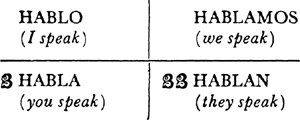
VENDER, to sell
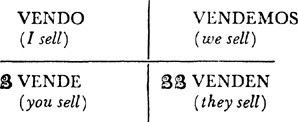
VIVIR, to live
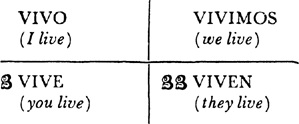
Notice that the third man plural is formed by adding the letter “N” to the third man singular.
| THIRD MAN SINGULAR | THIRD MAN PLURAL | ||
|
habla |
you speak |
hablan |
they speak |
|
compra |
you buy |
compran |
they buy |
|
termina |
you finish |
terminan |
they finish |
|
trabaja |
you work |
trabajan |
they work |
|
visita |
you visit |
visitan |
they visit |
|
invita |
you invite |
invitan |
they invite |
|
canta |
you sing |
cantan |
they sing |
|
baila |
you dance |
bailan |
they dance |
|
comprende |
you understand |
comprenden |
they understand |
|
vende |
you sell |
venden |
they sell |
|
lec |
you read |
leen |
they read |
|
aprende |
you learn |
aprenden |
they learn |
|
escribe |
you write |
escriben |
they write |
|
vive |
you live |
viven |
they live |
|
decide |
you decide |
deciden |
they decide |
|
recibe |
you receive |
reciben |
they receive |
|
describe |
you describe |
describen |
they describe |
LLEVAR, to wear, to carry
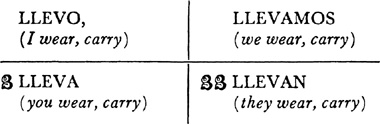
When you hear this verb you can tell whether it means “to wear” or “to carry” by its use in the sentence. “Llevan canastas” obviously means “They carry baskets” and certainly not “They wear baskets.”
| noches de luna, moonlight nights | pintoresco (masc.), picturesque |
| violetas frescas, fresh violets | el mercado, the market |
| hay, there is, there are, is there? are there? |
la literatura, literature la política, politics |
| son, are (plural of “es”) | los pantalones, the trousers |
| muchos, many | la cortesía, courtesy |
| sarapes, Mexican blankets | la falda, the skirt |
| con frecuencia, frequently, often (with frequence) |
la camisa, the shirt blanco (masc.), white |
| bonito (masc.), pretty | grande, big, large |
su canasta, your basket, his, her, their basket
sus canastas, your baskets, his, her, their baskets
acompañamiento de guitarra, guitar accompaniment
qué, what (with an accent)
que, that (without an accent)
mujeres que venden, women who sell (literally women that sell)
hombres que venden, men who sell (literally, men that sell)
“¿ Quién?” means “Who?” when asking a question such as
“¿ Quién cantó?” (Who sang?)
¿ Son interesantes los mercados mexicanos? Are Mexican markets interesting?
¿ Son interesantes los mercados mexicanos?
Sí, los mercados mexicanos son muy interesantes y pintorescos. En los mercados hay mujeres que venden tomates, naranjas, espárragos, papas, huevos, flores, etc.
¿ Qué lie van las mujeres?
Las mujeres llevan blusas de muchos colores y faldas muy bonitas.
¿ Venden canastas en el mercado?
Sí, en el mercado venden canastas con decoraciones muy bonitas.
¿ Venden flores en el mercado?
Sí, muchas mujeres llevan canastas de flores y con frecuencia invitan al turista a comprar sus flores. “Violetas, señorita violetas frescas, rosas bonitas, señorita. ¿ Va a comprar rosas?”
¿ Qué venden los hombres?
Los hombres venden sombreros y sarapes en el mercado.
¿ Qué llevan los hombres?
Los hombres llevan camisas blancas y pantalones blancos, sombreros grandes y sarapes de muchos colores diferentes. Los sarapes mexicanos son muy pintorescos.
¿ Dónde cultivan los mexicanos las frutas que venden en los mercados?
Los mexicanos cultivan las frutas que venden en los mercados en las haciendas y en los ranchos.
¿ Hablan español los mexicanos?
Sí, los mexicanos hablan español.
¿ Es interesante la conversación de los mexicanos?
Sí, la conversación de los mexicanos es muy interesante. Los mexicanos hablan mucho con sus amigos. Hablan de la política, la música, la literatura, y especialmente de las señoritas bonitas.
¿ Hay muchas fiestas en México?
Sí, en México hay muchas fiestas. Los mexicanos invitan a sus amigos a muchas fiestas. La hospitalidad mexicana es extraordinaria.
¿ Son románticos los mexicanos?
Sí, los mexicanos son muy románticos. Los hombres invitan a las señoritas a bailar con mucha cortesía. Los mexicanos son galantes y románticos. Las señoritas son coquetas.
¿ Cantan mucho los mexicanos?
Sí, los mexicanos cantan mucho. Los mexicanos cantan en las fiestas con acompañamiento de guitarra. Cantan en los patios en las noches de luna. Cantan, toman café, fuman cigarros, y hablan interminablemente.
¿ Bailan mucho los mexicanos?
Sí, los mexicanos bailan mucho.
Combine the words below in different ways to form as many sentences as you can. Just be sure to use words from each of the columns in every sentence you form.
A
| 1 | 2 | 3 |
| Trabajamos (we work) |
mucho la lección |
en la tienda muy bien |
| Preparamos | a mi primo | con frecuencia |
| Visitamos | la conversación | perfectamente |
| Comprendemos | muchas cartas | en el despacho |
| Escribimos | en una casa | en el campo |
| Vivimos | café | a la una (at one o’clock) |
| Tomamos | el almuerzo (lunch) | a las ocho (at eight o’clock) |
|
el desayuno (breakfast) la cena |
a las siete (at seven o’clock) |
B
| 1 | 2 | 3 |
| Los estudiantes |
hablan |
muy bien |
| Los hombres |
llevan |
camisas |
| Las señoritas |
llevan |
blusas |
| Las mujeres |
llevan |
canastas |
| Mis primos |
viven |
en Costa Rica |
| Mis amigos |
trabajan |
en el banco |
| Las secretarias |
escriben |
muchas cartas |
| Carlos y Roberto |
comprendcn |
la lección |
| María y Alicia |
preparan |
la cena |
Translate the following sentences into Spanish. Write out each sentence in Spanish, using the columns above as a guide. Check your sentences with the correct translations below this exercise.
Check your sentences with the correct translations below.
NOTE I: Remember that if a noun is feminine it is followed by a feminine adjective and if a noun is masculine it is followed by a masculine adjective. Boys don’t mix with girls grammatically as they do in real life.
Plural nouns are followed by plural adjectives. In other words, adjectives must agree with nouns in number and gender.
| MASCULINE SINGULAR | FEMININE SINGULAR |
| el sombrero bonito | la blusa bonita |
| el mercado pintoresco | la casa blanca |
| el hombre guapo | la mujer generosa |
| MASCULINE PLURAL | FEMININE PLURAL |
| los sombreros bonitos | las blusas bonitas |
| los mercados pintorescos | las casas blancas |
| los hombres guapos | las mujeres generosas |
NOTE II: The letters MOS and N are very important in Spanish because they form the plural of verbs.
| THIRD MAN SINGULAR | THIRD MAN PLURAL |
|
habla |
plus the letter N |
|
vende |
plus the letter N |
|
compra |
plus the letter N |
|
vota |
plus the letter N |
|
va (you go) |
plus the letter N |
|
está (you are) |
plus the letter N |
| THIRD MAN SINGULAR | FIRST PERSON PLURAL |
|
habla |
plus MOS |
|
vende |
plus MOS |
|
compra |
plus MOS |
|
vota |
plus MOS |
|
va (you, go) |
plus MOS |
|
está (you are) |
plus MOS |
Remember, however, that the first person plural of IR verbs is IMOS (vivimos, we live).
| I | YOU | WE | THEY |
| hablar | hablo |
habla |
hablamos |
| comprar | compro |
compra |
compramos |
| trabajar | trabajo |
trabaja |
trabajamos |
| bailar | bailo |
baila |
bailamos |
| visitar | visito |
visita |
visitamos |
| llevar | llevo |
lleva |
llevamos |
| invitar | invito |
invita |
invitamos |
| tomar | tomo |
toma |
tomamos |
| vender | vendo |
vende |
vendemos |
| comprender | comprendo |
comprende |
comprendemos |
| aprender | aprendo |
aprende |
aprendemos |
| vivir | vivo |
vive |
vivimos |
| recibir | recibo |
recibe |
recibimos |
| escribir | escribo |
escribe |
escribimos |
| decidir | decido |
decide |
decidimos |
Remember that in the present tense you must stress the next to the last syllable.
NOTE: “La comida” means “the meal” and also “lunch” when lunch is the big meal of the day. Both “comida” and “almuerzo” are used very much in Spanish.
| a la una, at one o’clock | a las siete, at seven o’clock |
| a las dos, at two o’clock | a las ocho, at eight o’clock |
| a las tres, at three o’clock | a las nueve, at nine o’clock |
| a las cuatro, at four o’clock | a las diez, at ten o’clock |
| a las cinco, at five o’clock | a las once, at eleven o’clock |
| a las seis, at six o’clock | a las doce, at twelve o’clock |
a las dos y media, at two-thirty (at two and a half)
a las dos y cuarto, at two-fifteen (at two and a quarter)
al cuarto para las tres, at a quarter to (for) three
el reloj, the clock, the watch
¿ A qué hora? At what time?
¿ A qué hora es la clase? At what time is the class?
ouns
are often very closely related to verbs. For example, there is a large
group of nouns that are identical to the first person present singular
of their corresponding verbs.
Read the following exercise aloud, firmly stressing the heavy-type letters.
| INFINITIVES | NOUNS | |
| votar | voto, I vote | el voto, the vote |
| usar | uso, I use | el uso, the use |
| cantar | canto, I sing | el canto, the song |
| progresar | progreso, I progress | el progreso, the progress |
| robar | robo, I steal | el robo, the robbery |
| estudiar | estudio, I study | el estudio, the study |
| besar | beso, I kiss | el beso, the kiss |
| insultar | insulto, I insult | el insulto, the insult |
| pesar | peso, I weigh | el peso, the weight |
| odiar | odio, I hate | el odio, the hatred |
| refrescar | refresco, I refresh | el refresco, the refreshment |
| triunfar | triunfo, I triumph | el triunfo, the triumph |
| trabajar | trabajo, I work | el trabajo, the work |
| anunciar | anuncio, I advertise | el anuncio, the advertisement |
| archivar | archivo, I file | el archivo, the file (letters) |
| cepillar | cepillo, I brush | el cepillo, the brush |
| dibujar | dibujo, I draw | el dibujo, the drawing |
| divorciar | divorcio, I divorce | el divorcio, the divorce |
| fracasar | fracaso, I fail | el fracaso, the failure |
| gritar | grito, I shout | el grito, the shout, scream |
| saludar | saludo, I greet | el saludo, the greeting |
| cambiar | cambio, I change | el cambio, the change |
| caminar | camino, I walk | el camino, the road |
| abrazar | abrazo, I hug | el abrazo, the hug |
| arreglar | arreglo, I arrange | el arreglo, the arrangement |
Notice that in the infinitive you stress the LAST syllable; in the present tense and the noun you stress THE NEXT TO THE LAST syllable.
Following is a list of infinitives converted into nouns.
| INFINITIVES | NOUNS |
| cantar, to sing | el canto, the song |
| usar, to use | el uso, the use |
| robar, to steal | el robo, the robbery |
| besar, to kiss | el beso, the kiss |
| insultar, to insult | el insulto, the insult |
| pesar, to weigh | el peso, the weight |
| odiar, to hate | el odio, the hatred |
| refrescar, to refresh | el refresco, the refreshment |
| trabajar, to work | el trabajo, the work |
| cepillar, to brush | el cepillo, the brush |
| dibujar, to draw | el dibujo, the drawing |
| fracasar, to fail | el fracaso, the failure |
| gritar, to shout | el grito, the shout |
| saludar, to greet | el saludo, the greeting |
| cambiar, to change | el cambio, the change |
| caminar, to walk | el camino, the road |
The verb “estar” is irregular.
ESTAR, to be (where, how)
| PRESENT TENSE | PAST TENSE |
| ESTOY, I am | ESTUVE, I was |
|
ESTÁ, you are, he, she, it is |
ESTUVO, you were, he, she, it was |
| ESTAMOS, we are | ESTUVIMOS, we were |
|
ESTÁN, they, you (pl.) are |
ESTUVIERON, they, you (pl.) were |
| Estoy ocupado. | Estuve ocupado. |
| (I am busy.) | (I was busy.) |
| Estoy cansado. | Estuve cansado. |
| (I am tired.) | (I was tired.) |
| Estoy en Cuba. | Estuve en Cuba. |
| (I am in Cuba.) | (I was in Cuba.) |
| Estoy con Roberto. | Estuve con Roberto. |
| (I am with Robert.) | (I was with Robert.) |
| Estoy en casa. | Estuve en casa. |
| (I’m at home.) | (I was at home.) |
Remember that you use the verb “estar” to say “where” or “how” things or people are.
The verb “tener” (to have) is irregular.
TENER, to have
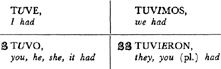
Now let’s study the pattern of these irregular verbs.
| ESTUVE, I was | TUVE, I had |
|
ESTUVO, you were, he, she, it was |
TUVO, you, he, she had |
Notice that these verbs end in “e” in the first person and in “o” in the third man form. They have the same endings as regular “ar” verbs in the past tense, except that the final letter has no accent.
Below there is a list of regular “ar” verbs and a list of irregular verbs. Compare the endings of the regular verbs with those of the irregular verbs and you will see that they are alike, except for the fact that the irregular verbs have no accent on the final letter.
Do not try to memorize all these verbs. They will be presented in future lessons. They are used here only to show you that irregular verbs are not the devils they are generally thought to be. Their endings in the past are like the endings of “ar” verbs except that they have no accent.
| PAST OF REGULAR “AR” VERBS | PAST OF IRREGULAR VERBS |
| trabajé |
trabajó |
| (I worked) | (you worked) |
| compré |
compró |
| (I bought) | (you bought) |
| hablé |
habló |
| (I talked) | (you talked) |
| tomé |
tomó |
| (I took) | (you took) |
| terminé |
terminó |
| (I finished) | (you finished) |
| canté |
cantó |
| (I sang) | (you sang) |
| cambié |
cambió |
| (I changed) | (you changed) |
| caminé |
caminó |
| (I walked) | (you walked) |
Perhaps it will comfort you to know that (aside from the verbs you have studied thus far) the above list includes most of the completely irregular verbs of the language that you will need to learn for ordinary conversation and that by the time you learn these verbs well you will have overcome what is considered one of the major obstacles in learning Spanish. I think that when you see these verbs gathered together in a list as they are above, you will agree that they are more friendly than forbidding. All you have to remember is that you must end them all in “e” for the first person singular and “o” for anybody else singular.
In this lesson we will work only with:
| ESTUVE I was | TUVE I had |
|
ESTUVO you were, he, she, it was |
TUVO, you, he, she had |
la entrevista, the interview
una cita, an appointment
cuándo, when
la semana pasada, last week
estuve enfermo (masc.), I was sick
estuve enferma (fem.), I was sick
lindo (masc.), linda (fem.), lovely, very pretty (used very much)
las visitas, the visitors, company (both masc. and fem.)
¿ Dónde estuvo usted? Where were you?
¿ Estuvo usted en la clase? Were you in the class?
¿ Tuvo usted catarro? Did you have a cold?
Tuve catarro. I had a cold.
Tuve que estudiar. I had to study.
Tuve que trabajar. I had to work.
¿ Tuvo que trabajar? Did you have to work?
la primavera, spring
el verano, summer
Notice that “tuve que” and “tuvo que” are used with the infinitive. “Tuve que” means “I had to” and “Tuvo que” means “You had to.”
¿ Estuvo usted en clase la semana pasada?
Sí, estuve en la clase la semana pasada.
¿ Estuvo usted en su despacho esta mañana?
Sí, estuve en mi despacho esta mañana.
¿ Dónde estuvo usted esta tarde?
Estuve en mi despacho esta tarde.
¿ Estuvo usted ocupado?
Sí, estuve muy ocupado.
¿ Estuvo usted cansado anoche?
Sí, estuve muy cansado anoche.
¿ Cuándo estuvo usted en México?
Estuve en México en la primavera.
¿ Es linda la primavera en México?
Sí, la primavera es linda en México.
¿ Cuándo estuvo usted en Costa Rica?
Estuve en Costa Rica en el verano.
¿ Tuvo usted una entrevista con el presidente de Costa Rica?
No, no tuve una entrevista con el presidente de Costa Rica.
¿ Tuvo usted una conversación interesante en la clase?
Sí, tuve una conversación muy interesante en la clase.
¿ Tuvo usted una fiesta anoche?
Sí, tuve una fiesta anoche.
¿ Tuvo muchas visitas?
Sí, tuve muchas visitas.
¿ Tuvo usted catarro?
Ay no, por fortuna no tuve catarro.
¿ Tuvo usted una cita con el doctor?
No, no tuve una cita con el doctor.
¿ Tuvo que estudiar la lección?
Sí, tuve que estudiar la lección para la clase.
¿ Tuvo que trabajar esta mañana?
Sí, tuve que trabajar esta mañana.
¿ Tuvo que preparar la cena?
No, no tuve que preparar la cena.
¿ Tuvo que leer la composición?
Sí, tuve que leer la composición.
¿ Tuvo que escribir muchas cartas?
Sí, tuve que escribir muchas cartas.
¿ Tuvo que aprender la lección?
Sí, tuve que aprender la lección.
¿ Tuvo que estudiar mucho?
Sí, tuve que estudiar mucho.
Combine the words below in different ways to form as many sentences as you can. Just be sure to use words from each of the columns in every sentence you form.
A
| 1 | 2 | 3 |
| Tuve | catarro | la semana pasada |
| (I had) | una fiesta | anoche |
|
¿ Tuvo |
una cita | esta tarde |
| (Did you have?) | un accidente | esta mañana |
| una conversación | interesante | |
| visitas | el sábado (on Saturday) |
B
| 1 | 2 | 3 |
| Estuve | en Cuba | en la primavera |
| (I was) | en México | el verano pasado |
|
¿ Estuvo |
en la clase | esta mañana |
| (Were you. Was he, she?) | en casa | anoche |
| con Roberto | ayer (yesterday) | |
| cansado (a) (tired) | esta tarde | |
| ocupado (a) | en el despacho | |
| contento (a) | en Cuba | |
| en el despacho | esta noche | |
| en Costa Rica | en el otoño | |
| en Francia | en el invierno | |
| enfermo (a) (sick) | en el hospital |
C
| 1 | 2 | 3 |
| Tuve que | estudiar | mucho |
| (I had to) | preparar | la cena |
|
¿ Tuvo que |
trabajar | ayer |
| (Did you have to?) | leer | el libro |
| escribir | muchas cartas | |
| aprender | las palabras | |
| caminar (to walk) | al despacho |
D
| 1 | 2 |
|
¿ Por qué no vende (Why don’t you sell?) |
la casa? |
|
¿ Por qué no compra (Why don’t you buy?) |
el fonógrafo? |
|
¿ Por qué no va (Why don’t you go?) |
un auto? |
|
¿ Por qué no está (Why aren’t you?) |
un refrigerador? |
|
¿ Por qué no lee (Why don’t you read?) |
a la fiesta? |
|
¿ Por qué no toma (Why don’t you take?) |
al cine? |
|
¿ Por qué no escribe (Why don’t you write?) |
contento? |
| listo? | |
| el periódico? | |
| la revista? | |
| un taxi? | |
| un avión? | |
| la carta? | |
| las frases? |
E
| 1 | 2 |
| Cuándo estuve (When I was) | en el hospital |
| Cuándo estuvo (When you were) | en Costa Rica |
| en México | |
| en Cuba | |
| enfermo | |
| en California | |
| en Buenos Aires |
Translate the following sentences into Spanish. Write out each sentence in Spanish, using the columns above as a guide. Check your sentences with the correct translations below this exercise.
Check your sentences with the correct translations below.
At the beginning of this lesson there is a list of nouns that are identical to the first person present of the verb. There are other nouns that are identical to the third person present of their corresponding “ar” verbs. These are all feminine since they end in “a.”
Say these aloud, stressing firmly the heavy type letters in the Spanish words.
| INFINITIVES | THIRD PERSON PRESENT | NOUNS |
| notar | nota, he notices | la nota, the note |
| dudar | duda, he doubts | la duda, the doubt |
| envidiar | envidia, he envies | la envidia, the envy |
| firmar | firma, he signs | la firma, the signature |
| visitar | visita, he visits | la visita, the visit, the visitor |
| renunciar | renuncia, he resigns | la renuncia, the resignation |
| preguntar | pregunta, he asks | la pregunta, the question |
| copiar | copia, he copies | la copia, the copy |
| culpar | culpa, he blames | la culpa, the blame |
| comprar | compra, he buys | la compra, the purchase |
| cargar | carga, he loads | la carga, the cargo |
| causar | causa, he causes | la causa, the cause |
| fabricar | fabrica, he manufactures | la fábrica, the factory |
| criticar | critica, he criticizes, reviews | la crítica, the review (play) |
Notice that “fábrica” and “crítica” have written accents on the first syllable and therefore are slightly irregular.
MÁS means “more”
| ADJECTIVE | comparative | SUPERLATIVE |
| bonito (a), pretty | más bonito, prettier (more pretty) | el más bonito, the prettiest |
| grande, big | más grande, bigger (more big) | el más grande, the biggest |
| alto (a), tall | más alto, taller (more tall) | el más alto, the tallest |
| gordo (a), fat | más gordo, fatter (more fat) | el más gordo, the fattest |
| delgado (a), thin | más delgado, thinner | el más delgado, the thinnest |
| raro (a), strange | más raro, stranger | el más raro, the strangest |
| *chiquito (a), small (little) | más chiquito, smaller | el más chiquito, the smallest |
| feo (a), ugly | más feo, uglier | el más feo, the ugliest |
*“Chiquito” really means “little,” but it is used very much in Spanish, “pequeño” is actually the word for “small.”
Two adjectives that become entirely different words in the comparative (both in Spanish and English) are:
| bueno, good | mejor, better | el mejor, the best |
| malo, bad | peor, worse | el peor, the worst |
TAN means “so”
| tan grande, so big | tan bonito, so pretty | tan malo, so bad |
| tan bueno, so good | tan alto, so tall | tan raro, so strange |
| tan chiquito, so little | tan feo, so ugly | tan interesante, so interesting |
EXAMPLES:
Es tan simpático. He’s so charming.
Es tan simpática. She’s so charming.
Es tan interesante. It’s so interesting.
Es tan raro. It’s so strange.
TANTO, TANTA means “so much”
TANTOS, TANTAS means “so many”
| MASCULINE | FEMININE |
| tanto queso, so much cheese | tanta limonada, so much lemonade |
| tanto café, so much coffee | |
| tantos hombres, so many men | tanta sopa, so much soup |
| tantos autos, so many cars | tantas mujeres, so many women |
| tantas blusas, so many blouses |
EXAMPLES:
Hay tanto tráfico. (There is so much traffic.)
Hay tantas dificultades.
(There are so many problems.
There is so much trouble.
There are so many difficulties.)
| Tuve (I had) | catarro |
|
¿ Tuvo (Did you have?) |
una fiesta |
| visitas | |
| una cita |
| Estuve (I was) | en Cuba |
|
¿ Estuvo (Were you?) |
en casa |
| cansado (a) | |
| ocupado (a) |
Copy the above material on a card. Carry the card with you and glance at it whenever you get a chance.
here
is only one devil verb in Spanish and that is the verb “ir” (to
go). It has no rhyme or reason, no logic, and nothing to recommend
it except, perhaps, its eccentricity. When you first begin to use the
verb in its different forms you may be annoyed with it. But you will
soon learn to like it because, although it is very irregular, it will
save you work in many ways. This verb, combined with infinitives, is a
godsend.
IR, to go
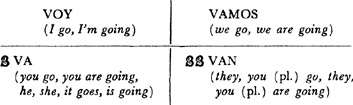
The past tense of “ir” is entirely different from the present but is easy to learn.
IR, to go
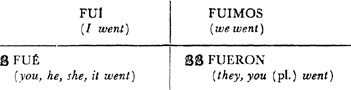
| Voy a la fiesta. I’m going to the party. | Fuí a la fiesta. I went to the party. |
| Voy a la clase. I’m going to the class. | Fuí a la clase. I went to the class. |
| Voy a México. I’m going to Mexico. | Fuí a Mexico. I went to Mexico. |
| Voy a su casa. I’m going to your house. | Fuí a su casa. I went to your house. |
| Voy a estudiar. I’m going to study. | Fuí a estudiar. I went to study. |
| Voy a nadar. I’m going to swim. | Fuí a nadar. I went to swim. |
| Voy a bailar. I’m going to dance. | Fuí a bailar. I went to dance. |
| Voy a pescar. I’m going to fish. | Fuí a pescar. I went to fish. |
NADAR, to swim
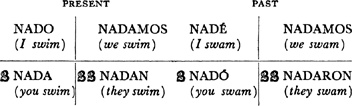
Voy a nadar. I’m going to swim (swimming).
Fuí a nadar. I went to swim (swimming).
Estoy nadando. I am swimming.
Voy a pescar. I’m going to fish (fishing).
| VINE, I came | HICE, I did |
|
VINO, you, he, she came did you, he, she come? |
HIZO, you, he, she did did you, he, she do? |
| – | – |
|---|---|
| la cosa, the thing | agua cristalina, crystal water |
| muchas cosas, many things | las palmeras, the palm trees |
| la vista, the view | ¡Qué undo! How lovely! |
| azul, blue | la playa, the beach |
| el cielo azul, the blue sky | septiembre, September |
| pintoresco, picturesque | octubre, October |
| hay, there is, there are, is there? are there? | una curva blanca, a white curve |
| magnifico, magnificent, excellent | bueno, good |
| el baño, the bath | ¿ Qué? (with accent), what? |
| la orquesta, the orchestra | que (without accent), that |
| la calle, the street | con mis primos, with my cousins |
| los jardines, the gardens |
¿ Fué? Did you go? |
| el cuarto, the room | Fuí. I went. |
| la lancha, the launch, the boat (small) | baño de sol, sun bath (bath of sun) |
| el barco, the ship, the boat (large) |
¿ Vino en barco? Did you come by boat? |
|
¿ Qué hizo? What did you do? |
Hice muchas cosas. I did many things. |
|
¿ Tuvo usted? Did you have? |
¿ Estuvo usted en Cuba? Were you in Cuba? |
¿ Estuvo usted en Cuba en septiembre o en octubre?
Estuve en Cuba en septiembre.
¿ Hizo muchas cosas interesantes en Cuba?
Sí, hice muchas cosas interesantes en Cuba.
¿ Qué hizo?
Hice muchas cosas. Fuí a nadar con mis amigos, fuí a tomar la cena en
muchos restaurantes y fuí a pescar en una lancha.
¿ Nadó usted mucho?
Sí, nadé mucho y tomé baños de sol en una playa blanca y tropical.
¿ Hay playas magníficas en Cuba?
Sí, en Cuba hay playas magníficas. Hay una playa linda que es una curva
blanca con una vista de agua cristalina y de palmeras y de cielo azul. ¡
Qué lindo!
¿ Son interesantes los restaurantes cubanos?
Sí, los restaurantes cubanos son muy interesantes. En unos restaurantes
hay orquestas excelentes y guitarristas que cantan canciones lindas.
¿ Fué a muchos restaurantes? Did you go to many
restaurants?
Sí, fuí a muchos restaurantes.
¿ Fué al cine en Cuba? Did you go to the movies in
Cuba?
Sí, fuí al cine.
¿ Fué a muchas playas diferentes?
Sí, fuí a muchas playas diferentes.
¿ Fué a muchas fiestas?
Sí, fuí a muchas fiestas.
¿ Fué a visitar a Luis?
Sí, fuí a visitar a Luis.
¿ Fué a pescar con Luis?
Sí, fuí a pescar con Luis.
¿ Fué a Cuba solo (sola)?
No, no fuí a Cuba solo (sola). Fuí a Cuba con mis primos.
¿ Tuvo usted un cuarto bueno en el hotel?
Sí, tuve un cuarto muy bueno en el hotel.
¿ Son pintorescas las calles en Cuba?
Sí, las calles son muy pintorescas en Cuba. En las calles hay hombres
que venden flores y frutas. En las casas hay patios y jardines con
canarios que cantan y con flores lindas.
¿ Cuándo vino usted a Nueva York?
Vine a Nueva York la semana pasada.
¿ Vino usted en avión?
No, no vine en avión.
¿ Fué a nadar con Luis?
Sí, fuí a nadar con Luis.
¿ Fué a las fiestas con Luis?
Sí, fuí a las fiestas con Luis.
¿ Fué en barco o en avión?
Fuí en barco.
¿ Vino usted en barco?
Sí, vine en barco.
Combine the words below in different ways to form as many sentences as you can. Be sure to use words from each of the columns in every sentence you form.
A
| 1 | 2 | 3 |
|
¿ Estuvo (Were you?) |
en el despacho | esta mañana |
| Estuve (I was) | en Cuba | con mis primos |
| en México | el verano pasado | |
| en casa | (last summer) | |
| con Luis | anoche | |
| en la clase | esta tarde | |
| en el parque (in the park) | toda la tarde (all afternoon) |
B
| 1 | 2 | 3 |
| Tuve (I had) | un accidente | en Cuba |
|
¿ Tuvo (Did you have?) |
catarro (a cold) | la semana pasada |
| una fiesta linda | linda | |
| un plan | excelente | |
| visitas (company) | el sábado (on Saturday) |
C
| 1 | 2 | 3 |
| Vine (I came) | a la clase | esta mañana |
|
¿ Vino (Did you come?) |
a la fiesta | anoche |
|
¿ Carlos vino (Charles came) |
a mi casa | ayer |
| al despacho | esta tarde | |
|
¿ María vino (Mary came) |
a Nueva York | en tren |
| a México | en barco (by boat) | |
|
¿ Vino Carlos (Did Charles come?) |
a Bolivia | |
| a la playa | en avión | |
| la semana pasada (last week) |
D
| 1 | 2 | 3 |
| Hice (I did) | una cosa, a thing | interesante |
|
¿ Hizo (Did you do?)
|
muchas cosas | interesantes |
|
Carlos hizo (Charles did)
|
el trabajo (the work) |
esta mañana en Cuba |
E
| 1 | 2 | 3 |
| Voy a (I’m going to) | trabajar | mañana |
|
¿ Va a (Are you going to?) |
estudiar | esta mañana |
| Vamos a (We are going to) | ver | un cine |
|
Van a (They are going to) |
pescar | en Canadá |
| Fuí a (I went to) | nadar | con mi primo |
| Fuimos a (We went to) | vender | el auto |
|
Fueron a (They went to) |
comprar | una casa |
|
Roberto va a |
hablar | por teléfono |
| (Robert is going to) | leer | la novela |
|
Alicia va a (Alice is going to) |
tomar | el tren |
|
Carlos va a (Charles is going to) |
estar | cansado (tired) |
In the above exercise (E) the forms of the verb “ir” (to go) have been used with the infinitive to show what people are going to do or did. Notice that the second column of this exercise is made up entirely of infinitives. In the exercise below (F) the forms of the verb “ir” (to go) are used with places to show where people are going or went, so the second column of the exercise is made up entirely of a list of places.
F
| 1 | 2 | 3 |
| Voy (I’m going, I go) | al cine | esta noche |
|
¿ Va (Are you going?) |
a la clase | mañana (tomorrow) |
| Vamos (We are going) | al campo | el sábado (on Saturday) |
|
Van (They are going, they go) |
al teatro | con frecuencia (often) |
| Fuí (I went) | a una fiesta | todas las semanas (every week) |
|
¿ Fué (Did you go?) |
a la ópera | con Carlos |
| Fuimos (We went) | al parque | esta tarde |
|
Fueron (They went) |
a la estación | con Marta |
Translate the following sentences into Spanish. Write out each sentence in Spanish, using the columns above as a guide. Check your sentences with the translations below this exercise.
Check your sentences with the correct translations below.
NOTE: Remember the subject pronouns are frequently dropped in Spanish. “Yo vine” means “I came,” but you almost always drop the pronoun “yo” and simply say, “Vine.” “¿ Vino usted a la fiesta?” means “Did you come to the party?” but you almost always drop the “usted” and simply say “¿ Vino a la fiesta?” You can either use the word “usted” or drop it. Both forms are absolutely correct and complete. However, you will find that in ordinary conversation Spanish-speaking people almost always drop subject pronouns.
| el hotel, the hotel | el tercer piso, the third floor |
| la llave, the key | el cuarto piso, the fourth floor |
| la cuenta, the bill | el quinto piso, the fifth floor |
| un cuarto con baño, a room with bath | el sexto piso, the sixth floor |
| un cuarto exterior, an outside room | el séptimo piso, the seventh floor |
| el cuarto, the room | el octavo piso, the eighth floor |
| el primer piso, the first floor | el noveno piso, the ninth floor |
| el segundo piso, the second floor | el décimo piso, the tenth floor |
Copy the material that is shown on the samples below on cards. Carry the cards with you and glance at them whenever you get a chance.
| Hice (I did) | una cosa interesante |
|
¿ Hizo (Did you do?) |
muchas cosas |
|
¿ Hizo Carlos (Did Charles do?) |
el trabajo |
|
Carlos hizo (Charles did) |
| Vine (I came) | a la fiesta |
|
¿ Vino (Did you come?) |
a mi casa |
|
Eduardo vino (Edward came) |
a la playa |
|
¿ Vino Eduardo (Did Edward come?) |
al despacho |
| Fuí a (I went to) | nadar (swimming) |
|
¿ Fué a (Did you go to?) |
pescar (fishing) |
| Fuimos a (We went to) | trabajar |
|
Fueron a (They went to) |
ver a mamá |
| Fuí (I went) | al cine |
|
Fué (Did you go?) |
al campo |
| Fuimos (We went) | a una fiesta |
|
Fueron (They went) |
a la estación |
here
are two verbs in Spanish that mean I have: “Tengo,” which
denotes possession, “Tengo un auto” (I have a car), and “he,”
which is an auxiliary or helping verb and which can be used only with
other verbs. “He preparado” (I have prepared).
HE means I have (only when used in combination with another verb).
HE PREPARADO, I have prepared.
PREPARADO is the past participle of the verb. In order to form the past participle of AR verbs, remove the AR from the infinitive and add ADO.
| INFINITIVES | present perfect tense |
| hablar, to talk | he hablado, I have talked |
| depositar, to deposit | he depositado, I have deposited |
| tomar, to take | he tornado, I have taken |
| bailar, to dance | he bailado, I have danced |
| trabajar, to work | he trabajado, I have worked |
| terminar, to finish | he terminado, I have finished |
| comenzar, to begin | he comenzado, I have begun |
| estar, to be | he estado, I have been |
| cantar, to sing | he cantado, I have sung |
| ganar, to earn | he ganado, I have earned |
| caminar, to walk | he caminado, I have walked |
| mandar, to send | he mandado, I have sent |
| esperar, to hope | he esperado, I have hoped |
| regresar, to return | he regresado, I have returned |
| contestar, to answer | he contestado, I have answered |
| cambiar, to change | he cambiado, I have changed |
| pescar, to fish | he pescado, I have fished |
| viajar, to travel | he viajado, I have traveled |
COMPRAR, to buy
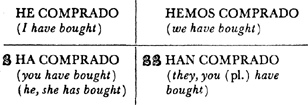
AUXILIARY VERB (Use only with other verbs)
HABER, to have
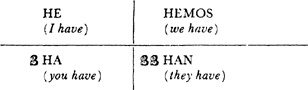
TRABAJAR, to work
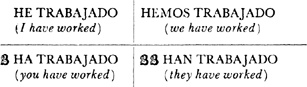
Notice that the past participle (trabajado) does not change. Only the auxiliary verbs “he, ha, hemos, han” change.
CAMINAR, to walk
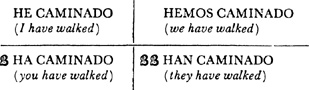
Notice that the past participle (caminado) does not change. It remains the same in the four forms.
GANAR, to earn, to win, to gain
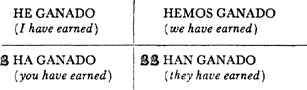
Notice that the past participle (ganado) does not change. It remains the same in the four forms. Only the auxiliary verbs “he, ha, hemos, han” change.
VIAJAR, to travel
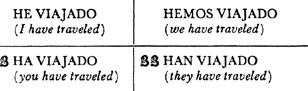
Words that are associated with traveling begin with the letters “via” (as in via Chicago).
VIAJAR, to travel
EL VIAJE, the trip
EL VIAJERO, the traveler
In order to form the past participle of “er” or of “ir” verbs. remove the “er” or the “ir” from the infinitive and add “ido.”
| INFINITIVES | PRESENT PERFECT TENSE |
| vender, to sell | he vendido, I have sold |
| comprender, to understand | he comprendido, I have understood |
| aprender, to learn | he aprendido, I have learned |
| convencer, to convince | he convencido, I have convinced |
| correr, to run | he corrido, I have run |
| ofender, to offend | he ofendido, I have offended |
| ofrecer, to offer | he ofrecido, I have offered |
| asistir, to attend | he asistido, I have attended |
| decidir, to decide | he decidido, I have decided |
| discutir, to discuss, to argue | he discutido, I have discussed |
| dividir, to divide | he dividido, I have divided |
| existir, to exist | he existido, I have existed |
| permitir, to permit | he permitido, I have permitted |
| persuadir, to persuade | he persuadido, I have persuaded |
| recibir, to receive | he recibido, I have received |
| sufrir, to suffer | he sufrido, I have suffered |
| vivir, to live | he vivido, I have lived |
| resistir, to resist | he resistido, I have resisted |
| oir, to hear | he oído, I have heard |
| leer, to read | he leido, I have read |
“Oído” and “leído” have an accent on the letter “í.”
VENDER, to sell
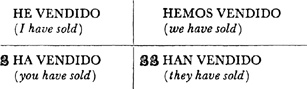
VIVIR, to live
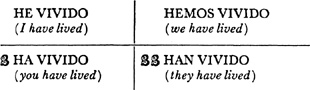
Remember that the third man form in all tenses stands for everybody and everything in the world except you.
HA CAMINADO means:
| you have walked | have you walked? |
| he has walked | has he walked? |
| she has walked | has she walked? |
| it has walked | has it walked? |
There are a few irregular past participles in Spanish. Two of them which you must know are “visto” (seen) and “escrito” (written).
VER, to see
HE VISTO (I have seen)
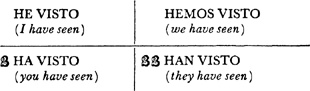
ESCRIBIR, to write
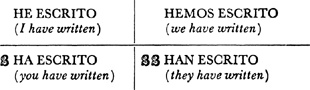
| este año, this year | He terminado. I have finished. |
| la familia, the family | también, too, also |
| el viaje, the trip | nunca, never |
| la América del Sur, South America | hoy, today |
| todo el día, all day (singular) | últimamente, lately |
| todos los días, every day (plural) | unos clientes, some clients |
| varios (masc), varias (fem., several | unos contratos, some contracts |
| varias veces, several times |
He visto. I have seen. He escrito. I have written. He leido. I have read. |
He ganado dinero. I have earned money.
He estado. I have been.
He estado ocupado. I have been busy.
¿Dónde ha estado? Where have you been?
¿Ha estado en Cuba? Have you been in Cuba?
¿Ha estado en Cuba este año? Hare you been in Cuba this
year?
Sí, he estado en Cuba este año.
¿Ha viajado en la América del Sur? Have you traveled in South
America?
Sí, he viajado mucho en la América del Sur.
¿Ha viajado en barco o en avión? Have you traveled by boat or by
plane?
He viajado en barco y también en avión.
¿Ha viajado con su familia?
Sí, he viajado con mi familia.
¿Ha hablado de sus viajes en la clase?
Sí, he hablado de mis viajes en la clase.
¿Ha estudiado la lección para la clase?
Sí, he estudiado la lección para la clase.
¿Ha preparado una composición para la clase?
Sí, he preparado una composición para la clase.
¿Ha terminado la composición?
Sí, he terminado la composición.
¿Ha trabajado mucho este año?
Sí, he trabajado mucho este año. He vendido muchos autos este año.
¿Ha leído el periódico hoy?
Sí, he leído el periódico hoy.
¿Ha leído una novcla esta semana?
Sí, he leido una novela esta semana.
¿Ha recibido muchas cartas últimamente?
Sí, he recibido muchas cartas últimamente.
¿Ha escrito muchas cartas hoy?
Sí, he escrito muchas cartas hoy.
¿Ha escrito una novela últimamente?
Ay no, no he escrito una novela últimamente. Nunca he escrito una
novela.
¿Ha visto a Roberto últimamente?
No, no he visto a Roberto últimamente.
¿Ha visto a María últimamente?
No, no he visto a María últimamente.
¿Dónde ha estado hoy?
He estado en el despacho hoy.
¿Ha estadomuy ocupado (a)?
Sí, he estado muy ocupado (a) todo el día. He trabajado mucho hoy. He
hablado por teléfono con varias personas, he visto a varios clientes, he
escrito muchas cartas y he leído unos contratos.
¿Ha ganado mucho dinero este año?
Sí, he ganado mucho dinero este año.
Combine the words below in different ways to form as many sentences as you can. Just be sure to use words from each of the columns in every sentence you form.
A
| 1 | 2 |
| He estudiado (I have studied) | 2 la lección |
| He preparado | la cena |
| He terminado (I have finished) | la composición |
| He viajado (I have traveled) | mucho |
| He tornado (I have had) | la cena |
| He trabajado | en el despacho |
| He contestado (I have answered) | el teléfono |
| He escrito (I have written) | la carta |
| He visto (I have seen) | a Roberto |
| He mandado (I have sent) | el cable |
| He cambiado (I have changed) | el dinero |
| He pescado | en Cuba |
| He nadado | en México |
| He vivido | en Guatemala |
| He vendido | lacasa |
| He convencido | a Roberto |
| He aprendido | el vocabulario |
| He asistido a (I have attended) | la clase |
Notice that “asistir” (to attend) must be followed by “a.”
When asking a question, you generally use the third man verb form.
B
| 1 | 2 |
|
¿Ha depositado (Have you deposites?) |
el dinero? |
|
¿Ha tornado |
la cena? |
|
¿Ha estudiado |
español? |
|
¿Ha mandado (Have you sent?) |
el cable? |
|
¿Ha trabajado |
hoy |
|
¿Ha pescado |
útimamente? |
|
¿Ha escrito |
la carta? |
|
¿Ha visto |
a Roberto últimamente? |
|
¿Ha leído |
el libro? |
|
¿Ha asistido a |
la clase? |
|
¿Ha vivido |
en Cuba? |
C
| 1 | 2 |
| Hemos vendido (We have sold) | la casa |
|
Han estudiado (They have studied) |
español |
| Hemos viaj do | mucho |
|
Han vivido |
en Venezuela |
| Hemos ofendido | a Carlos |
|
Han estado (They have been) |
ocupados |
| Hemos tomado (We have had) | la cena |
|
Han visto |
la comedia |
| Hemos terminado | el trabajo |
|
Han viajado |
mucho |
Translate the following sentences into Spanish. Write out each sentence in Spanish, using the columns above as a guide. Check your sentences with the correct translations below this exercise.
Check your sentences with the translations below.
The past participle is used as an adjective in Spanish.
| EXAMPLE: | he educado, I have educated |
| un hombre educado, an educated man |
When the past participle is used as an adjective it has the masculine, feminine, singular, and plural endings as adjectives do.
un hombre educado, an educated man
una mujer educada, an educated woman
hombres educados, educated men
mujeres educadas, educated women
Adjectives must agree with nouns in gender and number.
EXAMPLES:
la leche evaporada, the evaporated milk
la leche condensada, the condensed milk
la tierra cultivada, the cultivated earth
una colonia explorada, an explored colony
el papel perforado, the perforated paper
el programa variado, the varied program
los hombres educados, the educated men
los cuartos ventilados, the ventilated rooms
“He estado” is used with the present participle in the following manner:
he estado estudiando, I have been studying
he estado cantando, I have been singing
he estado trabajando, I have been working
he estado bailando, I have been dancing
he estado vendiendo, I have been selling
he estado aprendiendo, I have been learning
Don’t forget that “ing” equals “ando” (for “ar” verbs), “iendo” (for “er” and “ir” verbs).
mandando, sending
escribiendo, writing
| ahora, now | fácil, easy | hasta, until |
| hoy, today | difícil, difficult | mientras, while |
| aprisa, fast |
cada, each todaví, yet, still |
entonces, then |
Todavía no he terminado. I haven’t finished yet.
| AR VERBS | |
|
He (I have) |
trabajado mucho estudiado español terminado el trabajo |
|
¿Ha (Have you?) |
contestado la carta |
| ER AND IR VERBS | |
|
Hemos (We have) |
vivido en Cuba recibido la carta |
|
Han (They have) |
vendido la casa (Irr.) visto (seen) a Luis (Irr.) escrito un libro |
Copy the above material onto a card. Carry the card with you and glance at it whenever you get a chance.
la bicicleta
here
are some verbs in Spanish that are regular when you pronounce them but
that have irregularities in spelling when you write them. The only
purpose of the irregularities in spelling is to keep the verbs regular
in their pronunciation.
PAGAR, to pay
PAGUÉ, I paid
PAGÓ, you, he, she paid
Notice that “pagué” ends in “gué” instead of just “gé.” Verbs that end in “gar” in the infinitive end in “gué” in the first person past, in order to retain the hard sound of the “g.” The hard “g” is sometimes indicated in the same way in English. The “g” in “gentle” is soft, and in order to make it hard you spell it “gue” as in “guest.” The “gue” in Spanish is pronounced as the “gue” in “guest.”
| INFINITIVE | FIRST PERSON PAST | THIRD PERSON PAST |
| investigar, to investigate | investigué, I investigated |
investigó, you investigated |
| cargar, to load | cargué, I loaded |
cargó, you loaded |
| castigar, to punish | castigué, I punished |
castigó, you punished |
| fumigar, to fumigate | fumigué, I fumigated |
fumigó, you fumigated |
| irrigar, to irrigate | irrigué, I irrigated |
irrigó, you irrigated |
| llegar, to arrive | llegué, I arrived |
llegó you arrived |
| entregar, to deliver | entregué, I delivered |
entregó, you delivered |
| navegar, to sail | navegué, I sailed |
navegó, you sailed |
| jugar, to play (a game) | jugué, I played |
jugó, you played |
| apagar, to put out (the light) | apagué, I put out (the light) |
apagó, you put out (the light) |
| obligar, to oblige, force | obligué, I forced |
obligó, you forced |
| PUBLICAR, to publish | PUBLIQUÉ, I published |
PUBLICÓ, you, he, she published |
Notice that “publiqué” ends in “qué” instead of “cé.” Verbs that end in “car” in the infinitive end in “qué” in the first person past, in order to retain the hard “k” sound. The “qué” is pronounced “ke” as in “ kept.”
| INFINITIVE | FIRST PERSON PAST | THIRD PERSON PAST |
| atacar, to attack | ataqué, I attacked |
atacó, you attacked |
| fabricar, to manufacture | fabriqué, I manufactured |
fabricó, you manufactured |
| criticar, to criticize | critiqué, I criticized |
criticó, you criticized |
| sacrificar, to sacrifice | sacrifiqué, I sacrificed |
sacrificó, you sacrificed |
| practicar, to practice | practiqué, I practiced |
practicó, you practiced |
| marcar, to mark | marqué, I marked |
marcó, you marked |
| complicar, to complicate | compliqué, I complicated |
complicó, you complicated |
| duplicar, to duplicate | dupliqué, I duplicated |
duplicó, you duplicated |
| dedicar, to dedicate | dediqué, I dedicated |
dedicó, you dedicated |
| indicar, to indicate | indiqué, I indicated |
indicó, you indicated |
| lubricar, to lubricate | lubriqué, I lubricated |
lubricó, you lubricated |
| explicar, to explain | expliqué, I explained |
explicó, you explained |
| pescar, to fish | pesqué, I fished |
pescó, you fished |
| tocar, to play (an instrument) | toqué, I played |
tocó, you played |
| sacar, to take out | saqué, I took out |
saco, you took out |
PAGAR, to pay
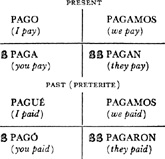
LLEGAR, to arrive, get here, get there
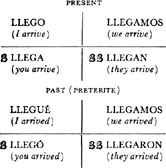
|
Voy a llegar. I’m going to arrive. |
|
|
He llegado. I have arrived. |
Estoy llegando. I am arriving. |
SACAR, to take out
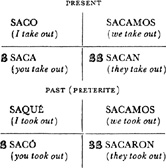
|
Voy a sacar.I’m going to take out. |
|
|
He sacado. I have taken out. |
Estoy sacando. I am taking out. |
| TOCAR, |
to play (an instrument) to knock on the door, to touch |
PRESENT
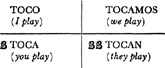
*PAST (PRETERITE)
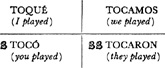
Voy a tocar el piano. I’m going to play the piano.
He tocado el piano. I have played the piano.
Estoy tocando el piano. I’m playing the piano.
*Notice that the word “preterite” appears after “past” above. “Preterite” is actually the name of this past tense.
| la bicicleta, the bicycle | futbol, football (Spanish spelling) |
| el vestido, the dress | ¿A qué hora? At what time? |
| su hermano, your brother | llegar, to arrive |
| la tienda, the store | sacar, to take out |
| su tío, your uncle | Tuve una fiesta. I had a party. |
| mi tía, my aunt | ayer, yesterday |
| la renta, the rent | para, in order to, for |
|
¿Quién ganó? Who won? |
para pagar, in order to pay |
| beisbol, baseball (Spanish spelling) | para comprar, in order to buy |
| ¡Que suerte! What luck! | jugar, to play (a game) |
| tarde, late | Jugué bridge. I played bridge. |
| temprano, early | siempre, always |
| a tiempo, on time | el cumpleaños, the birthday |
| ganar, to earn, gain, win |
¿Tuvo una fiesta? Did you have a party?
a las ocho, at eight o’clock
a las ocho y media, at eight-thirty (at eight and a half)
a las ocho y cuarto, at eight-fifteen (at eight and a quarter)
la cuenta, the bill, the check in a restaurant, the account
Papá paga las cuentas. Father pays the bills.
¿Va a comprar un sombrero su mamá?
Sí, mamá va a comprar un sombrero en la tienda.
¿Quién va a pagar la cuenta de la tienda?
Papá va a pagar la cuenta de la tienda. Papá siempre paga las
cuentas.
¿Va a sacar el dinero del banco su papá?
Sí, papá va a sacar el dinero del banco para pagar las cuentas.
¿Va a pagar la renta su papá?
Sí, papá va a pagar la renta.
¿Va a sacar dinero del banco su hermano?
Sí, mi hermano va a sacar dinero del banco para comprar una
bicicleta.
¿Sacó usted dinero del banco ayer?
Sí, ayer saqué dinero del banco para comprar un vestido.
¿A qué hora va a llegar su tío est a noche?
Mi tío va a llegar a las ocho.
¿Va a llegar tarde el tren?
No, el tren no va a llegar tarde. Va a llegar a tiempo.
¿Va a llegar temprano el tren?
No, el tren no va a llegar temprano. Va a llegar a tiempo.
¿A qué hora va a llegar el tren?
El tren va a llegar a las ocho.
¿Llegó usted a la clase tarde?
No, no llegué a la clase tarde. Llegué a tiempo, pero Roberto llegó
tarde porque es muy perezoso.
¿A qué hora llegó usted al teatro anoche?
Anoche lleguá al teatro a las ocho y media, pero Roberto llegó a las
ocho y cuarto. Roberto siempre llega a la clase tarde y al teatro
temprano.
¿Tuvo usted una fiesta anoche?
Sí, anoche tuve una fiesta para celebrar el cumpleaños de Roberto.
¿Jugó usted tenis en la fiesta?
Ay no, no jugué tenis en la fiesta.
¿Jugó usted beisbol en la fiesta?
Caramba, profesor, eso es ridículo. No jugué beisbol en la fiesta.
¿Jugó usted futbol en la fiesta?
Por favor, profesor, eso es absolutamente ridículo. No jugué futbol en
la fiesta.
¿Jugó usted canasta en la fiesta?
Sí, jugué canasta en la fiesta.
¿Quien ganó?
Roberto ganó. Roberto siempre gana.
¿Jugó usted bridge en la fiesta?
Sí, jugué bridge en la fiesta.
¿Quién gano?
Roberto ganó. ¡Qué suerte!
¿Tocó usted el piano en la fiesta?
No, no toqué el piano en la fiesta.
¿Quién tocó el piano?
Luis tocó el piano.
¿Toca bien Luis?
Sí, Luis toca el piano muy bien.
¿Tocó usted la guitarra?
Sí, toqué la guitarra.
¿Quién cantó?
Roberto cantó.
¿Canta bien Roberto?
Ay no, Roberto canta muy mal. Es catastrófico cuando Roberto canta.
Combine the words below in different ways to form as many sentences as you can. Be sure to use words from each of the columns in every sentence you form.
A
JUGAR, to play a game
| 1 | 2 | 3 |
| Jugué (I played) | tenis | esta tarde |
|
¿Jugó (Did you play?)
|
canasta | con Marta |
| Voy a jugar | beisbol | mañana |
|
¿Ha jugado (Have you played?)
|
futbol |
con Roberto en el club |
| Estoy jugando (I am playing) |
anoche ayer |
|
|
Roberto está jugando (Robert is playing) |
NOTE: The verb “jugar” is followed by “a,” but you will find that the “a” is often omitted.
B
LLEGAR, to arrive, to get to, to get here, there
| 1 | 2 | 3 |
| Llegué (I got to, arrived) |
a la clase al teatro |
tarde temprano |
|
¿Llegó (Did you get to, arrive?)
|
a su casa al despacho |
a tiempo esta mañana esta noche |
| Voy a llegar | a Cuba | a las ocho |
| He llegado | al cine | a las ocho y media |
|
Luis llegó
|
al teatro | a las ocho y cuarto |
|
El tren llegó
|
a la fiesta | a tiempo |
|
El avión va a llegar
|
a Nueva York | muy tarde |
C
TOCAR, to play (an instrument), to knock on the door, to ring, to touch
| 1 | 2 | 3 |
| Toqué (I played, rang, etc.) |
el piano el violín |
ayer hoy (today) |
|
¿Tocó (Did you play, ring, etc.?
|
el órgano la guitarra |
esta noche en la fiesta |
|
Luis tocó
|
la flauta | en la orquesta |
|
Quién tocó
|
(the flute) | en la banda |
| (Who played, etc? | el acordeón | muchas veces |
|
Roberto tocó
|
la puerta | (many times) |
| He tocado | (the door) | esta mañana |
| (I have played, etc.) | el timbre | |
| Estoy tocando (I am playing, etc.) |
(the doorbell) muchas veces |
|
|
El teléfono tocó
|
(many times) | |
| (The phone rang) |
D
PAGAR, to pay
| 1 | 2 | 3 |
| Pagué (I paid) | la cuenta en | el restaurante |
|
¿Pagó (Did you pay?) |
las cuentas | de la tienda |
|
Papá paga (Father pays) |
la renta | estemes (this month) |
|
Luis pagó (Louis paid) |
E
| 1 | 2 |
|
¿Cuánto pagó por
|
2 sombrero? |
| (How much did you pay for, | la casa? |
| how much did he pay for, | el auto? |
| how much did she pay for?) |
el radio? el vestido (the dress)? |
F
| 1 | 2 | 3 |
| Pagué | la cuenta | ayei |
|
Luis pagó |
las cuentas | la semana pasada |
|
Papá pagó |
(2) dos dólares | por la pipa |
|
Marta pagó |
(3) tres dólares | por el libro |
|
Alberto pagó |
(4) cuatro dólares | por las flores |
| Pagamos | (5) cinco dólares | por la blusa |
|
Pagaron |
(6) seis dólares | por los discos |
| (7) siete dólares | por el sombrero | |
| (8) ocho dólares | por la pipa | |
| (9) nueve pesos | por la canasta | |
| (10) diez pesos | por el perfume | |
| (15) quince centavos | por el periódico | |
| (20) veinte centavos | por la revista | |
| (25) veinticinco centavos | por el pan | |
| (30) treinta centavos | por la leche | |
| (40) cuarenta centavos | por las frutas | |
| (50) cincuenta centavos | por las rosas |
Accent the “o” in “dólares” firmly. Almost all students mispronounce this word.
Translate the following sentences into Spanish. Write out each sentence in Spanish, using the columns above as a guide. Check your sentences with the translations below this exercise.
Check your sentences with the translations below.
The three auxiliary verbs “ha,” “va,” and “esta” end in the letter “a.” In the third man form singular (when speaking of anybody but yourself) the auxiliary verbs end in “a.”
¿Ha trabajado mucho? Have you worked a lot?
¿Va a trabajar mucho? Are you going to work a lot?
¿Está trabajando mucho? Are you working a lot?
¿Ha pagado la cuenta? Have you paid the bill?
¿Va a pagar la cuenta? Are you going to pay the bill?
¿Está pagando la cuenta? Are you paying the bill?
¿Ha estudiado mucho?
¿Va a estudiar mucho?
¿Está estudiando mucho?
Keep in mind that in the third man verb form auxiliary verbs (singular) end in “a.” It makes conversation much easier.
| MASCULINE SINGULAR | MASCULINE PLURAL |
| este hombre, this man | estos hombres, these men |
| este barco, this ship | estos barcos, these ships |
| este sombrero, this hat | estos sombreros, these hats |
| este perro, this dog | estos perros, these dogs |
| este gato, this cat | estos gatos, these cats |
| este papel, this paper | estos papeles, these papers |
| este mes, this month | estos meses, these months |
| este año, this year | estos años, these years |
| ese hombre, that man | esos hombres, those men |
| ese barco, that ship | esos barcos, those ships |
| ese papel, that paper | esos papeles, those papers |
| ese año, that year | esos años, those years |
| ese doctor, that doctor | esos doctores, those doctors |
| ese caballo, that horse | esos caballos, those horses |
| FEMININE SINGULAR | FEMININE PLURAL |
| esta blusa, this blouse | estas blusas, these blouses |
| esta casa, this house | estas casas, these houses |
| esta semana, this week | estas semanas, these weeks |
| esta mesa, this table | estas mesas, these tables |
| esa mesa, that table | esas mesas, those tables |
| esa flor, that flower | esas flores, those flowers |
| esa pluma, that pen | esas plumas, those pens |
| esa taza, that cup | esas tazas, those cups |
“Este” means “this” when it is used as a masculine adjective that modifies a noun.
EXAMPLES:
este hombre, this man
este mes, this month
“Esto” means “this” when it is used as a pronoun referring to something that is neither masculine nor feminine.
EXAMPLES:
Esto es bueno. This is good.
Esto es malo. This is bad.
“Este” is an adjective. (“Este” is used as a pronoun only when it means “this one,” masc.)
“Esto” is a pronoun.
LOS NÚMEROS (THE NUMBERS)
0 cero
1 uno
2 dos
3 tres
4 cuatro
5 cinco
6 seis
7 siete
8 ocho
9 nueve
10 diez
11 once
12 doce
13 trece
14 catorce
15 quince
16 diez y seis
17 diez y siete
18 diez y ocho
19 diez y nueve
20 veinte
21 veintiuno
22 veintidós
23 veintitrés
24 veinticuatro
25 veinticinco
26 veintiséis
27 veintisiete
28 veintiocho
29 veintinueve
30 treinta
31 treinta y uno
32 treinta y dos, etc.
40 cuarenta
41 cuarenta y uno
42 cuarenta y dos, etc.
50 cincuenta
51 cincuenta y uno, etc.
60 sesenta
61 sesenta y uno, etc.
70 setenta
71 setenta y uno, etc.
80 ochenta
81 ochenta y uno, etc.
90 noventa
91 noventa y uno, etc.
100 cien
101 ciento uno
102 ciento dos
103 ciento tres
104 ciento cuatro, etc.
150 ciento cincuenta
175 ciento setenta y cinco
200 doscientos
300 trescientos
400 cuatrocientos
500 quinientos
600 seiscientos
700 setecientos
800 ochocientos
900 novecientos
1,000 mil
1,300 mil trescientos
2,000 dos mil, etc.
50,000 cincuenta mil
1,000,000 un millón
$2,000,000 dos millones de dólares.
las palmeras
erb”
is derived from the Latin “verbum,” which means “word.” The verb is the
master word, the king of words. It is the word that governs, dominates,
and breathes life into a sentence.
You cannot speak Spanish correctly without being able to use verbs in all their forms. This is not difficult, however, because Spanish verbs follow a beautiful logic; they are clear, concise, well ordered, and almost perfectly organized.
You have already learned the most useful and important forms of the verb. But before you proceed with other material it is good to assemble all the tenses of the verbs that you already know into one lesson, so that you can review what you have studied. Master the verbs.
In reviewing, you will find one complete “ar” verb in the left-hand column below, and one complete “er” verb in the right-hand column below. The endings and the auxiliary verbs (estoy, he, etc.) have been printed in capital letters so that you can recognize them easily.
| AR VERB CAMINAR, to walk | ER VERB APRENDER, to learn |
| PRESENT | PRESENT |
| camin O, I walk | aprendO, I learn |
|
caminA, you walk, he, she walks |
aprendE, you learn |
| aprendEMOS, we learn | |
| caminAMOS, we walk |
aprendEN, they learn |
|
caminAN, they, you (pl.) walk |
| PAST (PRETERITE) | PAST (PRETERITE) |
| caminÉ, I walked | aprendĺ, I learned |
|
caminÓ, you walked |
aprendIÓ, you learned |
| caminAMOS, we walked | aprendlMOS, we learned |
|
caminARON, they walked |
aprendlERON, they learned |
| FUTURE | FUTURE |
| VOY A caminAR, I’m going to walk | VOY A aprendER, I’m going to learn |
|
VA A caminAR, you are going to walk |
VA A aprendER, you are going to learn |
| VAMOS A caminAR, we are going to walk | VAMOS A aprendER, we are going to learn |
|
VAN A caminAR, they are going to walk |
VAN A aprendER, they are going to learn |
| PRESENT PERFECT | PRESENT PERFECT |
| HE caminADO, I have walked | HE aprendIDO, I have learned |
|
HA caminADO, you have walked |
HA aprendIDO, you have learned |
| HEMOS caminADO, we have walked | HEMOS aprendIDO, we have learned |
|
HAN caminADO, they have walked |
HAN aprendIDO, they have learned |
| PRESENT PROGRESSIVE | PRESENT PROGRESSIVE |
| ESTOY caminANDO, I am walking | ESTOY aprendIENDO, I am learning |
|
ESTÁ caminANDO, you are walking |
ESTÁ aprendIENDO, you are learning |
| ESTAMOS caminANDO, we are walking | ESTAMOS aprendIENDO, we are learning |
|
ESTÁN caminANDO, they are learning |
ESTÁN aprendIENDO, they are walking |
Following is a list of infinitives for you to put into all tenses and forms. Use the model verbs above as a guide.
1. Remove “ar” from each of the following infinitives and write out all the tenses as shown in “caminar,” above. All the letters and words that are printed in capital letters in “caminar” must be added to each “ar” verb.
| ganar, to win, earn, gain | llorar, to cry |
| limpiar, to clean | gritar, to shout, to scream |
| mandar, to send | tomar, to take |
| manejar, to drive (a car) | cantar, to sing |
| pintar, to paint | cocinar, to cook |
| planchar, to iron | terminar, to finish |
| lavar, to wash | contestar, to answer |
| saltar, to jump | arreglar, to arrange |
| cuidar, to take care of | nadar, to swim |
| ayudar, to help, to aid | trabajar, to work |
| alquilar, to rent | hablar, to speak, to talk |
| dudar, to doubt | comprar, to buy |
| cambiar, to change | |
| pasar, to pass, to spend time, to happen | |
| regresar, to return, to come back, to get back | |
| dejar, to let, to allow, to leave (a thing or person) | |
| llevar, to wear, to carry, to take (someone someplace) | |
| bajar, to go down, to get off (a train, plane, bus, etc.) |
2. Remove “er” from each of the following infinitives and write out all the tenses as shown in “aprender” above. All the letters and words that are printed in capital letters in “aprender” must be added to each “er” verb.
| vender, to sell | comprender, to understand |
| correr, to run | sorprender, to surprise |
| comer, to eat | prometer, to promise |
| beber, to drink | barrer, to sweep |
| coser, to sew |
“Ir” and “er” verbs are identical in all their forms except one. The first person present of “er” verbs ends in EMOS in the plural.
EXAMPLE: “aprendemos” (WE LEARN). HOWEVER, THE FIRST PERSON PRESENT OF “IR” VERBS ENDS IN “IMOS” IN THE PLURAL.
EXAMPLE: vivimos, we live.
Remove “ir” from each of the following infinitives and write out all the tenses as shown in “aprender” above, but remember to change the first person plural ending of the present to “imos.”
| vivir, to live | recibir, to receive |
| decidir, to decide | persuadir, to persuade |
| dividir, to divide | asistir, to attend |
| subir, to go up | discutir, to discuss, to argue |
| resistir, to resist | interrumpir, to interrupt |
You probably will be tempted to skip some of the verbs above because there are so many of them. Resist the temptation. This is by far the most important exercise in the book. MASTER THE VERBS.
The three most important things to remember about verbs are:
1. IN THE PAST TENSE, END ALL VERBS IN “Ó” WHEN SPEAKING ABOUT ANYBODY BUT YOURSELF (SINGULAR).
2. END ALL AUXILIARY VERBS IN “A” WHEN SPEAKING ABOUT ANYBODY BUT YOURSELF (SINGULAR).
va a comprar, anybody (except me) is going to buy
ha comprado, anybody (except me) has bought
está comprando, anybody (except me) is buying
3. VERBS THAT APPEAR IN QUESTIONS ARE GENERALLY IN THE THIRD MAN VERB FORM IN ALL TENSES. You usually ask questions about other people and not about yourself.
|
he estado, I have been |
este año, this year |
|
una taza de café, a cup of coffee |
contestar, to answer |
|
el trabajo, the work |
siempre, always |
|
por dos años, for two years |
hermano, brother |
|
Aprendí a nadar. I learned to swim. |
|
|
Aprendí a manejar el auto. I learned to drive the car. (Use “a” when “aprender” is followed by a verb.) |
|
|
Aprendí las palabras. I learned the words. |
|
|
He visto. I have seen (irregular). |
|
|
He escrito. I have written (irregular). |
|
Translate the following sentences into Spanish. Check your sentences with the correct translations that follow this exercise.
Check your sentences with the following translations.
PRESENT PERFECT
| He trabajado, | I have worked |
|
Ha trabajado, |
you have worked, he, she has worked |
| Hemos trabajado, | we have worked |
|
Han trabajado, |
they, you (pl.) have worked |
PAST PERFECT
| Había trabajado, | I had worked |
|
Había trabajado, |
you had worked |
| Habíamos trabajado, | we had worked |
|
Habían trabajado, |
they had worked |
Remember that “mos” is the symbol of all first person plurais and “n” is the symbol of all third man form plurals. All verbs end in “mos” in the first person plural, and in “n” in the third man plural.
plural first person = MOS
plural third man form = N
Notice that in order to form the plural of “había” you just add “mos” or “n” to the singular.
| SINGULAR | PLURAL | |
| había + mos | = | habíamos |
| había + n | = | habían |
PRESENT PROGRESSIVE
| Estoy trabajando, | I am working |
|
Está trabajando, |
you are working |
| Estamos trabajando, | we are working |
|
Están trabajando, |
they are working |
PAST PROGRESSIVE
| Estaba trabajando, | I was working |
|
Estaba trabajando, |
you were working |
| Estábamos trabajando, | we were working |
|
Estaban trabajando, |
they were working |
| SINGULAR | PLURAL | |
| estaba + mos | = | estábamos |
| estaba + n | = | estaban |
| yo, I | nosotros, we (masculine) |
| usted, you | nosotras, we (feminine) |
| él, he | ustedes, you (plural) |
| ella, she | ellos, they (masculine) |
| ellas, they (feminine) |
La América del Sur
PRESENT TENSE
| AR verb | ER verb |
| hablar, to speak | vender, to sell |
| hablO, I speak | vendO, I sell |
|
hablA, you speak |
vendE, you sell |
| hablAMOS, we speak | vendEMOS, we sell |
|
hablAN, they speak |
vendEN,
they sell |
The endings of the above verbs have been printed in capital letters to remind you that in the present tense, the endings of “ar” verbs are based on the letter “a” and the endings of “er” verbs are based on the letter “e,” except for the first person singular, which ends in “o.” In chart form:
PRESENT TENSE
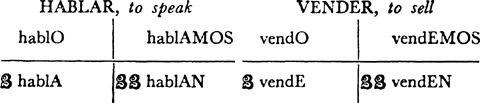
There are some verbs that are completely regular in their endings but that change in the body (root, stem) of the verb. These verbs are known as “Radical Changing Verbs,” which means root or stem changing verbs.
There are some verbs in which the letter “e” changes to “ie” in the stem.
EXAMPLE:
PENSAR, to think
| pIEnso, I think | pensamos, we think |
|
pIEnsa, you think |
pIEnsan, they think |
The changes have been printed in capital letters for your convenience. Notice that the “e” changes to “ie” in all forms of the present except the first person plural. The “e” remains an “e” in the infinitive and in the first person plural and changes to “ie” in the other forms. Following is a chart that shows the connection between the infinitive and the first person plural.
pensar
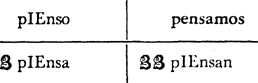
THE FIRST PERSON PLURAL DOES NOT CHANGE.
The letter “e” does not change to “ie” unless the stress or accent of the word falls upon it. The letter “e” does not receive the stress in “pensamos” or in “pensar,” consequently the “e” does not change to “ie” in these two forms.
CERRAR, to close, to shut
| cIErro, I close | cerramos, we close |
|
cIErra, you close |
cIErran, they close |
IN CHART FORM:
cerrar
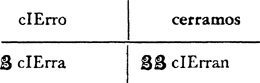
THE FIRST PERSON PLURAL DOES NOT CHANGE.
These radical changing verbs are regular in the past and in all the other tenses you have learned.
| RADICAL CHANGING “AR” VERB | RADICAL CHANGING “ER” VERB |
| CERRAR, to close, to shut | ENTENDER, to understand |
| PRESENT (IRREGULAR) | PRESENT (IRREGULAR) |
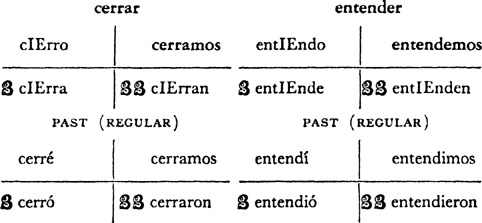
| Voy a cerrar | Voy a entender |
| (I’m going to close) | (I’m going to understand) |
| He cerrado | He entendido |
| (I have closed) | (I have understood) |
| Estoy cerrando | Estoy entendiendo |
| (I am closing) | (I am understanding) |
NOTICE THAT THE “E” CHANGES TO “IE” ONLY IN THE PRESENT TENSE.
There are some verbs in which the letter “o” changes to “ue” in the stem or body of the verb.
EXAMPLE:
ENCONTRAR, to find, to meet, to encounter
| encuentro, I find | encontramos, we find |
|
encuentra, you find |
encuentran, they find |
IN CHART FORM:
encontrar
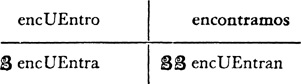
THE FIRST PERSON PLURAL DOES NOT CHANGE. RECORDAR, to remember, to recall
| recuerdo, I remember | recordamos, we remember |
|
recuerda, you remember |
recuerdan, they remember |
IN CHART FORM:
recordar
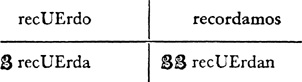
THE FIRST PERSON PLURAL DOES NOT CHANGE. CONTAR, to count, to recount, to tell (a story)
| cuento, I count | contamos, we count |
|
cuenta, you count |
cuentan, they count |
IN CHART FORM:
contar
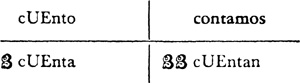
THE FIRST PERSON PLURAL DOES NOT CHANGE.
In one verb the letter “u” changes to “ue.”
jugar, to play (a game)
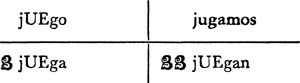
All these rules and examples can be boiled down to:
I. E = IE O = UE
THESE CHANGES OCCUR ONLY IN THE PRESENT TENSE.
THE FIRST PERSON PLURAL OF THE PRESENT TENSE DOES NOT CHANGE.
el chiste, the joke
chistoso, funny
el cuento, the story
Elena, Helen
la puerta, the door
la ventana, the window
la semana pasada, last week
después (de), after
después de la cena, after dinner
después del almuerzo, after lunch
antes de la clase, before the class
¿Cuánto cuesta? How much does it cost?
¿Cuánto vale? How much is it worth?
el nombre, the name
el nümero de teléfono, the telephone number
la dirección, the address
también, also
¿Quién ganó? Who won?
When you ask the price of things in stores you can use either of the above expressions, but “¿Cuánto vale?” is preferred.
| juego, I play (games) | cuento, I tell (a story) |
| pienso, I think | conté, I told |
| cierro, I close | abrir, to open (regular verb) |
| entiendo, I understand | abro, I open |
| recuerdo, I remember |
¿Juega usted tenis en la clase?
No, no juego tenis en la clase. Juego tenis en el club.
¿Juega usted futbol en la clase?
Ay no, eso es imposible, no juego futbol en la clase.
¿Juega usted bridge en la clase?
No, no juego bridge en la clase. Es imposible.
¿Habla usted español en la clase?
Sí, hablo español en la clase.
¿Piensa usted en español en la clase?
Sí, pienso en español en la clase.
¿Piensa mucho en la clase?
Sí, pienso mucho en la clase.
¿Cierra usted la puerta de la casa?
Sí, cierro la puerta de la casa.
¿Cierra usted las ventanas?
No, no cierro las ventanas. Abro las ventanas.
¿Entiende usted la conversación en la clase?
Sí, entiendo la conversación en la clase.
¿Entiende usted español?
Sí, entiendo español.
¿Entiende usted italiano?
No, no entiendo italiano.
¿Entiende usted la lección?
Sí, entiendo la lección.
¿Recuerda usted el vocabulario de la semana pasada?
Sí, recuerdo el vocabulario de la semana pasada.
¿Recuerda usted el nombre del doctor?
Sí, recuerdo el nombre del doctor.
¿Recuerda usted el número de teléfono de Roberto?
Sí, recuerdo el número de teléfono de Roberto.
¿Recuerda usted la dirección de Enrique?
No, no recuerdo la dirección de Enrique.
¿Cuenta usted cuentos en la clase?
Sí, cuento cuentos en la clase.
¿Cuenta cuentos el profesor?
Sí, el profesor cuenta cuentos muy interesantes.
¿Cuenta chistes el profesor?
Sí, el profesor cuenta chistes.
¿Cuenta chistes Roberto?
Sí, Roberto cuenta muchos chistes.
Combine the words below in different ways to form as many sentences as you can. Be sure to use words from each of the columns in every sentence you form.
A
| 1 | 2 |
|
¿Juega usted (Do you play?) |
tenis |
| Juego (I play) | canasta |
| Jugamos (We play) | bridge |
|
¿Juegan (Do you (pl.), they play?) |
beisbol |
| Jugué (I played) | futbol |
|
¿Jugó usted (Did you play?) |
golf |
| Jugamos (We played) | |
|
Jugaron (They played) |
|
| He jugado (I have played) |
B
| 1 | 2 |
|
¿Entiende usted (Do you understand?) |
la lección |
| Entiendo (I understand) | el vocabulario |
| Entendemos | español |
|
Entienden |
italiano |
C
| 1 | 2 |
|
¿Quién abrió (Who opened?) |
la ventana |
|
Carlos abrió (Charles opened) |
la puerta |
| Abrí (I opened) | las ventanas |
| Abrimos (We opened) | las puertas |
| Abrieron
(They opened) |
|
|
¿Quién cerró (Who closed?) |
|
| Cerré (I closed, I shut) | |
| Cierro (I close, I shut) | |
|
Carlos cierra (Charles closes) |
D
| 1 | 2 |
|
¿Recuerda (Do you remember?) |
el número de teléfono |
| Recuerdo (I remember) | (the telephone number) |
| No recuerdo (I don’t remember) | la dirección (the address) |
|
¿No recuerda (Don’t you remember?) |
el poema |
Translate the following sentences into Spanish. Write out each sentence in Spanish, using the columns above as a guide. Check your sentences with the translations below this exercise.
Check your sentences with the translations below.
Remember that you can either use the word “usted” or drop it. You can either say “¿Entiende usted?” (Do you understand?) or simply “¿Entiende?” Both of these forms are correct, and both are used in ordinary conversation.
When “antes de” (before) and “después de” (after) are followed by verbs, the infinitive form is used.
antes de estudiar, before studying
antes de tomar la cena, before having dinner
antes de contar el cuento, before telling the story
antes de ir, before going
antes de ver, before seeing
después de recibir la carta, after receiving the letter
después de ver a Elena, after seeing Helen
después de cerrar la puerta, after closing the door
“Antes de” and “después de” are not necessarily followed by verbs. They can be followed by nouns.
antes de la cena, before dinner
antes del desayuno, before breakfast
antes del almuerzo, before lunch
después de la fiesta, after the party
después de la clase, after the class
“Comprender” and “entender” both mean to understand. They are interchangeable. It’s a good idea to study “entender” well, since it is radical changing. Remember that the present tense is:
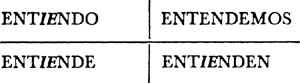
“Pensar” (to think) expresses the act of thinking, but don’t forget that if you wish to express an opinion and say, “I think,” you must use the verb “creer” (to believe).
Creo que es interesante. I think that it’s interesting.
Creo que sí. I think so.
Creo que no. I think not.
You have learned that there is a large group of nouns that are identical to the first person present of their corresponding verbs.
EXAMPLES:
| INFINITIVES | PRESENT | NOUNS |
| cantar | canto, I sing | el canto, the song |
| trabajar | trabajo, I work | el trabajo, the work |
| cepillar | cepillo, I brush | el cepillo, the brush |
| dibujar | dibujo, I draw | el dibujo, the drawing |
| diseñar | diseño, I design | el diseño, the design |
When a verb is irregular its corresponding noun is irregular in the same way.
EXAMPLES:
| INFINITIVES | PRESENT | nouns |
|---|---|---|
| gobernar, to govern | gobierno, I govern | el gobierno, the government |
| helar, to freeze | hielo, I freeze | el hielo, the ice |
| contar, to recount, to tell | cuento, I tell | el cuento, the story |
| volar, to fly | vuelo, I fly | el vuelo, the flight |
| consolar, to console | consuelo, I console | el consuelo, the consolation |
| descontar, to discount | descuento, I discount | el descuento, the discount |
| soltar, to untie, to let loose | suelto, I let loose | el suelto, loose change |
| soñar, to dream | sueño, I dream | el sueño, the dream |
| tronar, to thunder | trueno, I thunder | el trueno, the thunder |
| encontrar, to encounter | encuentro, I encounter | el encuentro, the encounter |
| recordar, to remember | recuerdo, I remember | el recuerdo, the remembrance |
| jugar, to play | juego, I play | el juego, the game |
| apretar, to squeeze | aprieto, I squeeze | un aprieto, a jam, a tight spot |
There are some feminine nouns that are identical to the third person singular of their corresponding verbs.
EXAMPLES:
| INFINITIVES | PRESENT | NOUNS |
|---|---|---|
| apostar, to bet | apuesta, he bets | la apuesta, the bet |
| mostrar, to show | muestra, he shows | la muestra, the sample |
| probar, to taste, to prove | prueba, he proves | la prueba, the proof |
| rodar, to roll | rueda, he rolls | la rueda, the wheel |
| contar, to count | cuenta, he counts | la cuenta, the bill, check in a restaurant |
ow
that you have completed thirty lessons, it’s time to check your progress
again.
Fill in each blank below, translating the words under the blanks. You should be able to complete this test in five minutes.
raro (strange)
1. (stranger):
2. (the strangest):
bonito (pretty)
3. (prettier):
4. (the prettiest):
grande (big)
5. (bigger):
6. (the biggest):
alto (tall)
7. (taller):
8. (the tallest):
gordo (fat)
9. (fatter):
10. (the fattest):
delgado (thin)
10. (thinner):
12. (the thinnest):
feo (ugly)
13. (uglier):
14. (the ugliest):
bueno (good)
15. (better):
16. (the best):
malo (bad)
17. (worse):
18. (the worst):
bonita (pretty, fem.)
17. (prettier, fern.):
18. (the prettiest, fern.):
Now check your answers with those below. If you made less than four errors you are doing exceptionally good work. If you made more than ten errors, however, you have not learned this material carefully enough.
Now comes the important verb test. Fill in the blanks with the Spanish equivalents of the following English words. You should be able to complete this test in twenty minutes.
I work.
They bought.
We take.
Do you speak?
I invite.
Edward sings.
We visit.
I have finished.
I’m going to pass.
I am singing.
I have received.
Mary is writing.
I have understood.
We have sold.
Have you read?
I heard.
I saw.
Where are you?
She has invited.
They are reading.
I went.
I had bought.
She was writing.
Did you go?
I had an accident.
I prepare.
Have you bought?
They have invited.
He smokes.
He is swimming.
I paid.
He lives.
They wear.
Who paid?
I hope.
I hope to see.
We hope to buy.
I close.
I tell (a story).
We find.
I play (a game).
She is going to buy.
They are working.
We are studying.
They are studying.
She came.
They did.
We went.
I had to work.
He had to see.
Check your answers with those below.
This was a very difficult test. If you made no more than five errors, you passed the test with flying colors. You are a first class student. Keep up the good work.
If you made twenty or more errors, you should review Lessons 20–30 before you go on.
 asically,
there are three main groups of verbs in Spanish.
asically,
there are three main groups of verbs in Spanish.
I call the irregular verbs the nonconformists because they don’t conform to the rules and frequently go off half cocked in different directions.
The nonconformist verbs have a sort of club in which they accept only peculiar verbs as members of their society. If a verb has an outstanding idiosyncrasy, it can belong to the nonconformist club. If a verb dares to be regular or even radical changing, the nonconformists will have nothing to do with it, tagging it as “too common.”
“Ir” (to go) is the president of the nonconformist club because it is so completely irregular that you can’t even recognize its different tenses unless you know them, which you do.
The nonconformist club consists of eighteen important members and a few hangers-on.
PAST TENSE (PRETERITE)
You already know the past tense of most of the nonconformist verbs. Of the eighteen verbs, eleven end in “e” in the first person singular of the past and in “o” in the third man form singular of the past. You have already studied these verbs and know that the “e” and the “o” are not accented.
The past tense endings of eleven nonconformist verbs are:
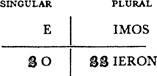
This is the most important chart in the book. It puts the past tense of irregular verbs snugly in your pocket.
Remember that these are the endings of eleven nonconformist verbs. Some are “ar” verbs, some are “er,” and some are “ir” verbs. But they all have the same past tense endings as in the chart above.
PAST TENSE (PRETERITE)
GROUP I
For your convenience, the letters that should be stressed will be in heavy type in the following lists.
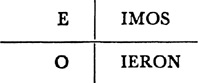
| E | O | IMOS | IERON | |
| 1. tener, to have | tuve |
tuvo |
tuvimos |
tuvieron |
| 2. estar, to be | estuve |
estuvo |
estuvimos |
estuvieron |
| 3. andar, to walk | anduve |
anduvo |
anduvimos |
anduvieron |
| 4. poner, to put | puse |
puso |
pusimos |
pusieron |
| 5. poder, to be able | pude |
pudo |
pudimos |
pudieron |
| 6. saber, to know | supe |
supo |
supimos |
supieron |
| 7. venir, to come | vine |
vino |
vinimos |
vinieron |
| 8. hacer, to do | hice |
hizo |
hicimos |
hicieron |
| 9. querer, to want | quise |
quiso |
quisimos |
quisieron |
| 10. decir, to say | dije |
dijo |
dijimos |
dijeron |
| 11. traer, to bring | traje |
trajo |
trajimos |
trajeron |
Notice that all the verbs end in “ieron” in the third person plural with the exception of the last two verbs, “dijeron” and “trajeron.” In these two verbs the letter “i” is omitted.
Notice that in the eleven verbs above, the first person of each verb sets the pattern for the entire past tense of the verb.
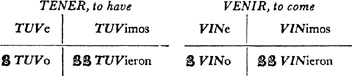
Once you know that “TUVE” is the first person singular, you can be sure that the three other forms will begin with “TUV.” Only the endings change. Once you establish that the first person of “venir” is “VINE,” you know that all the other forms must begin with “VIN.”
These verbs play a kind of follow-the-leader in their irregularities.
Two of the eighteen nonconformist verbs are completely regular in the past.
| 12. salir, to go out | salí |
salió |
salimos |
salieron |
| 13. ver, to see | ví |
vió |
vimos |
vieron |
In two of the eighteen verbs the letter “i” changes to “y” when it appears between vowels.
| 14. oír, to hear | oí |
oyó |
oímos |
oyeron |
| 15. caer, to fall | caí |
cayó |
caímos |
cayeron |
Although “dar” (to give) is an “ar” verb it has “er” endings in the past tense.
| 16. dar, to give | dí |
dió |
dimos |
dieron |
You already know the past of “ir.” And if you know the past of “ir,” you know the past of “ser” because they are absolutely identical.
| 17. ir, to go | fuí |
fué |
fuimos |
fueron |
| 18. ser, to be | fuí |
fué |
fuimos |
fueron |
IMPERFECT TENSE OF SABER AND QUERER
When you wish to say “I wanted” in Spanish you generally use the imperfect tense, “quería.” The imperfect is a past tense that you will learn later on.
IMPERFECT
QUERER, to want, to love
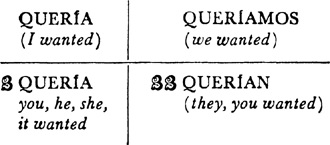
Notice that there is no differenuce between the first person and the third man form in the singular. The entire singular is “quería,” which means: I wanted, you wanted, he wanted, she wanted, it wanted.
When you wish to say, “I knew” in Spanish you use the imperfect tense “sabía.”
IMPERFECT
SABER, to know
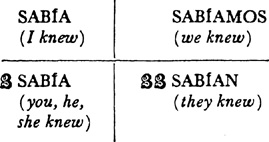
Notice that there is no difference between the first person and the third man form in the singular. “Sabía” means: I knew, you knew, he knew, she knew.
PRESENT TENSE OF NONCONFORMIST VERBS
GROUP I
Of the eighteen members, nine end in “go” in the first person singular of the present.
| FIRST PERSON SINGULAR, PRESENT | INFINITIVE |
| TENGO, I have | TENER, to have |
| VENGO, I come | VENIR, to come |
| PONGO, I put | PONER, to put |
| TRAIGO, I bring | TRAER, to bring |
| CAIGO, I fall | CAER, to fall |
| DIGO, I say | DECIR, to say |
| HAGO, I do, I make | HACER, to do, to make |
| OIGO, I hear | OÍR, to hear |
| SALGO, I go out | SALIR, to go out |
The best way to learn these verb forms is by reciting them in groups of threes. Recite them out loud and learn them just as you would learn a poem.
Stress the heavy-type letters firmly.
| tengo | traigo | hago |
| vengo | caigo | salgo |
| pongo | oigo | digo |
Of these nine verbs, five are regular in the present, except for the first person singular. They are:
PRESENT TENSE
HACER, to do, to make
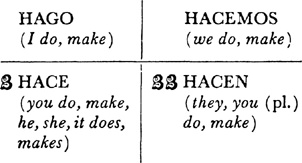
PONER, to put
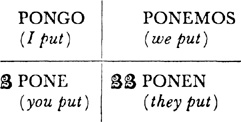
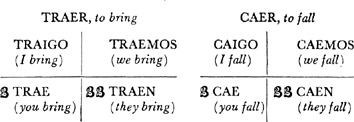
SALIR, to go out, to leave (a place)
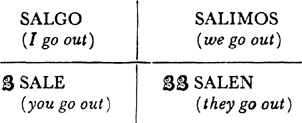
Two of the nine verbs that end in “go” in the first person singular present are radical changing in all forms except the first person singular present. In these verbs the “e” changes to “ie.”
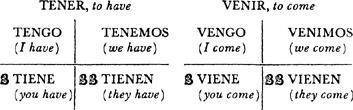
And the last two verbs are irregular in their own sweet way.
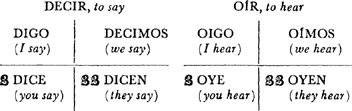
Actually, in “oír” the letter “i” changes to “y,” obeying the
AGE-OLD RULE: The letter “i” changes to “y” when it appears between two vowels.
GROUP II
Of the eighteen nonconformists, four end in “oy” in the first person singular of the present. They are:
| VOY, I go | SOY, I am |
| DOY, I give | ESTOY, I am |
1. You already know that the present of “ir” is:
IR, to go
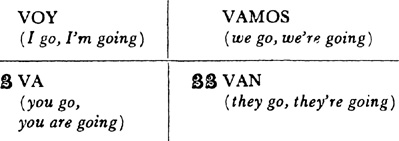
2. You know that the present of “estar” is:
ESTAR, to be (where, how)
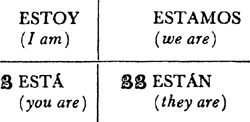
3. The present of “dar” is:
DAR, to give
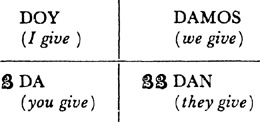
4. “Ser” is the vice-president of the nonconformists. It is a very irregular verb. Its present tense is:
SER, to be
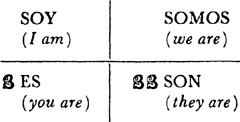
GROUP III
Of the eighteen nonconformists, two are radical changing in the present tense. They made the nonconformist club for irregularities in other tenses.
QUERER, to want, to love
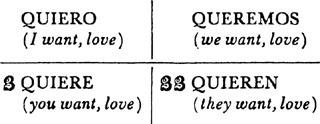
PODER, to be able
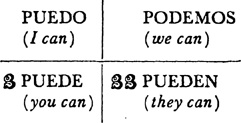
GROUP IV
Of the eighteen nonconformists, two are completely different from the others in the first person singular, but aside from that they are regular.
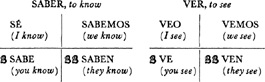
Of the eighteen nonconformists, only one ugly duckling is completely regular in the present tense. “Andar” made the nonconformist club for irregularities in other tenses.
ANDAR, to walk
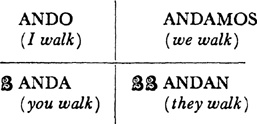
PRESENT TENSE
GROUP I
These end in “go” in the first person singular, present.
| 1. hacer, to do | hago |
hace |
hacemos |
hacen |
| 2. poner, to put | pongo |
pone |
ponemos |
ponen |
| 3. traer, to bring | traigo |
trae |
traemos |
traen |
| 4. caer, to fall | caigo |
cae |
caemos |
caen |
| 5. salir, to go out | salgo |
sale |
salimos |
salen |
| 6. tener, to have | tengo |
tiene |
tenemos |
tienen |
| 7. venir, to come | vengo |
viene |
venimos |
vienen |
| 8. oír, to hear | oigo |
oye |
oímos |
oyen |
| 9. decir, to say | digo |
dice |
decimos |
dicen |
GROUP II
These end in “oy” in the first person singular, present.
| 10. ir, to go | voy |
va |
vamos |
van |
| 11. estar, to be | estoy |
está |
estamos |
están |
| 12. dar, to give | doy |
da |
damos |
dan |
| 13. ser, to be | soy |
es |
somos |
son |
GROUP III
These are radical changing in the present.
| 14. poder, to be able | puedo |
puede |
podemos |
pueden |
| 15. querer, to love, to want | quiero |
quiere |
queremos |
quieren |
GROUP IV
These are different from the other groups.
| 16. saber, to know | sé |
sabe |
sabemos |
saben |
| 17. ver, to see | veo |
ve |
vemos |
ven |
And then there is one more verb that is completely regular in the present.
| 18. andar, to walk | ando |
anda |
andamos |
andan |
This, then, covers the eighteen nonconformist verbs in the present and past tenses. You have seen that, although they are nonconformist, they have many things in common that make them easy to learn. You must pay particular attention to these verbs and learn them well. Among them you will find some of the most used verbs of the Spanish language.
The most important advice that any Spanish teacher could give you is:
MASTER THE NONCONFORMIST VERBS
Nothing you could study before or after these verbs could compare in importance with them. Furthermore, once you have learned them, you will have easy sailing for the rest of your Spanish course.
Combine the words below in different ways to form as many sentences as you can. Be sure to use words from each of the columns in every sentence you form.
A
| 1 | 2 |
| Tengo (I have) | un perro (a dog) |
|
¿Tiene (Have you?) |
un caballo (a horse) |
| Tenemos (We have) | una casa en el campo |
|
Tienen (They have) |
un gato (a cat) |
| Tuve (I had) | un accidente ayer |
B
| 1 | 2 | 3 |
| Tengo que | ir (to go) | al despacho |
| (I have to) | trabajar | el sábado |
|
¿Tiene que |
estudiar | la lección |
| (Do you have to?) | escribir | una carta |
| Tenemos que | comprar | una casa |
| (We have to) | vender | el auto |
|
Tienen que |
pintar | la casa |
| (They have to) | lavar | la ropa |
| Tuve que | (to wash) | (the clothes) |
| (I had to) | regresar | pronto |
|
¿Tuvo que |
(come back) | (soon) |
| (Did you have to?) | alquilar | la casa |
| Tuvimos que | (to rent) | el teléfono |
|
Tuvieron que |
contestar | la carta |
|
Mi tío tiene que |
(to answer) | a los niños |
| (My uncle has to) | leer | (the children) |
| cuidar | la cuenta | |
| (to take care of) | (the bill) | |
| persuadir | ||
| pagar | ||
| (to pay) |
Translate the following sentences into Spanish. Write out each sentence in Spanish, using the columns above as a guide. Check your sentences with the correct translations below this exercise.
Check your sentences with the translations below.
Combine the words below in different ways to form as many sentences as you can. Be sure to use words from each of the columns in every sentence you form.
A
In English you sometimes use the present tense instead of the future: When do you leave? In Spanish the present tense is also used sometimes instead of the future. “¿Cuándo viene?” (When do you come? When are you coming?)
| 1 | 2 |
|
¿Cuándo viene (When are you coming?) |
a México |
|
¿Por qué no viene (Why don’t you come?) |
a la clase |
|
José vino (Joseph came) |
a la fiesta |
|
Mi tío va a venir (My uncle is going to come) |
al despacho |
| a Santa Bárbara | |
| mañana | |
| el sábado |
B
| 1 | 2 | 3 |
| Quiero (I want) | ir (to go) | a. cine |
|
¿Quiere |
tomar | la cena |
| (Do you want?) | invitar | a Eduardo |
| Queremos | jugar | tenis |
|
Quieren |
una taza | de café |
| Quería (I, you, he, she wanted | (a cup) | el trabajo |
| terminar | (the work) | |
| Quiere | ver | la casa |
| Queríamos | comprar | un auto |
|
Querían |
C
| 1 | 2 | 3 |
| Puedo (I can) | hablar | español |
|
¿Puede (Can you?) |
ir | al despacho |
|
José puede (Joseph can) |
nadar | muy bien |
|
María puede (Mary can) |
comprar | el piano |
| Podemos (we can) | venir | el domingo |
|
Pueden |
nadar | (on Sunday) |
| He podido (I have been able to) | trabajar | mucho |
| escribir | toda la tarde | |
| No puedo (I can’t) | terminar | la carta |
| No pude (I couldn’t) | el trabajo |
Notice that all forms of “poder” are followed by the infinitive (Column 2).
Translate the following sentences into Spanish. Write out each sentence in Spanish, using the columns above as a guide. Check your sentences with the correct translations below this exercise.
Check your sentences with the translations below.
Combine the words below in different ways to form as many sentences as you can. Be sure to use words from each of the columns in every sentence you form.
A
HACER, meaning “to make”
| 1 | 2 | 3 |
| Hago (I make) |
la cama (the bed) |
todas las mañanas deliciosos |
|
María hace
|
dulces (candy) | para los muchachos |
| Hacemos | café | (for the boys) |
| (We make) | sandwiches | para mi tía |
|
Hacen (They make)
|
una limonada | esta tarde |
| un refresco | para mi tío | |
| Hice (I made) | (a refreshment) | para las muchachas |
|
¿Hizo (Did you make?)
|
sombreros | (for the girls) |
| las blusas | para mi mamá | |
| Hicimos | ||
|
Hicieron
|
B
HACER, meaning “to do”
| 1 | 2 | 3 |
| Hago (I do) | lo que puedo | en casa |
|
Carlos hace |
(what I can) | muy bien |
| (Charles does) | el trabajo | interesantes |
| Hacemos (We do) | muchas cosas | en la mañana |
|
Hacen (They do) |
una cosa | diferentes |
| Hice (I did) | lo que pudo | interesante |
|
Isabel hizo |
(what she could) | ayer |
| (Isabel did) | hoy (today) |
C
“Que era” means:
| that it was | that he was |
| that you were | that she was |
“Era” (was) is the imperfect of “ser” (to be)
| 1 | 2 | 3 |
| Digo (I say) | que es | imposible |
|
Elena dice (Helen says) |
(that it is) | terrible |
| Decimos (We say) | que son | indiscretas |
| 1 | 2 | 3 |
|
Dicen (They say) |
(that they are) | muy interesante |
| Dije (I said) | muchas cosas | inteligente |
|
Eduardo dijo (Edward said) |
que era | muy bueno |
| que era | (very good) | |
| Dijimos (We said) | que no era | excelente |
|
Dijeron (They said) |
que era | bonita |
D
“Salir” (to leave, to go out) is followed by “de.”
| 1 | 2 | 3 |
| Salgo (I leave) | del trabajo (work) | a las cinco (at five o’clock) |
|
Eduardo sale |
del despacho | |
| Salimos (We leave) | de la casa | a las cuatro |
| de la tienda | tarde | |
|
Salen |
del teatro | temprano (early) |
| Salí (I left) | del cine | a las once (at eleven o’clock) |
|
Salió |
del hotel | |
| Salimos | a las ocho (at eight o’clock) | a las diez |
|
Salieron |
a las ocho | |
| el sábado |
Translate the following sentences into Spanish. Write out each sentence in Spanish, using the columns above as a guide. Check your sentences with the correct translations below this exercise.
Check your sentences with the translations below.
Uses of TENER, to have
In Spanish we do not say, “I’m hungry. I’m cold,” etc. Instead, we say, “I have hunger. I have cold,” etc.
Tengo hambre. I’m hungry (I have hunger).
¿Tiene hambre? Are you hungry?
Tengo frío. I’m cold.
¿Tiene frío? Are you cold?
Tengo calor. I’m warm.
¿Tiene calor? Are you warm?
Tengo sed. I’m thirsty.
¿Tiene sed? Are you thirsty?
Tengo sueño. I’m sleepy.
¿Tiene sueño? Are you sleepy?
Tengo miedo. I’m afraid (I have fear).
¿Tiene miedo? Are you afraid?
Tengo tos. I have a cough.
¿Tiene tos? Have you a cough?
Tengo catarro. I have a cold.
¿Tiene catarro? Have you a cold?
Tengo razón. I’m right.
Tiene razón. You are right.
Tengo dolor de estómago. I have a stomach ache.
Tengo dolor de cabeza. I have a headache.
Tengo dolor de muela. I have a toothache.
You can also ask the question “¿Qué tiene?” which means “What’s wrong with him?” (What has he got?) “¿Qué tiene?” means “What’s wrong with you? What’s wrong with him? What’s wrong with her?” “Qué tiene Carlos?” means “What’s wrong with Charles?”
“Tengo ganas de …” means “I feel like …” and is used with the infinitive.
Tengo ganas de nadar. I feel like swimming.
Tuve ganas de nadar. I felt like swimming.
He tenido ganas de nadar. I have felt like swimming.
¿Tiene ganas de nadar? Do you feel like swimming?
“Tener” is also used to express a person’s age.
Tiene un año. He’s a year old (He has one year).
Tiene dos años. He’s two years old.
¿Cuántos años tiene? How old is he? (How many years has
he?)
Tiene diez años. He’s ten years old.
Don’t forget that “tiene” is the third man form singular and refers to anybody but yourself.
Tiene quince años.
You’re fifteen years old.
He’s fifteen years old.
She’s fifteen years old.
“Tener que …” means “to have to …”
Tengo que trabajar. I have to work.
“Tener” is used in still another expression: “Tengo mucho que hacer” means “I have a lot to do” (I have a lot of work).
Uses of QUERER, to want, to love.
Remember that “querer” (to want) is used with the infinitive in Spanish just as it’s used in English.
Quiero ver. I want to see.
Quiero ir al cine. I want to go to the movies.
Quería nadar. I wanted to swim.
He querido verlo. I have wanted to see him.
When “querer” means “to love,” it is followed by a personal “a.”
Quiero a mi madre. I love my mother.
Quiero a Roberto. I love Robert.
Elena quería a su esposo. Helen loved her husband.
Luis quería a su esposa. Louis loved his wife.
Queremos al nene. We love the baby (boy).
Quieren a la nena. They love the baby (girl).
Uses of PODER, to be able
Remember that in Spanish we do not say, “I can go”; we say, “puedo ir” (I can to go). ALL FORMS OF “PODER” ARE FOLLOWED BY THE INFINITIVE.
Puedo ver. I can see.
Puedo ir. I can go.
¿Puede estudiar? Can you study?
He podido estudiar. I have been able to study.
No puedo ir. I can’t go.
It is very, very important to remember that all forms of “poder” are followed by the infinitive.
Uses of HACER, to do, to make.
In Spanish we do not say “It’s hot.” Instead, we say, “Hace calor” (It makes heat).
Hace calor. It’s hot.
Hace mucho calor. It’s very hot.
Hace frío. It’s cold.
Hace mucho frío. It’s very cold.
Hizo calor ayer. It was hot yesterday.
Hizo frío ayer. It was cold yesterday.
Hace viento. It’s windy.
¡Qué calor! What heat!
“Hace” is also the equivalent of “ago.”
Hace un momento, a moment ago
Hace una hora, an hour ago
Hace una semana, a week ago
Hace un mes, a month ago
Hace un año, a year ago
Hace mucho tiempo, a long time ago
Hace poco tiempo, a short time ago
Sometimes Spanish-speaking people say, “eight days ago,” instead of “a week ago,” and “fifteen days ago,” instead of “two weeks ago.” Why? Heaven only knows.
Hace ocho días, a week ago (eight days ago)
Hace quince días, two weeks ago (fifteen days ago)
“Hacer” is used in three other common idiomatic expressions.
1. Hacer caso. To pay attention (to make a
case)
No hace caso. He doesn’t pay attention.
No hacen caso. They don’t pay attention.
No hice caso. I didn’t pay attention.
No hizo caso. You, he, she, didn’t pay attention.
2. Hacer daño. To be bad for (to make harm)
Me hace daño. It’s bad for me (It does me harm).
Me hace daño la leche. Milk doesn’t agree with me.
3. Hacer falta. To miss (to make a lack), to
need
Me hace falta Carlos. I miss Charles (Charles makes me a
lack).
Me hacen falta los niños. I miss the children.
Me hizo falta Luis. I missed Louis.
 ost
masculine words end in “o” in Spanish. The letter “o” represents the
male and is strong, short, vigorous—a commanding letter. Most feminine
words end in “a” in Spanish. The “a” is the feminine letter symbol. It
is soft, deep, sustained—an elemental letter. When you pronounce the
letter “o” cut it off short as in a command. When you pronounce the
letter “a” hang on to it as in “Ah, Sweet Mystery.”
ost
masculine words end in “o” in Spanish. The letter “o” represents the
male and is strong, short, vigorous—a commanding letter. Most feminine
words end in “a” in Spanish. The “a” is the feminine letter symbol. It
is soft, deep, sustained—an elemental letter. When you pronounce the
letter “o” cut it off short as in a command. When you pronounce the
letter “a” hang on to it as in “Ah, Sweet Mystery.”
THE DIRECT OBJECT PRONOUNS
“Lo” means “him” and “you” (masculine).
“La” means “her” and “you” (feminine).
When you are addressing a man “I invited you” is “Lo invité.”
When you are addressing a woman “I invited you” is “La invité.”
“I invited him” is “Lo invité.”
“I invited her” is “La invité.”
Notice that the pronoun precedes the verb.
All you have to remember about these pronouns is that “lo” is for men and “la” is for women.
Lo visité. I visited him, you (masc.).
La visité. I visited her, you (fem.).
Lo recomendé. I recommended him, you (masc.).
La recomendé. I recommended her, you (fem.).
Lo ví. I saw him, you (masc.).
La ví. I saw her, you (fem.).
Lo visitó. You, he, she visited him.
La visitó. You, he, she visited her.
The plural of these pronouns is formed by adding the letter “s.”
Los visitó. He visited them (masc.).
Las visitó. He visited them (fem.).
When you are speaking of both men and women you use the plural masculine pronoun.
EXAMPLE:
Los ví. I saw you (Mary and John).
Los invité. I invited them (a group of men and women).
| “Me” is “me.” | “Nos” is “us.” |
|
Me invitó. He invited me. |
Nos invitó. He invited us. |
|
Me visitó. He visited me. |
Nos visitó. He visited us. |
|
Me vió. He saw me. |
Nos vió. He saw us. |
Notice that the pronoun precedes the verb.
THE DIRECT OBJECT PRONOUNS
| SINGULAR | PLURAL |
| ME, me | NOS, us |
|
LO, him, you (masc.) |
LOS, them, you (masc.) |
|
LA, her, you (fem.) |
LAS, them, you (fem.) |
| Isabel, Elizabeth | el vals, the waltz |
| también, also, too | mi abuelo, my grandfather |
| Lo ví. I saw him. | La ví. I saw her. |
| la fiesta de Carlos, Charles’s party | ¡Qué terrible! How terrible! |
| ¿Va su abuelo? Is your grandfather going? |
con mucho gusto, with much pleasure, gladly
“Con mucho gusto” is a charming expression that is used very much in Spanish. It is the answer to any honorable invitation.
BAILAR, to dance
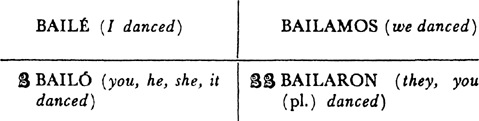
Voy a bailar. I’m going to dance.
Estoy bailando. I’m dancing.
¿Vió usted a Juan esta tarde?
Sí, lo ví en el despacho.
¿Invitó usted a Juan a la fiesta?
Sí, lo invité a la fiesta.
¿Vió usted a Marta esta tarde?
Sí, la ví en el despacho.
¿Invitó usted a Marta a la fiesta?
Sí, la invité a la fiesta.
¿Aceptó Marta la invitación?
Sí, Marta aceptó la invitación con mucho gusto.
¿Quién invitó a Roberto a la fiesta?
Juan lo invitó a la fiesta.
¿Quién invitó a Isabel a la fiesta?
Juan la invitó.
¿Va usted al cine esta noche?
No, no voy al cine esta noche; voy a la fiesta de Carlos. Carlos me invitó a la fiesta la semana pasada y acepté la invitación con mucho gusto.
¿Va a bailar en la fiesta?
Sí, voy a bailar mucho en la fiesta. Voy a bailar con Carlos (Marta).
¿Va a bailar la rumba?
Sí, voy a bailar la rumba y el tango.
¿Va a cantar en la fiesta?
No, no voy a cantar.
¿Quién va a cantar?
Roberto va a cantar.
¡No es posible!
Sí, Roberto va a cantar. ¡Qué terrible!
¿Va a bailar la rumba Isabel?
Sí, Isabel va a bailar la rumba y el tango.
¿Bailó usted anoche?
Sí, anoche bailé con Carlos (Marta). Roberto nos invitó a su casa y bailamos mucho.
¿Va usted al cine mañana?
Sí, voy al cine mañana. Roberto me invitó.
¿Invitó Roberto a María y a Juan?
Sí, Roberto los invitó.
¿Invitó Roberto a Marta y a Isabel?
Sí, Roberto las invitó también.
¡Caramba! Roberto invitó a muchas personas.
Sí, Roberto es muy simpático y muy generoso.
¿Está bailando en este momento su abuelo?
No, eso es ridículo, mi abuelo no está bailando. Mi abuelo está leyendo el periódico y fumando su pipa.
¿Va su abuelo a la fiesta esta noche?
Sí, mi abuelo va a la fiesta esta noche. Carlos lo invitó.
¿Va a bailar la rumba su abuelo?
Sí, mi abuelo va a bailar la rumba y también el vals. Mi abuelo está muy contento con la idea de la fiesta. Esta tarde compró chocolates y confetti para la fiesta.
Write out charts of the present and past tenses of the following verbs and compare them carefully with the charts below.
| besar, to kiss | interrumpir, to interrupt |
| cuidar, to take care of | criticar, to criticize |
| odiar, to hate | castigar to punish |
| sorprender, to surprise |
BESAR, to kiss
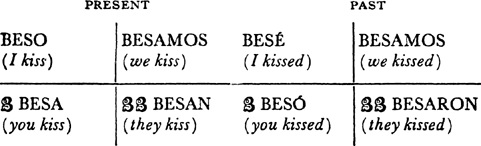
CUIDAR, to take care of
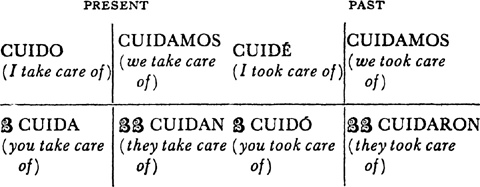
ODIAR, to hate
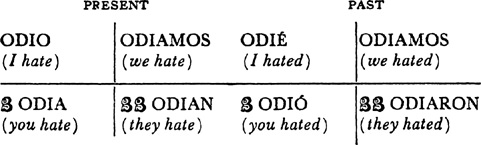
SORPRENDER, to surprise
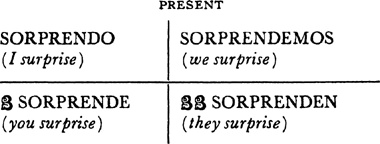
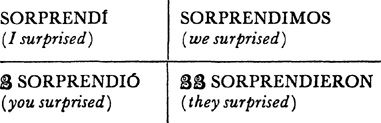
CASTIGAR, to punish
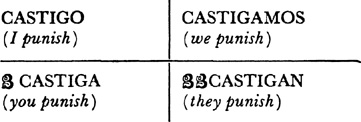
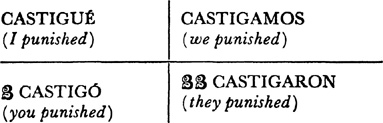
CRITICAR, to criticize
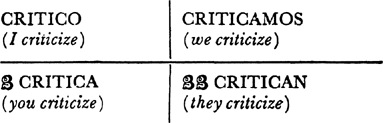
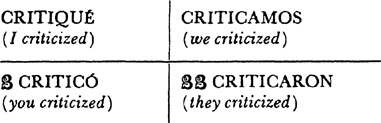
Notice that “castigué” ends in “gué” and “critiqué” ends in “qué” (As explained in Lesson 28).
Combine the words below in different ways to form as many sentences as you can. Be sure to use words from each of the columns in every sentence you form.
A
| 1 | 2 | 3 |
| El doctor |
la curó |
completamente |
| Carlos |
la vió |
en el parque |
| Roberto |
las vió |
en el despacho |
| Juan |
la invitó |
al cine |
| Papá |
lo invitó |
a la fiesta |
| Isabel |
lo recomendó |
muy bien |
| El conductor |
lo saludó |
esta mañana |
| Isabel | (greeted him) | esta tarde |
| Juan |
lo insultó |
a la fiesta (to the party) |
| Carlos |
me invitó |
al cine (to the movies) |
| María |
nos invitó |
en Acapulco |
| Luis |
nos visitó |
anoche |
| Isabel |
me visitó |
la semana pasada |
| Marta |
los visitó |
en el despacho |
| Mi abuelo |
las vió |
la semana pasada |
|
los visitó |
cuando entró (when he came in) | |
|
lo abrazó |
||
| (hugged him) |
B
| 1 | 2 |
| Alberto |
la sorprendió (surprised her) |
| Eduardo |
la besó |
| Roberto |
lo castigó |
| Mi primo (My cousin) |
lo interrumpió |
| Mi tío (My uncle) |
la cuidó |
| Mi tía (My aunt) |
lo besó |
| Marta |
lo interrumpió |
| Isabel (Elizabeth) |
la castigó |
| Alicia |
lo criticó |
| Dorotea (Dorothy) |
lo odia (hates him) |
| Elena (Helen) |
los cuidó (took care of them) |
| Mi tío (My uncle) |
los vió (saw them) |
| Mi tía |
nos vió (saw us) |
|
nos sorprendió |
|
|
las vió (fem.) (saw them) |
|
|
me sorprendió |
|
|
me besó |
C
| 1 | 2 |
| Lo ví (I saw him) | esta mañana |
| La ví | esta tarde |
| Los ví | la semana pasada |
| Las ví | el sábado (on Saturday) |
| Lo invité | a la fiesta |
| La invitó | al cine |
| Los invité | a mi casa |
| Las invité | a la clase |
| Lo visité | ayer |
| éa visité | el otro dí (the other day) |
| Lo saludé |
cuando entró |
| Lo sorprendí | anoche |
| Lo cuidé (I took care of him) | toda la tarde (all afternoon) |
| La cuid | toda la mañana (all morning) |
| Lo besé | |
| La besé |
Translate the following sentences into Spanish.
Check your sentences with the correct translations below.
ayer, yesterday
antier, day before yesterday
la semana pasada, last week
el mes pasado, last month
el año pasado, last year
ayer en la tarde, yesterday afternoon
ayer en la mañana, yesterday morning
anoche, last night
antenoche, night before last
el sábado pasado, last Saturday
el domingo pasado, last Sunday
el fin de semana, the week end
durante, during
después, afterward
mañana, tomorrow
pasado mañana, day after tomorrow
en un mes, in a month
en dos meses, in two months
en un año, in a year
en una semana, in a week
la semana entrante, next week
el año entrante, next year
hoy, today
esta semana, this week
este mes, this month
este año, this year
mientras, while
mientras tanto, meanwhile
Remember the different meanings of “vió” used with pronouns.
ME VIÓ means:
| you saw me | did you see me? |
| he saw me | did he see me? |
| she saw me | did she see me? |
LO VIÓ means:
| you saw him | did you see him? |
| he saw him | did he see him? |
| she saw him | did she see him? |
LA VIÓ means:
| you saw her | did you see her? |
| he saw her | did he see her? |
| she saw her | did she see her? |
NOS VIÓ means:
| you saw us | did you see us? |
| he saw us | did he see us? |
| she saw us | did she see us? |
LOS VIÓ means:
| you saw them | did you see them? |
| he saw them | did he see them? |
| she saw them | did she see them? |
la puerta y la ventana
he
Spanish verb has great versatility. Nothing shows this more clearly than
the third man verb form, which can be used in six different ways (see
“Vió” below). When you add pronouns to the third man verb form you get
even greater variety. The following examples and exercises show how much
a little word like “vió” can yield when used with pronouns.
EXAMPLES:
VIÓ means:
| you saw | did you see? |
| he saw | did he see? |
| she saw | did she see? |
LO VIÓ means:
| you saw him | did you see him? |
| he saw him | did he see him? |
| she saw him | did she see him? |
LA VIÓ means:
| you saw her | did you see her? |
| he saw her | did he see her? |
| she saw her | did she see her? |
INVITÓ means:
| you invited | did you invite? |
| he invited | did he invite? |
| she invited | did she invite? |
LO INVITÓ means:
| you invited him | did you invite him? |
| he invited him | did he invite him? |
| she invited him | did she invite him? |
LA INVITÓ means:
| you invited her | did you invite her? |
| he invited her | did he invite her? |
| she invited her | did she invite her? |
1. Cover up the right-hand column.
2. Translate the sentences in the left-hand column.
3. Check your translations with the right-hand column.
Remember to use “lo” for men and “la” for women. Each italicized word represents “lo” or “la,” depending on whether it is masculine or feminine.
|
VIÓ |
|
| He saw her. | La vió. |
| She saw him. | Lo vió. |
| You saw him. | Lo vió. |
| You saw her. | La vió. |
| He saw you (masc.). | Lo vió. |
| He saw you (fem.). | La vió. |
|
INVITÓ |
|
| She invited him. | Lo invitó. |
| You invited him. | Lo invitó. |
| He invited her. | La invitó. |
| She invited her. | La vió. |
| She invited you (masc.). | La invitó. |
| He invited you (fem.). | La invitó. |
|
VISITÓ |
|
| He visited her. | La visitó. |
| She visited him. | Lo visitó. |
| You visited her. | La visitó. |
| You visited him. | Lo visitó. |
| He visited you (masc.). | Lo visitó. |
| He visited you (fem.). | La visitó. |
LLEVAR, to take (someone or something someplace)
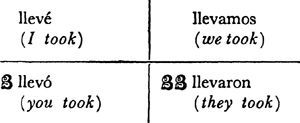
Voy a llevar. I’m going to take.
| ¡Qué lastima! What a pity! | anoche, last night |
| mi abuelo, my grandfather | mi primo (masc.), my cousin |
| simpático, charming | mi prima (fem.), my cousin |
| el campo, the country | Lo llevé. I took him. |
| su, your, his, her, its, their | La llevé. I took her. |
|
¿La llevó al cine? Did you take her to the
movies? |
La llevé al cine. I took her to the movies. |
(Dialogues between two students)
The first student asks the questions.
The second student answers them.
DIÁLOGO 1.
This entire conversation is about Carlos. Every “lo” in it refers to Carlos.
1. ¿Vió usted a Carlos?
2. Sí, lo ví esta mañana.
1. ¿Dónde lo vió?
2. Lo ví en el despacho.
1. ¿ Lo vió en “Hamlet” anoche?
2. Sí, lo ví en “Hamlet” anoche.
1. ¿Lo vió en “Romeo y Julieta” la semana pasada?
2. No, no lo ví en “Romeo y Julieta” la semana pasada.
1. ¡ Que lastima! Trabajó muy bien en el papel de Romeo.
DIÁLOGO 2.
This entire conversation is about Isabel. Every “la” in it refers to Isabel.
1. ¿Vió usted a Isabel?
2. Sí, la ví esta tarde.
1. ¿Dónde la vió?
2. La ví en la clase.
1. ¿La vió en “Romeo y Julieta” la semana pasada?
2. Sí, la ví en “Romeo y Julieta” la semana pasada. Trabajó muy bien.
1. ¿La vió en “Hamlet” anoche?
2. Sí, la ví en “Hamlet” anoche.
DIÁLOGO 3.
This entire conversation is about “mi abuelo” (my grandfather). Every “lo” in it refers to grandfather.
1. ¿Vió usted a mi abuelo esta mañana?
2. No, no lo ví esta mañana. Lo ví anoche.
1. ¿Dónde lo vií?
2. Lo ví en mi casa.
1. ¿Lo invitó a su casa?
2. Sí, lo invité a tomar la cena en mi casa anoche.
1. ¿Lo invitó a la fiesta?
2. Sí, lo invité a la fiesta.
1. ¿Aceptó la invitación?
2. Sí, aceptó la invitación con mucho gusto. Su abuelo es muy simpático.
DIÁLOGO 4.
1. ¿Llevó usted a su mamá al cine?
2. Sí, la llevé al cine anoche.
1. ¿Llevó usted a su abuelo a la fiesta?
2. Sí, lo llevé a la fiesta.
1. ¿Llevó usted a su primo al ballet?
2. Sí, lo llevé al ballet.
1. ¿Llevó usted a su prima a la fiesta?
2. Sí, la llevé a la fiesta.
1. Llevo usted a su abuela al campo?
2. Sí, la llevé al campo.
1. ¿La llevó en su auto?
2. Sí, la llevé en mi auto.
1. ¿La llevó a la casa de Roberto?
2. Sí, la llevé a la casa de Roberto.
You can never separate an auxiliary from its verb. For example, in “he invitado” (I have invited), you can never separate the word “he” from “invitado.”
Pronouns precede both the auxiliary and the main verb. The auxiliary and the main verb can never, never be separated.
EXAMPLES
Lo he invitado. I have invited him.
(NEVER say, “he lo invitado.”)
Los he invitado. I have invited them.
Los estoy castigando. I am punishing them.
(NEVER say, “estoy los castigando.”)
In the future form the pronouns can go either before the verb or after the verb.
EXAMPLES:
I’m going to see him. Voy a verlo, or, Lo voy a ver.
I’m going to invite her. Voy a invitarla, or, La voy a invitar.
I’m going to take her to the movies. Voy a llevarla al cine, or,
La voy a llevar al cine.
In ordinary conversation you will hear the pronouns used either before or after the verbs of the future form.
Combine the words below in different ways to form as many sentences as you can. Be sure to use words from each of the columns in every sentence you form.
A
| 1 | 2 | 3 |
| Mi primo |
me llevó (took me) |
al cine |
| Mi prima |
lo llevó |
a la playa |
| Mi hermano |
la llevó |
al campo |
| (My brother) |
nos llevó |
al circo |
| Mi hermana |
los llevó |
(to the circus) |
| Mi tío |
las llevó |
al despacho |
| (My uncle) |
me invitó |
a la fiesta |
| Mi tía (My aunt) |
lo invitó |
al mercado |
| El doctor |
la invitó |
a la ópera |
| Isabel |
nos invitó |
al ballet |
| Elena (Helen) | al concierto | |
| Dorotea | ||
| (Dorothy) |
B
| 1 | 2 |
| Lo he invitado (I have invited him) |
a la clase a la fiesta |
| Lo he visto (I have seen him) |
dos veces (twice) muchas veces (many times, often) |
| La he visto (I have seen her) | |
|
Los ha visto (You have seen them, he, she has seen them)
|
en México tres veces (three times) hoy (today) |
|
Lo ha visto (Have you seen him?)
|
el sábado últimamente (lately) |
| Voy a verlo (I’m going to see him) |
mañana esta noche |
|
Elena va a verlo
|
porque es travieso (because he’s mischievous)
|
| Vamos a verlos (We’re going to see them) | |
| Lo estoy castigando (I’m punishing him) |
Translate the following sentences into Spanish. Write out each sentence in Spanish, using the columns above as a guide. Check your sentences with the correct translations below this exercise.
Check your sentences with the correct translations below.
LO also means “IT” (masc.).
LA means “IT” (fem.).
If “it” refers to a masculine word, use LO.
If “it” refers to a feminine word, use LA.
EXAMPLES:
1. El libro es interesante. Lo í.
The book is interesting. I read it.
Since “it” refers to “book,” which is a masculine word in Spanish (el libro), you must use the masculine pronoun for “it,” “lo.”
2. La blusa es bonita. ¿Dónde la compró?
The blouse is pretty. Where did you buy it?
Since “it” refers to “blouse,” which is a feminine word in Spanish (la blusa), you must use the feminine word for “it,” “la.”
LAS means “them” (either feminine persons or feminine things).
LOS means “them” (either masculine persons or masculine things).
EXAMPLES:
1. Los artículos son interesantes. Los leí ayer.
The articles are interesting. I read them yesterday.
Since “them” refers to “articles,” which is a masculine word in Spanish (los artículos), you must use the masculine pronoun for “them,” “los.”
2. Las blusas son muy bonitas. ¿Las vió?
The blouses are very pretty. Did you see them?
Since “them” refers to “blouses,” which is a feminine word in Spanish (las blusas), you must use the feminine pronoun for “them,” “las.”
If “it” refers to an abstract idea, as in “I doubt it,” you must use the masculine pronoun for “it,” “lo.”
EXAMPLES:
Lo dudo. I doubt it.
No lo dudo. I don’t doubt it.
No lo comprendo. I don’t understand it.
Voy a arreglarlo. I’m going to arrange it.
¿Lo arregló? Did you arrange it?
Translate the following sentences into Spanish. Check your sentences with the correct translations below this exercise.
VERBS USED IN THIS EXERCISE
| dudar, to doubt | vender, to sell |
| arreglar, to arrange | ver, to see |
| dejar, to leave (a thing) | comprender, to understand |
| comprar, to buy | leer, to read |
| tomar, to take | terminar, to finish |
Check your sentences with the correct translations below.
NOTE:
TOMAR, to take (food or vehicles)
Tomé el tren. I took the train
Tomé el avión. I took the plane.
Tomé café. I had (took) coffee.
Tomé la cena. I had (took) dinner.
LLEVAR, to take (people)
Llevé a mi primo al cine. I took my cousin to the movies.
Llevé a mi abuelo a la fiesta. I took my grandfather to the party.
Llevé a mamá al campo. I took mother to the country.
| SINGULAR | PLURAL |
| ME, me | NOS, we |
|
LE, you, him, her |
LES, you (pl.), they |
Verbs that require the indirect object pronouns are as easy as pie to spot. If you can say the word “to” or “for” after the verb in English, it takes “le” in Spanish.
EXAMPLES:
| I spoke to him. | Le hablé. |
| I sang to her. | Le canté. |
| I bought for him. | Le compré. |
| I sold to her. | Le vendí. |
| I wrote to him. | Le escribí. |
But it sounds wrong to say:
I kissed to him.
I visited to him.
I invited to her.
So these verbs do not take “le.” They take “lo” or “la.”
| I kissed him. | Lo besé. |
| I visited him. | Lo visité. |
| I invited her. | La invité. |
Your ear is your best friend in learning Spanish. You will find that after hearing certain word combinations a few times your ear will lead you unerringly into the same correct combinations. That is why it is so important to read all the lessons aloud. After you have read a lesson or series of lessons that cover a subject, things begin to sound right or wrong to you. Sometimes you can “let your conscience be your guide,” but in learning Spanish you must let your ear be your guide.
This lesson takes advantage of your English ear, that is, what sounds right or wrong to you in English: “Kissed to him” sounds wrong; “spoke to him” sounds right.
There is only one thing to remember in this lesson. But that one thing is of vital importance: Verbs must be tested IN ENGLISH to determine whether they take “le” or “lo.” I call this the acid test.
Following is an exercise that shows how to give the verbs the acid test. In the left-hand column there is a list of verbs in English.
| VERBS | THE ACID TEST | CORRECT PRONOUNS |
| wrote | to him, her | le |
| visited | no | lo, la |
| bought | for him, her | le |
| invited | no | lo, la |
| bothered | no | lo, la |
| gave | to him, her | le |
| examined | no | lo, la |
| worried | no | lo, la |
| sang | to him, her | le |
| kissed | no | lo, la |
| sold | to him, her | le |
| spoke | to him, her | le |
| insulted | no | lo, la |
| congratulated | no | lo, la |
| saw | no | lo, la |
All these exercises, examples, and explanations can be reduced to a simple formula:
TO, FOR = LE
WORD ORDER
Le escribí a mi papá. (To him) I wrote to my father.
Le escribí a mi mamá. (To her) I wrote to my mother.
Notice that you can’t simply say, “I wrote to my mother.” In Spanish you must use both the noun and the pronoun with verbs that take “le.” You must say, “To him I wrote to my father” or “To her I wrote to my mother.”
EXAMPLES:
Le escribí a mi primo. (To him) I wrote to my cousin.
Le compré una pipa a mi abuelo. (For him) I bought a pipe for my grandfather.
Le vendí la casa a Carlos. (To him) I sold the house to Charles.
Le hablé a Roberto. (To him) I talked to Robert.
The same thing happens when you ask a question.
¿Le vendió la casa a Roberto? (To him) Did you sell the house to Robert?
¿Le compró una pipa a su abuelo? (For him) Did you buy a pipe for your grandfather?
The most important thing to remember is that “le” sticks to verbs like a bur.
| cuándo, when | Le escribí. I wrote to you, him, her. |
| largo (masc.), larga (fem.) long | Le hablé. I talked to you, him, her. |
| una carta larga, a long letter | Le compré. I bought for you, him, her. |
| su abuelo, your grandfather | el cumpleaños, the birthday |
| la Navidad, Christmas (Nativity) | un disco, a phonograph record |
| inglés, English | o, or |
| un libro, a book | su, your, his, her, its |
The first student asks the questions. The second answers them.
DIÁLOGO 1.
This entire conversation is about Isabel. Every “le” in it refers to Isabel.
1. ¿Le escribió una carta a Isabel?
2. Sí, le escribí una carta a Isabel.
1. ¿Cuándo le escribió?
2. Le escribí esta tarde.
1. ¿Le escribió en inglés o en español?
2. Le escribí en español.
1. Le escribió una carta larga?
2. Sí, le escribií una carta muy larga.
DIÁLOGO 2.
This entire conversation is about grandfather. Every “le” in it refers to grandfather.
1. ¿Le compró usted una pipa a su abuelo?
2. Sí, le compré una pipa a mi abuelo.
1. ¿Le compró la pipa para la Navidad?
2. No, no le compré la pipa para la Navidad.
1. ¿Le compró la pipa para su cumpleaños?
2. Sí, le compré la pipa para su cumpleaños.
1. ¿Le compró usted un libro a su abuelo?
2. Sí, le compré un libro a mi abuelo. Le compré una novela para su cumpleaños.
DIÁLOGO 3.
This conversation is about grandmother. Every “le” in it refers to grandmother.
1. ¿Le compró usted una blusa a su abuela?
2. Sí, le compré una blusa a mi abuela.
1. ¿Le compró usted la blusa para la Navidad?
2. No, no le compré la blusa para la Navidad.
1. ¿Le compró la blusa para su cumpleaños?
2. Sí, le compré la blusa para su cumpleaños.
1. ¿Le compró usted un disco a su abuela?
2. Sí, le compré un disco para su cumpleaños.
DIÁLOGO 4.
This conversation is about Roberto. Every “le” in it refers to Roberto.
1. ¿Le habló usted a Roberto?
2. Sí, le hablé a Roberto.
1. ¿Le habló por teléfono?
2. Sí, le hablé por teléfono.
1. ¿Le habló esta tarde?
2. Sí, le hablé esta tarde?
1. ¿Le habló en inglés?
2. No, no le hablé en inglés.
1. ¿Le habló en español?
2. Sí, le hablé en español.
MANDAR, to send
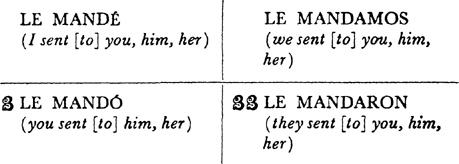
EXPLICAR, to explain
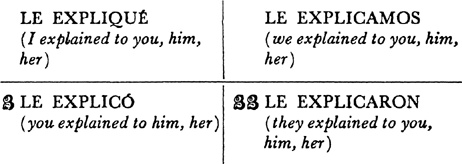
ENTREGAR, to deliver
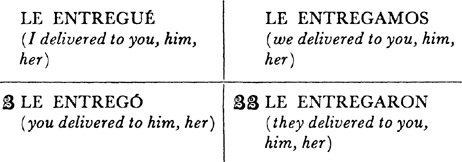
EXAMPLES
Le mandé un libro. I sent him a book (To him I sent a book).
Le mandé un cable. I sent you a cable (To you I sent a cable).
Le mandé una blusa. I sent her a blouse (To her I sent a blouse).
Le mandamos un regalo. We sent him a present (To him we sent a present).
Le mandaron unas rosas. They sent her some roses. (To her they sent some roses).
Le mandé una pipa a Carlos. I sent Charles a pipe (To him I sent a pipe to Charles).
Le expliqué la situación a mi tía. I explained the situation to my aunt (To her I explained the situation to my aunt).
Le explicamos la lección a Luis. We explained the lesson to Louis (To him we explained the lesson to Louis).
Le entregué el paquete a su secretaria. I delivered the package to your secretary (To her I delivered the package to your secretary).
Le entregué la carta. I delivered the letter to him (To him I delivered the letter).
Me entregó el paquete. He delivered the package to me
(To me he delivered the package).
entrega, deliver
entrega inmediata, special delivery (immediate
delivery)
Combine the words below in different ways to form as many sentences as you can. Be sure to use words from each of the columns in every sentence you form.
A
| 1 | 2 | 3 |
| Le escribí ([To him] I wrote) | una carta (a letter) | a Roberto (to Robert) |
| Le vendí | una casa | a Luis |
| Le canté | una canción | a Carlos |
| Le hablé | por teléfono | al doctor |
| ée compré | una pipa | a mi abuelo |
| Le compré | una blusa | a mi abuela |
| ée mandé | un libro |
a Isabel (Elizabeth) |
B
| 1 | 2 | 3 |
|
¿Le escribió ([To him] Did you write?) |
una carta (a letter) | a Roberto (io Robert?) |
|
¿Le vendió |
la casa | a Luis? |
|
¿Le cantó |
una canción | a Carlos? |
|
¿Le habló |
por teléfono | al doctor? |
|
¿Le compró |
una pipa | a su abuelo? |
|
¿Le compró |
una blusa | a su abuela? |
|
¿Le compró |
un libro | a Isabel? |
C
| 1 | 2 |
| Lemandé (I sent you, him, her) |
unos discos (some records) un libro |
|
Me mandó (You, he, she sent me)
|
un cable unas rosas (some roses) |
|
Nos mandó (You, he, she sent us)
|
la situación la lección |
|
Le mandaron (They sent you, him, her)
|
el cable la carta |
| Le expliqué (I explained to you, him, her) |
un telegrama unas flores (some flowers) |
| Le entregué (I delivered to you, him, her) |
un regalo (a present) el paquete (a package) |
Translate the following sentences into Spanish. Write out each sentence in Spanish, using the columns above as a guide. Check your sentences with the correct translations below this exercise.
Be sure to write these sentences exactly as shown in the columns above.
Check your sentences with the translations below.
NOTE: If pronouns seem at all complicated to you, don’t worry about them. In fact, forget you ever heard of them. They will come up so often in future lessons that before you know it you will be using them automatically.
DAR, to give
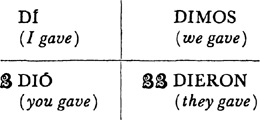
Voy a dar. I’m going to give.
Notice that although “dar” is an “ar” verb, it has the past tense endings of “er” verbs. It is irregular.
Le dí means: I gave (to) you, him, her
le dió means:
| you gave him | did you give him? |
| he gave him | did he give him? |
| she gave him | did she give him? |
Le dí el libro a Roberto. (To him) I gave the book to Robert.
In forming sentences using the indirect object, ALWAYS USE the following word order (1,2,3).
| (TO HIM) GAVE | WHAT | TO WHOM |
| 1 | 2 | 3 |
| Le dí | el libro | a Roberto |
| Le dí | el suéter | a Carlos |
| Le dí | la pipa | a Luis |
| Le dí | la cámara | a Roberto |
| 1 | 2 | 3 |
|
¿Le dió |
el libro | al doctor? ([To him] Did you give the book to the doctor?) |
|
¿Le dió |
el suéter | a Carlos? |
|
¿Le dió |
la pipa | a Luis? |
|
¿Le dió |
la cámara | al doctor? |
| la caja, the box | perezoso, lazy |
| la lechem, the milk | un disco, a phonograph record |
| el sofá, the sofa | mi primo (masc.), my cousin |
| mi hermano, my brother | mi prima (fem.), my cousin |
| mi hermana, my sister | una botella de leche, a bottle of milk |
| la Navidad, Christmas | |
| la botella, the bottle | |
| su cumpleaños, your, his, her birthday | |
| una caja de chocolates, a box of chocolates |
¿Le dió un disco a Roberto?
Sí, le dí un disco a Roberto para su cumpleaños.
¿Le dió una blusa a su prima?
Sí, le dí una blusa a mi prima para su cumpleaños.
¿Le dió una pipa a su abuelo?
Sí, le dí una pipa a mi abuelo para su cumpleaños.
¿Le dió un suéter a su primo?
Sí, le dí un suéter a mi primo para la Navidad.
¿Le dió una novela a Carlos?
Sí, le dí una novela a Carlos para la Navidad.
¿Le dió un radio a su mamá?
Sí, le dí un radio a mi mamá para la Navidad.
¿Le dió una guitarra a su hermano?
Sí, le dí una guitarra a mi hermano para su cumpleanños.
¿Le dió una cámara a su hermana para su cumpleaños?
Sí, le dí una cámara a mi hermana para su cumpleaños.
¿Le dió una corbata a su papá para la Navidad?
Sí, le dí una corbata a mi papá para la Navidad.
¿Le dió un tractor a Isabel para la Navidad?
Caramba, profesor, eso es ridículo. No le dí un tractor a Isabel para la Navidad. Le dí una caja de chocolates.
¿Le dió un auto a Luis para la Navidad?
No, no le dí un auto a Luis para la Navidad. Le dí una corbata.
¿Le dió un avión a Alicia?
No, eso es ridículo, no le dí un avión a Alicia. Le dí una botella de perfume a Alicia para la Navidad.
¿Le dió una botella de leche a Marta para la Navidad?
Ay no, no le dí una botella de leche a Marta. Le dí una botella de perfume para la Navidad.
¿Le dió un sofá a Roberto?
Sí, le dí un sofá a Roberto para la Navidad porque es muy perezoso.
Combine the words below in different ways to form as many sentences as you can. Be sure to use words from each of the columns in every sentence you form.
A
| 1 | 2 | 3 |
| Le dí (I gave) | un disco | a mi prima |
|
Le dió (He gave) |
una blusa | a su hermana |
| Le dimos (We gave) | una corbata | a su hermano |
| Le
dieron |
(a necktie) | |
| (They gave) | un suéter | a su primo |
| Voy a darle | un radio | a su mamá |
| (I’m going to give) | una novela | a Carlos |
| ¿Va
a darle |
una cámara | a Luis |
| (Are you going to give?) | una guitarra | a Roberto |
| un tractor | a Isabel | |
| un sofá | a Alberto |
B
| 1 | 2 | 3 |
| Le mandé (I sent) | el libro | a Carlos |
| ¿Le
mandó |
un cable | a su tío |
| (Did you send?) | unas rosas | a Elena |
| Le mandamos | un telegrama | a su tía |
| (We sent) | el paquete | a Luis |
|
Le mandaron |
(the package) | |
| (They sent) | un regalo | a Roberto |
| Voy a mandarle | (a present) | |
| (I’m going to send) | unos discos | a mi primo |
|
¿Va a mandarle |
las flores | a su prima |
| (Are you going to send?) |
C
| 1 | 2 |
| Le hablé (I talked, spoke) | a Luis |
|
¿Le habló (Did you talk?) |
al doctor |
| Le hablamos (We talked) | a su primo |
|
Carlos le habló |
a Elena |
|
Luis le habló |
a Dorotea |
|
Mi papá le habló |
a Eduardo |
Translate the following sentences into Spanish. Write out each sentence in Spanish, using the columns above as a guide. Check your sentences with the correct translations below this exercise.
Check your sentences with the translations below.
If you use both the direct and indirect object pronouns, THE INDIRECT OBJECT PRONOUN COMES FIRST.
EXAMPLES:
Me lo dió. He gave it to me (To me it he gave).
Me lo vendió. He sold it to me (To me it he sold).
The indirect object LE changes to SE when it is used in combination with LO, LA, LOS, LAS. “Le lo” becomes SE LO.
EXAMPLES:
Se lo dí. I gave it to him (To him [her, you] it I gave).
Se lo vendí. I sold it to you (To you [him, her] it I sold).
Se la vendí. I sold it to her. (The “la” refers to something feminine, such as “la mesa,” the table.)
Se los vendí. I sold them to him. (The “los” refers to something masculine plural.)
Se las vendí. I sold them to you. (The “las” refers to something feminine plural.)
Nos lo vendió. He sold it to us.
Se lo vendí. I sold it to you, to him, to her, to them.
“SE” means: To you, to him, to her, to them.
ME, me (to, for me)
LE, you, him, her (to, for you, him, her)
NOS, us (to, for us)
LES, you (pl.), them (to, for them)
“Traje” (I brought) takes “le” because you can say “brought to.” Verbs that can be followed by “to” or “for” take “le.”
Le traje unos discos. I brought you some records (To you I brought some records).
Le dí el dinero. I gave you the money (To you I gave the money).
Le dimos el libro. We gave you the book (To you we gave the book).
| VERB | WHAT | TO WHOM |
| 1 | 2 | 3 |
|
Carlos le dió (Charles [to her] gave)
|
un libro (a book) | a Elena (to Helen) |
|
Carlos le dió (Charles [to him] gave)
|
el dinero (the money) | a Juan (to John) |
| María y yo le dimos (Mary and I [to her] gave) | el dinero (the money) | a Elena (to Helen) |
|
Carlos y María le dieron (Charles and Mary [to her]
gave)
|
los libros (the books) |
a mi tía (to my aunt) |
|
Enrique le trajo (Henry [to him] brought)
|
el periódico (the newspaper) |
a su papá (to his father) |
|
María le trajo (Mary [to her] brought)
|
unas rosas (some roses) | a mi mamá (to my mother) |
| Roberto y yo le trajimos (Robert and I [to him] brought) | unos libros (some books) | a Carlos (to Charles) |
|
Carlos y María le trajeron (Charles and Mary [to him]
brought)
|
unos dulces (some candy) | a Juan (to John) |
había terminado (I had finished, you had finished, he had finished)
habíamos terminado (we had finished)
habían terminado (they had finished)
que habíamos terminado (that we had finished)
que habíamos estudiado (that we had studied)
“Dije” (I said) takes “le” because you can say, “said to.” Verbs that can be followed by “to” or “for” take “le.”
Le dije a mi tío que habíamos estudiado. I told my uncle that we had studied (To him I said to my uncle that we had studied).
¿Qué le dijeron a su tío? What did you tell your uncle (What [to him] did you [plural] say to your uncle)?
Le dijimos que habíamos estudiado. We told him that we had studied (To him we said that we had studied).
ALWAYS REMEMBER: Verbs that can be followed by “to” or “for” take “le.”
The object pronouns for nonconformist verbs are:
| dar, to give (to) | LE Le dí. I gave (to) him. |
| traer, to bring (to) | LE Le traje. I brought (to) him. |
| decir, to say (to) | LE Le dije. I said (to) him. |
| hacer, to do (to) | LE ¿Qué le hizo? What did you do to him? |
Some verbs take either “lo” or “le,” depending on their meaning.
Le traje el libro. I brought the book to him.
Lo traje a la fiesta. I brought him to the party.
If you say that you brought “him,” then you can’t use the word “to.” You can’t say, “I brought to him to the party,” so you can’t use the pronoun “le.”
If you say that you brought a person, use “lo, la.”
If you say that you brought a thing to a person, use “le.”
“Ver” (to see) and “querer” (to love) can’t be followed by “to” or “for,” so they take the direct object pronouns “lo, la.”
| La ví. I saw her. | Lo quiero. I love him. |
| conmigo, with me (with my ego) | con nosotros, with us (masc.) |
| con usted, with you | con nosotras, with us (fem.) |
| con él, with him | con ellos, with them (masc.) |
| con ella, with her | con ellas, with them (fem.) |
| el domingo, on Sunday | descansar, to rest |
| el sábado pasado, last Saturday | alquilar, to rent |
| un muchacho, a boy | regresar, to return |
| una muchacha, a girl | ¿Fué? Did you go? |
| caliente, hot | Sí, fuí. Yes I went. |
| chistoso, funny | manejar, to drive (a car) |
| conmigo, with me | Nos trajo. He brought us. |
| cosas locas, crazy things | Nos dijo. He told us. |
| siempre, always | Le dimos. We gave him. |
| para ir, in order to go | Somos. We are. |
| pollo frito, fried chicken | Tengo. I have. |
| todo el tiempo, all the time | ¿Tiene usted? Have you? |
| toda la tarde, all afternoon | el sol, the sun |
a las diez de la mañana, at ten in the morning
a las cuatro de la tarde, at four in the afternoon
cansados pero contentos (pl.), tired but happy
¿Quiere comprar? Do you want to buy?
Vino a ofrecernos. He came to offer us.
Está bien frío (fría). It’s good and cold.
Que era imposible, that it was impossible
¿Qué hizo Roberto? What did Robert do?
Comenzó a hacer. He began to do.
¿Sabe manejar? Do you know how to drive?
Sé manejar. I know how to drive.
Salí de mi casa. I left my house (I went out of my house).
Llegué. I arrived, got there, got here
¿Hizo calor? Was it hot (Did it make heat)?
¿Cuántos años tiene? How old are you? How old is he, she?
la casa tiene, the house has
traje de baño, bathing suit (suit of bath)
nos pusimos, we put on
“Nos pusimos” (we put on) and “se puso” (you, he, she put on) will be fully explained in Lesson 38. Accept them now on faith.
¿Tiene usted un auto?
Sí, tengo un auto nuevo.
¿Sabe usted manejar?
Sí, sé manejar.
¿Fué usted a Acapulco el sábado pasado?
Sí, fuí a Acapulco el sábado. Salí de mi casa en la mañana y llegué a Acapulco a las cuatro de la tarde.
¿Dónde pasó usted el fin de semana?
Pasé el fin de semana en la casa de Luis en Acapulco.
¿Quién fué a Acapulco con usted?
Roberto y mi tío fueron a Acapulco conmigo.
¿Qué hizo Roberto en Acapulco?
Roberto nadó, pescó, tocó la guitarra, y cantó muchas canciones en Acapulco.
¿Qué hizo su tío?
Mi tío tomó baños de sol, nadó, leyó una novela y descansó mucho en Acapulco.
¿Fué usted a la playa el domingo?
Sí, fuí a la playa el domingo.
¿Quién fué con usted?
Roberto, Elena, y Luis fueron conmigo. Fuimos a la playa a las diez de la mañana. Nos pusimos el traje de baño y tomamos un baño de sol. Roberto se puso un traje de baño muy chistoso y comenzó a hacer cosas locas en la playa.
¿Hizo mucho calor en la playa?
Sí, hizo mucho calor en la playa. Nos pusimos unos sombreros muy grandes porque el sol de Acapulco es caliente. Después de unos momentos un muchacho vino a ofrecernos unas botellas de Coca Cola.
¿Qué dijo el muchacho?
El muchacho dijo, “¿Quieren comprar Coca Cola? Está bien fría.”
¿Quién compró la Coca Cola?
Roberto compró la Coca Cola.
¿Quién les trajo la Coca Cola?
El muchacho nos trajo la Coca Cola.
¿Qué le dijo el muchacho a Roberto?
El muchacho le dijo a Roberto que era posible alquilar lanchas para ir a pescar.
¿Alquiló Roberto una lancha?
Sí, Roberto alquiló una lancha.
¿Fueron a pescar con él?
Sí, fuimos a pescar con él.
¿Tomaron el almuerzo en la lancha?
Sí, tomamos un almuerzo delicioso en la lancha. Tomamos pollo
frito, una ensalada de papas, sandwiches, huevos, y café.
¿Hablaron en español con el muchacho?
Sí, hablamos en español todo el tiempo.
¿Cuántos años tiene el muchacho?
El muchacho tiene quince años.
¿A que hora regresaron a la casa de Luis?
Regresamos a la casa de Luis a las cinco de la tarde.
¿Cuánto dinero le dieron al muchacho?
Le dimos veinte pesos ($20, Mexican money) al muchacho.
Después, regresamos a la casa de Luis muy cansados pero muy contentos.
¿Qué le dijeron a su tío?
Le dijimos que habiamos alquilado una lancha y que habíamos pescado toda la tarde.
¿Tomaron la cena en la casa de Luis?
Sí, tomamos la cena en la casa de Luis.
¿Bailaron?
Sí, después de la cena bailamos y cantamos.
¿Cantó Roberto?
Sí, Roberto siempre canta. No sabe cantar, pero canta. Por fortuna Luis y Elena y yo somos muy pacientes y muy tolerantes.
¿Es bonita la casa de Luis?
Sí, la casa de Luis es linda. Tiene un patio muy bonito con plantas tropicales y también tiene una terraza grande. En las noches de luna la vista de la terraza es incomparable—palmeras tropicales, curvas blancas de las playas, y el Pacífico inmenso y tranquilo.
Combine the words below in different ways to form as many sentences as you can. Be sure to use words from each of the columns in every sentence you form.
A
TRAER, to bring
| 1 | 2 | 3 |
| Le traje | un libro | a mi tío |
| ¿Le
trajo |
el periódico | a mi hermano |
| Le trajimos | una pipa | a mi abuelo |
|
Le trajeron |
unas rosas | a mi abuela |
B
DAR, to give
| 1 | 2 | 3 |
| Le dí | una corbata (a necktie) | a mi primo |
|
Carlos le dió |
un libro | a mi hermana |
| Le dimos | un reloj (a watch) | al doctor |
|
Le dieron |
una blusa | a mi prima |
C
DECIR, to say, to tell
| 1 | 2 |
| Le dije (I told him) | que había estudiado (that I, you, he, she had studied) |
|
Carlos le dijo |
que habíamos pescado |
| Le dijimos | que habíamos trabajado |
|
Le dijeron |
que habían descansado (that they had rested) |
|
Me dijo (you, he, she told me) |
que habían terminado (that they had finished) |
D
followed by infinitives
QUERER, to want
PODER, to be able
SABER, to know how to
| 1 | 2 | 3 |
| Quiero (I want) | estudiar | la lección |
|
Quiere |
ir | a Cuba |
| Queremos | hacer (do) | el trabajo |
| ¿Quieren |
bailar | esta noche |
| Quería (I, you, he, she wanted) | tomar | la cena |
| Queríamos (We wanted) | venir | a su casa |
|
Querían (They wanted) |
decir (to say) | muchas cosas |
| Sé (I know how to) | jugar | tenis |
|
¿Sabe |
manejar (drive a car) | el auto |
| Sabemos | bailar | la rumba |
|
¿Saben |
ganar (earn) | dinero |
| Sabía (I, you, he, she knew how to) | bailar | el tango |
| Sabíamos (We knew how to) | manejar | el tractor |
|
Sabían |
hacer | dulces |
| Puedo (I can) | trabajar | mucho |
|
¿Puede |
escribir | en máquina |
| Podemos | pescar | mañana |
|
¿Pueden |
verlo (see him) | hoy (today) |
| Pude (I could) | hablarle | esta tarde |
|
¿Pudo |
invitarlo | a la fiesta |
| Pudimos | terminar | el trabajo |
|
¿Pudieron |
ir | a la fiesta |
| comprender | el problema |
Translate the following sentences into Spanish. Write out each sentence in Spanish, using the columns above as a guide. Check your sentences with the correct translation below this exercise.
Check your sentences with the translations below.
“Saber” means to know anything except persons or places.
“Saber” also means “to know how to.”
Sé nadar. I know how to swim.
Sabe bailar. He knows how to dance.
Sé la lección. I know the lesson.
Sé la dirección. I know the address.
No sé. I don’t know.
¿Sabe? Do you know?
Most of the past participles of the nonconformist verbs are regular.
In the following list the auxiliary verb “he” (I have) will be combined with the past participle to form the present perfect tense.
| INFINITIVE | PRESENT PERFECT TENSE |
| 1. salir, to go out | he salido, I have gone out |
| 2. tener, to have | he tenido, I have had |
| 3. venir, to come | he venido, I have come |
| 4. ir, to go | he ido, I have gone |
| 5. estar, to be | he estado, I have been |
| 6. dar, to give | he dado, I have given |
| 7. ser, to be | he sido, I have been |
| 8. poder, to be able | he podido, I have been able |
| 9. querer, to want, love | he querido, I have wanted, loved |
| 10. saber, to know | he sabido, I have known |
| 11. andar, to walk | he andado, I have walked |
Three past participles are regular except for the fact that they have an accent on the “i.”
| 12. traer, to bring | he traído, I have brought |
| 13. caer, to fall | he caído, I have fallen |
| 14. oír, to hear | he oído, I have heard |
There are four completely irregular past participles.
| 15. hacer, to do, make | HE HECHO, I have done, made |
| 16. decir, to say | HE DICHO, I have said |
| 17. poner, to put | HE PUESTO, I have put |
| 18. ver, to see | HE VISTO, I have seen |
Some of the members of the nonconformist club have large families. “Poner” (to put), for example, has quite a number of offspring. You can easily recognize them because they all end in “poner.” These verbs have the same irregularities as “poner” in all tenses. In the list below you will find the infinitive and the first person singular of the present of each important member of the “poner” family.
| PONER, to put | PONGO, I put |
| exponer, to expose | expongo, I expose |
| imponer, to impose | impongo, I impose |
| oponer, to oppose | opongo, I oppose |
| proponer, to propose | propongo, I propose |
| suponer, to suppose | supongo, I suppose |
| componer, to compose, fix | compongo, I compose, fix |
| disponer, to dispose | dispongo, I dispose |
“Descomponer” means “to decompose, to spoil, to get out of order.”
Next comes a list of the members of the “tener” family.
| TENER, to have | TENGO, I have |
| abstener, to abstain | abstengo, I abstain |
| contener, to contain | contengo, I contain |
| detener, to detain | detengo, I detain |
| retener, to retain | retengo, I retain |
| sostener, to maintain | sostengo, I maintain |
| obtener, to obtain | obtengo, I obtain |
| entretener, to entertain | entretengo, I entertain |
| mantener, to support | mantengo, I support (financially) |
Next comes a list of the members of the “traer” family.
| TRAER, to bring | TRAIGO, I bring |
| atraer, to attract | atraigo, I attract |
| contraer, to contract | contraigo, I contract |
| distraer, to distract | distraigo, I distract |
| extraer, to extract | extraigo, I extract |
| substraer, to subtract | substraigo, I subtract |
There are a few completely irregular verbs that are not included in the membership of the nonconformist club merely because they are not frequently used.
TRADUCIR, to translate
PRESENT
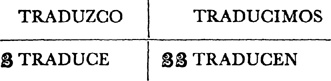
PAST
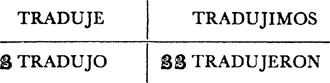
he traducido, I have translated
Five other verbs have the same irregularities as “traducir,” above.
| producir, to produce | produzco, I produce |
| reducir, to reduce | reduzco, I reduce |
| reproducir, to reproduce | reproduzco, I reproduce |
CABER, to fit (not clothes), to have room for
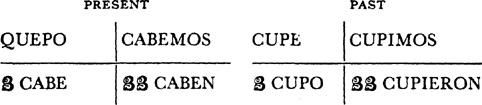
Ha cabido. It has fit (in a trunk, for example).
El libro cabe en la caja. The book fits in the box.
No cabe. It doesn’t fit.
Verbs that end in “cer” in the infinitive end in “ZCO” in the first person singular of the present.
ESTABLECER, to establish
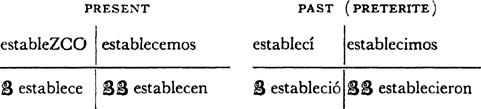
This verb is completely regular except for the “z,” which is inserted in the first person singular of the present.
Following is a list of “cer” infinitives that have been converted into the first person singular of the present.
| INFINITIVE | FIRST PERSON SINGULAR |
| establecer, to establish | establezco, I establish |
| conocer, to know (people) | conozco, I know |
| reconocer, to recognize | reconozco, I recognize |
| crecer. to grow | crezco. I grow |
| desaparecer, to disappear | desaparezco, I disappear |
| obedecer, to obey | obedezco, I obey |
| desobedecer, to disobey | desobedezco, I disobey |
| merecer, to deserve | merezco, I deserve |
| nacer, to be born | nazco, I am born |
| ofrecer, to offer | ofrezco, I offer |
| parecer, to seem like | parezco, I seem like |
| compadecer, to sympathize (with) | compadezco, I sympathize (with) |
“Conocer” (to know) is a very rich verb. It is used frequently in conversation and has several different meanings. They are:
1. “Conocer” is used in the sense of knowing people. In this case it takes the personal “a.”
Conozco a Juan. I know John.
Roberto conoce a Elena. Robert knows Helen.
¿ Conoce a Luis? Do you know Louis?
Conocemos a su tío. We know your uncle.
Conocen a su hermana. They know your sister.
“Conocer” takes the personal pronouns “lo, la” because you don’t say “I know to” or “I know for.” (Only verbs that can be followed by “to” or “for” take the indirect pronoun “le.”)
Lo conozco. I know him.
La conozco. I know her.
¿ La conoce? Do you know her?
¿ Lo conoce? Do you know him?
¿ Los conoce? Do you know them?
Lo he conocido por mucho tiempo. I have known him for a long time.
2. “Conocer” is used in the sense of knowing places, such as cities, countries, roads, buildings, etc. In this case “conocer” does not take the personal “a.” The personal “a” is only for persons.
¿ Conoce México? Do you know Mexico?
¿ Conoce la ciudad? Do you know the city?
¿ Conoce el edificio? Do you know the building?
¿ Conoce la carretera? Do you know the highway?
¿ Conoce el camino? Do you know the road?
¿ Conoce el pueblo? Do you know the town?
3. “Conocer” means “to meet” when you are meeting people for the
FIRST TIME, that is, when you are being introduced to people. It does
not mean to meet people by appointment or to meet people on the street.
It only means “to meet” on being introduced.
¿ Dónde conoció a Roberto? Where did you meet Robert (Where
were you introduced to Robert)?
Conocí a Enrique en el barco. I met Henry on the boat.
¿ Cuándo lo conoció? When did you meet him?
Lo conocí ayer. I met him yesterday.
RECONOCER, to recognize
“Reconocer” also takes the direct object pronouns “lo, la.”
Lo reconocí. I recognized him.
¿ Lo reconoce? Do you recognize him?
GUSTAR, to like
In Spanish we actually haven’t an expression that can be translated to mean “I like it.” Instead, we use the expression “me gusta,” which really means “it is pleasing TO me.” Since you can say “TO me,” this verb takes the indirect object pronoun “le.”
| Me gusta. I like it. | ¿ Me gusta? Do I like it? |
| Le gusta. You, he, she likes it. | ¿ Le gusta? Do you like it? Does he, she like it? |
| Nos gusta. We like it. | ¿ Nos gusta? Do we like it? |
| Les gusta. They like it. | ¿ Les gusta? Do they like it? |
Notice that the questions and answers are identical; only the punctuation changes. In conversation only the inflection of the voice changes.
Me gusta la música. I like music.
Notice that you use the article “la.” The article is absolutely required before the noun.
Me gusta el café. I like coffee.
Me gusta la leche. I like milk.
Me gusta la carne. I like meat.
Le gusta la ensalada. She likes the salad.
Nos gusta la casa. We like the house.
¿ Le gusta la revista? Do you like the magazine?
¿ Le gusta el garage? Does he like the garage?
¿ Le gusta el vestido? Does she like the dress?
¿ Le gusta el vestido a María? Does Mary like the dress?
A María le gusta el vestido. Mary likes the dress.
In the sentence “Le gusta el vestido” (She likes the dress), if you put the words “a María” before the expression, it makes a statement, “Mary likes the dress.” If you put “a María” after the expression, it makes a question, “Does Mary like the dress?”
Le gusta la casa. He likes the house.
A CARLOS le gusta la casa. Charles likes the house.
¿ Le gusta la casa A CARLOS? Does Charles like the house?
Le gusta la blusa. She likes the blouse.
A MI TÍA le gusta la blusa. My aunt likes the blouse.
¿ Le gusta la blusa A MI TÍA? Does my aunt like the the blouse?
If the person goes before the expression, it makes a statement of fact. If a person goes after the expression, it makes a question. The personal “a” is required in all of these expressions.
Les gusta el té. They like tea.
A LOS INGLESES les gusta el té. The English like tea.
¿ Les gusta el té A LOS INGLESES? Do the English like tea?
“Me gusta” is also used with the infinitive.
Me gusta nadar. I like to swim.
No me gusta trabajar. I don’t like to work.
A mis primos les gusta jugar bridge. My cousins like to play bridge.
IF WHAT YOU LIKE IS PLURAL, “GUSTA” BECOMES PLURAL (GUSTAN).
| SINGULAR: | Me gusta la rosa. I like the rose. |
| PLURAL: | Me gustan las rosas. I like the roses. |
| SINGULAR | PLURAL |
| Me gusta el sombrero. I like the hat. | Me gustan los sombreros. I like the hats. |
| Me gusta el gato. I like the cat. | Me gustan los gatos. I like cats. |
| Me gusta el perro. I like the dog. | Me gustan los perros. I like dogs. |
| ¿ Le gusta el disco? Do you like the record? | ¿ Le gustan los discos? Do you like the records? |
| Nos gusta el muchacho. We like the boy. | Nos gustan los muchachos. We like boys. |
| Le gusta la muchacha. He likes the girl. | Le gustan las muchachas. He likes girls. |
The past of “gustar” is “gustó” and “gustaron.”
| SINGULAR | PLURAL |
| Me gustó el libro. I liked the book. | Me gustaron los libros. I liked the books. |
| Me gustó el cine. I liked the movie. | Me gustaron las frutas. I liked the fruits. |
| Me gustó la sopa. I liked the soup. | Me gustaron los espárragos. I liked the asparagus. |
| Me gustó el baile. I liked the dance. | Me gustaron los discos. I liked the records. |
“Gustar” is used in the third man verb form of all tenses.
| SINGULAR | PLURAL |
|
PRESENT:
me gusta, I like (something singular)
|
me gustan, I like (something plural)
|
|
PAST:
me gustó, I liked (something singular)
|
me gustaron, I liked (something plural)
|
|
PRESENT PERFECT:
me ha gustado, I have liked (something singular)
|
me han gustado, I have liked (something plural)
|
|
FUTURE:
me va a gustar, I’m going to like (something singular)
|
me van a gustar, I’m going to like (something plural)
|
In Spanish we don’t say, “I love ham.” Instead, we say, “Ham enchants me” (Me encanta el jamón).
“Encanta” is used in exactly the same way as “gusta.”
| Me encanta el jamón. I love ham. | Me encantan las aceitunas. I love olives. |
| Me encantó la película. I loved the film (The film enchanted me). | Me encantaron los niños. I loved the children (The children enchanted me). |
| A mi papá le encanta nadar. My father loves to swim. | A mi papá le encantan las flores. My father loves flowers. |
| lo conozco, I know him | la lechuga, the lettuce |
| el arroz, rice | el postre, the dessert |
| el pollo, chicken | simpático, charming |
| las legumbres, the vegetables | cerca de, close to, near |
| las zanahorias, the carrots | Lo conozco. I know him. |
| he conocido, I have known | el señor Miranda, Mr. Miranda |
| arroz con pollo, rice with chicken | cenamos, we had dinner, we dined |
| cenar, to have dinner, to dine una chuleta de puerco, a pork chop | helado de vainilla, vanilla ice cream |
| Lo he conocido. I have known him. | por mucho tiempo, for a long time |
He conocido. I have known (people, places).
rubio (masc.), rubia (fem.), blond
moreno (masc.), morena (fem.), brunette
¿Dónde nació? Where were you born?
un coctel de camarones, a shrimp cocktail
una chuleta de carnero, a lamb chop (really mutton chop)
¿Conoce usted a Roberto? Do you know Robert?
¿ Conoce usted a Roberto?
Sí, lo conozco muy bien.
¿ Es simpático Roberto?
Sí, Roberto es muy simpático.
¿ Ha conocido a Roberto por mucho tiempo?
Sí, lo he conocido por mucho tiempo.
¿ Es rubio Roberto?
No, Roberto no es rubio, es moreno.
¿ Dónde nació Roberto?
Nació en México.
¿ Dónde nació usted?
Nací en California.
¿ Dónde nació el señor Miranda?
El señor Miranda nació en Madrid.
¿ Ha conocido al señor Miranda por mucho tiempo?
Sí, he conocido al señor Miranda por mucho tiempo.
¿ Tomó usted la cena con el señor Miranda anoche?
Sí, anoche tomé la cena con el señor Miranda. Cenamos en un restaurante que está cerca de mi casa.
¿ Qué tomó usted para la cena?
Tomé un coctel de camarones.
¿ Le gustan los camarones?
Sí, me gustan mucho los camarones.
¿ Tomó usted una chuleta de puerco?
Sí, tomé una chuleta de puerco.
¿ Qué legumbres tomó con la chuleta?
Tomé zanahorias y papas con la chuleta.
¿ Le gustan las zanahorias?
Sí, me gustan las zanahorias.
¿ Qué tomó Roberto?
Roberto tomó chuletas de carnero, zanahorias, y papas.
¿ Le gustan las chuletas de carnero a Roberto?
Sí, a Roberto le gustan mucho las chuletas de carnero.
¿ Qué tomó el señor Miranda?
El señor Miranda tomó sopa, arroz con pollo, zanahorias, y papas.
¿ Le gusta el arroz con pollo al señor Miranda?
Sí, al señor Miranda le gusta mucho el arroz con pollo.
¿ Tomaron una ensalada?
Sí, tomamos una ensalada de lechuga.
¿ Tomaron postre?
Sí, tomamos helado de vainilla.
¿ Fueron al cine después de la cena?
Sí, fuimos al cine después de la cena.
¿ Les gustó la película?
Sí, nos gustó mucho la película.
Write sentences with the following words.
A
| 1 | 2 |
| Conozco a (I know) | Roberto |
|
¿ Conoce a |
Enrique |
| Conocemos a | su hermano |
|
Conocen a |
su tío |
B
| 1 | 2 | 3 |
| Conocí a (I met, I was introduced to) | Luis | en el barco (boat, ship) |
| Enrique (Henry) | en una fiesta | |
| Elena | en el avión | |
| Marta | en el despacho | |
| su tío | el año pasado |
C
IF WHAT YOU LIKE IS SINGULAR, YOU MUST USE “GUSTA,” WHICH IS SINGULAR.
| PRESENT | |
| 1 | 2 |
| Me gusta (I like) | la casa |
|
¿ Le gusta |
el disco (the record) |
| Nos gusta | el libro (the book) |
|
¿ Les gusta (Do they like?) |
el café |
| PAST | |
| 1 | 2 |
| Me gustó (I liked) | el té (tea) |
|
¿ Le gustó |
el chocolate |
| Nos gustó | el tocino (the bacon) |
|
¿ Les gustó |
el jamón (the ham) |
| Me encantó (I loved) | la película |
| PRESENT | |
| 1 | 2 |
| Me encanta (I love) | el arroz con pollo |
|
Le encanta (He, she loves) |
(rice with chicken) |
| Nos encanta | el ajo (garlic) |
|
Les encanta (They love) |
nadar |
D
IF WHAT YOU LIKE IS PLURAL, USE “GUSTAN” WHICH IS PLURAL.
| PRESENT | |
| 1 | 2 |
| Me gustan | los tomates |
|
¿ Le gustan |
los espárragos |
| Nos gustan | los rábanos (radishes) |
|
¿ Les gustan |
los frijoles (beans) |
| PAST | |
| 1 | 2 |
|
¿ Le gustaron |
los discos (the records) |
| Me gustaron | las flores |
| Nos gustaron | las papas |
|
¿ Les gustaron |
las zanahorias |
| Me encantaron | las cebollas (onions) |
|
Les encantaron |
las aceitunas (olives) |
| Nos encantaron | los rábanos (radishes) |
E
| PRESENT | |
| 1 | 2 |
|
A María le gusta (Mary likes) |
la comedia |
|
A mi tío le gusta |
la pipa |
|
A mi hermano le gusta |
el disco |
|
Al doctor le encanta |
la ensalada |
|
Al general le encanta |
la novela |
|
Al señor Miranda le gusta |
el arroz |
|
A la señora Miranda le gusta |
la carne (meat) |
|
A la señorita Miranda le gusta |
el libro |
F
| 1 | 2 | 3 |
|
¿ Le gusta |
el sombrero | a Elena? |
|
¿ Le gusta |
la blusa | a su hermana? |
|
¿ Le gusta |
el disco | a su primo? |
|
¿ Le gusta |
la película | a Enrique? |
Translate the following sentences into Spanish. Write out each sentence in Spanish, using the columns above as a guide. Check your sentences with the correct translations below this exercise.
Check your sentences with the translations below.
There are some verbs that are converted into nouns by adding the letters “imiento.” Remove “er” or “ir” from the infinitive and add “imiento.”
| conocer, to know | conocimiento, knowledge |
| reconocer, to recognize | reconocimiento, recognition |
| sufrir, to suffer | sufrimiento, suffering |
| nacer, to be born | nacimiento, birth |
| establecer, to establish | establecimiento, establishment |
| crecer, to grow | crecimiento, growth |
| agradecer, to be grateful | agradecimiento, gratitude |
1. “Agradecer” (to be grateful) takes the indirect object
pronoun “lc” because you can say “I am grateful TO John.” As you know,
verbs that can be followed by “to” or “for” take the indirect object
pronoun “le.”
Le agradezco el favor. I am grateful to you for the
favor.
Se lo agradezco. I am grateful to you (for it).
2. “Compadecer” (to sympathize with, to pity) takes the
direct object pronouns “lo, la” because this verb cannot be followed by
the words “to” or “for.”
Lo compadezco. I sympathize with you. I feel sorry for you. I pity
you.
La compadezco. I sympathize with her.
¿ No lo compadece? Don’t you feel sorry for him?
Don’t forget to use “lo” for a man, “la” for a woman.
3. “Ofrecer” (to offer) takes the indirect object “le”
because you can offer things TO people.
Le ofrecí un premio. I offered you (him, her) a
prize.
¿ Qué le ofreció? What did you offer him (her)?
¿ Cuánto le ofreció? How much did you offer him
(her)?
Le he ofrecido muchas cosas. I have offered you (him,
her) many things.
Le estoy ofreciendo el sol y la tierra. I am offering you
(him, her) the sun and the earth.
Voy a ofrecerle un buen sueldo. I am going to offer you
(him, her) a good salary.
Me ofreció un buen sueldo. He offered me a good salary.
4. “Parecer” (to seem, to appear, to show up) takes the
indirect object “le” because you can say, “It seems TO me.”
Me parece que es interesante. It seems to me that it is
interesting.
¿ Qué le parece? What does it seem to you? What do you think? What
do you think of it?
This is a much used expression and you should learn it well.
¿ Qué le parece la comedia? What do you think of the play?
¿ Qué le parece la casa? What do you think of the house?
¿ Qué le pareció? What did you think of it?
5. “Nacer” (to be born)
¿ Dónde nació? Where were you born?
Nací en California. I was born in California.
el nacimiento, the birth
el Renacimiento, the Renaissance
| huevos fritos, fried eggs | papas fritas, fried potatoes |
| pescado frito, fried fish | a la parrilla, broiled, grilled |
| pollo a la parrilla, broiled chicken | puré de papas, mashed potatoes |
| horno, oven | al horno, roast, baked |
| pato al horno, roast duck | la sal, the salt |
| la pimienta, the pepper | el azúcar, the sugar |
| apio, celery | las cebollas, the onions |
| queso, cheese | galletas, crackers |
| una cuchara, a spoon | un cuchillo, a knife |
| un tenedor, a fork | un vaso, a glass |
| un plato, a plate, a dish | filete, filet, steak |
| cerca de, close to, near to | lejos de, far from |
| en frente de, in front of | detrás de, behind |
| encima de, on top of | debajo de, under, underneath |
| junto a, next to | arriba, up, upstairs |
| juntos (masc.), juntas (fem.), together | abajo, down, downstairs |
| pan con mantequilla, bread and butter (bread with butter) | |
| café con leche, coffee with milk | |
| pan con queso, bread and cheese | |
| pan con mermelada, bread and marmalade | |
| huevos con tocino, eggs and bacon |
| ME | myself |
|
SE |
yourself, himself, herself, itself |
| NOS | ourselves |
|
SE |
yourselves, themselves |
The pronouns precede the verbs in all the different tenses. But when the infinitive stands alone the pronoun is added on to it to form one word.
PESARSE, to weigh yourself
PRESENT
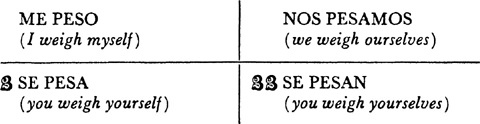
PAST (PRETERITE)
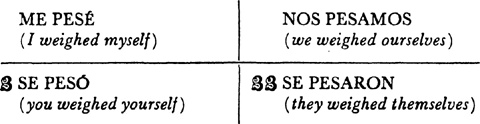
FUTURE
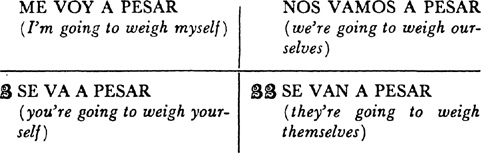
PRESENT PERFECT
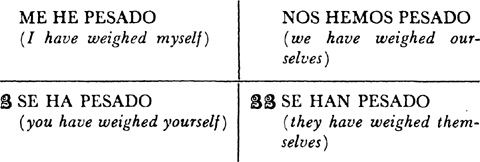
PRESENT PROGRESSIVE
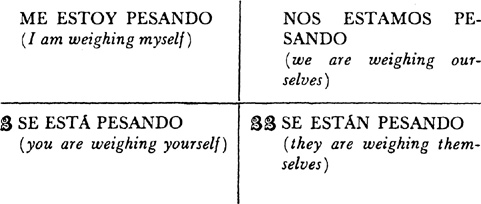
Verbs that are followed by “myself” are known as reflexive verbs. Reflexive verbs are verbs whose action is directed back upon the subject.

I kicked myself
The action is directed (reflects) back upon me. Therefore the verb is reflexive.
There are many more reflexive verbs in Spanish than there are in English. It is helpful to remember that many of the reflexive verbs that are commonly used in Spanish refer to a PHYSICAL action that is directed back upon the subject. Many of these physical verbs actually involve touching some part of your body.
EXAMPLES:
PHYSICAL VERBS THAT ARE REFLEXIVE
bañarse, to bathe (yourself, himself, herself, itself)
lavarse, to wash (yourself)
peinarse, to comb (yourself)
secarse, to dry (yourself)
afeitarse, to shave (yourself)
pararse, to stand (yourself) up, to stop (yourself)
quitarse, to take off (yourself)
levantarse, to get (yourself) up
ponerse, to put on (yourself)
sentarse, to sit (yourself) down
acostarse, to go (yourself) to bed
*dormirse, to go (yourself) to sleep
*vestirse, to dress (yourself)
*desvestirse, to undress (yourself)
“Sentarse” and “acostarse” are radical changing.
*Don’t try to use the verbs that are marked with asterisks. They have irregularities that will be presented in later lessons. These verbs have been included in the above list in order to give you a more complete concept of physical verbs that are reflexive. One of my pupils once said, “It’s easy for me to remember reflexive verbs because they’re the things I do when I’m getting ready for a party, such as bathe myself, dry myself, shave myself, comb myself, dress myself, and so forth.”
SOMETIMES THE SPANISH REFLEXIVE IS EQUIVALENT TO THE ENGLISH WORD “GET.”
EXAMPLES:
| to get better | mejorarse (related to “mejor,” better) |
| to get married | casarse (related to “casa,” house) |
| to get tired | cansarse (related to “cansancio,” fatigue) |
| to get ready | alistarse (related to “listo,” ready) |
| to get sick | enfermarse (related to “enfermo,” sick) |
| to get seasick | marearse (related to “mar,” sea) |
| to get restless | inquietarse (related to “quieto,” quiet) |
| to get exasperated | exasperarse (related to “exasperación”) |
| to get enthusiastic | entusiasmarse (related to “entusiasmo,” enthusiasm) |
| to get fat | engordarse (related to “gordo,” fat) |
| to get drunk | emborracharse (related to “borracho,” drunk) |
| to get close | acercarse (related to “cerca de,” close to) |
| to get frightened | asustarse (related to “susto,” fright) |
| to get cold | enfriarse (related to “frío,” cold) |
NOTE: “Resfriarse” means to catch cold.
PONER, to put, to set (the table), to lay (an egg)
PAST (PRETERITE)
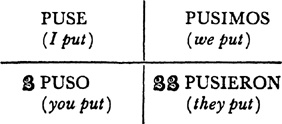
When “poner” is reflexive it becomes a physical verb and means “to put on.”
PAST (PRETERITE)
PONERSE, to put on
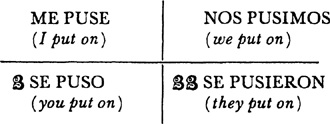
Me puse el sombrero. I put on my hat.
Me lavé las manos. I washed my hands.
Notice that in the above sentences you do not say “my hat” or “my hands,” but “the hat” and “the hands.” YOU DO NOT USE POSSESSIVE ADJECTIVES AFTER REFLEXIVE VERBS.
We have covered three points in this lesson.
REFLEXIVE VERB EXERCISE
SAMPLE VERB
BAñARSE, to bathe (yourself)
PRESENT
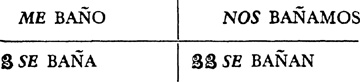
PAST (PRETERITE)
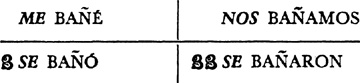
PRESENT PERFECT

PRESENT PROGRESSIVE
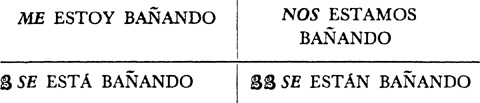
FUTURE

Write out the following reflexive verbs, using the sample above as a guide.
1. Remove “ARSE” from each infinitive.
2. Write out each verb, adding the reflexive pronouns that are in heavy type above.
| casarse, to get married | afeitarse, to shave |
| levantarse, to get up | lavarse, to wash |
| peinarse, to comb | quitarse, to take off |
| agua, water | la cara, the face |
| el jabón, the soap | el pelo, hair, the hair |
| el peine, the comb | las manos, the hands |
| la toalla, the towel | la ropa, the clothes |
| a las once, at eleven o’clock | la ropa interior, underwear |
| a las siete, at seven o’clock | los calcetines, the socks |
| Me afeité. I shaved. | los pantalones, the trousers |
| ¿Se afeitó? Did you shave? | la corbata, the necktie |
| Me bañé. I bathed. | el saco, the suit jacket |
| ¿Se bañó? Did you bathe? | las medias, the stockings |
| Me peiné. I combed hair). | el fondo, the slip |
| ¿Se peinó? Did you comb (your hair)? | la falda, the skirt |
| Me levanté. I got up. | el vestido, the dress |
| ¿Se levantó? Did you get up? | el traje, the suit (man’s or woman’s) |
| Me puse la camisa. I put on my shirt. | |
| Me puse los zapatos. I put on my shoes. | |
| Me lavé las manos. I washed my hands. | |
| ¿Se lavó las manos? Did you wash your hands? | |
| ¿Se puso los zapatos? Did you put on your shoes? | |
| ¿Se lavó el pelo? Did you wash your hair? | |
| ¿A qué hora se levantó? At what time did you get up? | |
| ¿A qué hora se acostó? At what time did you go to bed? |
¿A qué hora se acostó anoche?
Anoche me acosté a las once.
¿A qué hora se levantó esta mañana?
Me levanté a las siete esta mañana.
¿Se bañó usted esta mañana?
Sí, me bañé esta mañana.
¿Se bañó con agua y jabón?
Sí, me bañé con agua y jabón.
¿Se secó usted con una toalla?
Sí, me sequé con una toalla.
¿Se lavó el pelo?
Sí, me lavé el pelo.
¿Se secó el pelo con una toalla?
Sí, me sequé el pelo con una toalla.
¿Se peinó usted?
Sí, me peiné con un peine.
¿Se lavó usted las manos?
Sí, me lavé las manos.
¿Se lavó usted la cara?
Sí, me lavé la cara.
Sí, me puse la ropa interior.
¿Se puso la ropa interior?
¿Se puso usted los zapatos?
Sí, me puse los zapatos.
The following questions are for men only.
¿Se puso usted los calcetines?
Sí, me puse los calcetines.
¿Se puso usted los pantalones?
Sí, me puse los pantalones.
¿Se afeitó usted?
Sí, me afeité.
¿Se puso usted la camisa?
Sí, me puse la camisa.
¿Se puso usted la corbata?
Sí, me puse la corbata.
¿Se puso usted el saco?
Sí, me puse el saco.
¿Se puso usted el traje?
Sí, me puse el traje.
The following questions are for women only.
¿Se puso usted las medias?
Sí, me puse las medias.
¿Se puso usted el fondo?
Sí, me puse el fondo.
¿Se puso usted la blusa?
Sí, me puse la blusa.
¿Se puso usted la falda?
Sí, me puse la falda.
¿Se puso usted el traje?
Sí, me puse el traje.
Se puso usted el vestido?
Sí, me puse el vestido.
Combine the words below in different ways to form as many sentences as you can. Just be sure to use words from each of the columns in every sentence you form.
A
PONERSE, to put on
| 1 | 2 |
| Me pongo | el sombrero |
|
Roberto se pone
|
la camisa (the shirt) |
| Nos ponemos | el abrigo (the coat) |
|
Se ponen
|
los guantes (the gloves) |
| Me puse | el vestido (the dress) |
|
Se puso
|
los zapatos (the shoes) |
| Nos pusimos | la bufanda (the scarf) |
|
Se pusieron
|
las medias (the stockings) |
| Me he puesto (I have put on) |
el traje (the suit) la ropa (the clothes) |
| Me estoy poniendo (I am putting on) |
los calcetines (the socks) la ropa interior (the underwear) |
B
LEVANTARSE, to get up
ACOSTARSE, to go to bed (radical changing)
| 1 | 2 |
| Me acuesto (I go to bed) | temprano (early) |
|
Carlos se acuesta
|
tarde |
|
¿Se acuesta (Do you go to bed?)
|
muy temprano a las once (11) |
| Nos acostamos | a las diez (10) |
|
Se acuestan
|
a las siete (7) |
| Me levanto | a las ocho |
|
¿Se levanta
|
a las ocho y media (8:30) |
| Nos levantamos | a las seis (6) |
|
Se levantan
|
a las cinco (5) |
| Me voy a levantar |
PAST
| Anoche me acosté (Last night I went to bed) |
muy temprano muy tarde |
|
¿Se acostó (Did you go to bed?)
|
temprano |
| Nos acostamos | tarde |
|
Se acostaron
|
a las once |
| Me levanté (I got up) | a las deiz |
|
¿Se levantó
|
a las seis |
| Nos levantamos | a las ocho |
|
Se levantaron
|
a las cinco |
C
CASARSE, to get married
In Spanish you don’t say, “He married Helen.” You must say, “He got married with Helen (Se casó con Elena).”
| 1 | 2 |
| Me casé (I got married) | en junio (in June) |
|
Eduardo se casó |
en agosto |
|
Elena se casó |
con Eduardo |
|
Luis se casó |
el año pasado |
|
Marta se casó |
con Juan |
| Nos casamos | en mayo |
|
Se casaron |
en abril |
|
Se van a casar |
en septiembre |
| Juan se casó | en diciembre |
| Elena se casó | en marzo (March) |
| Isabel se casó | en enero (January) |
| Enrique se casó | en febrero |
Translate the following sentences into Spanish. Write out each sentence in Spanish, using the columns above as a guide. Check your sentences with the correct translations below this exercise.
Check your sentences with the translations below.
1. “Ponerse a” means “to start to” (to put yourself to). It is used with the infinitive.
Me puse a cantar. I started to sing.
Se puso a llorar. He started to cry.
Se pusieron a trabajar. They started to work.
“Ponerse” also means “to become” (to get) when it is followed by an adjective.
Se puso furioso. He got furious. He became furious.
Se puso pálido. He got pale. He became pale.
2. Sometimes reflexive pronouns are used instead of a subject.
EXAMPLES:
Se habla español. Spanish is spoken.
Se permite. It is permitted, allowed.
Se prohibe. It is prohibited, forbidden.
Se necesita una criada. Wanted, a maid (A maid is needed).
The above sentences do not state who speaks, permits, needs, etc. Therefore the reflexive pronoun is used. These expressions are not frequently used in conversation. You’ll find them mostly in signs such as “Se prohibe fumar” (Smoking is forbidden) or in newspaper ads such as “Se necesita una criada” (Maid wanted).
3. The reflexive is also used in what we call reciprocal action, that is, when people do things to each other.
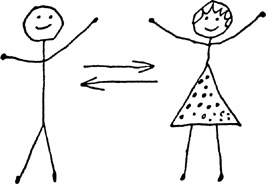
Se besaron. They kissed each other.
Nos vemos. We see each other.
Se parecen. They resemble each other.
No se hablan. They don’t speak to each other.
Se comprenden. They understand each other.
4. You have learned that “I’m going to the theater” is “Voy al
teatro” and “He’s going to the movies” is “Va al cine.”
When you don’t say where you’re going all forms of the verb “ir” become
reflexive.
Sometimes you use the word “away” in English when you don’t say where
you are going: “I’m going away.”
IRSE, to go (away)
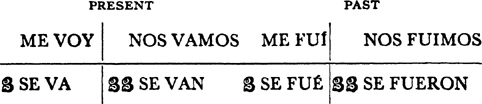
Me fuí con Roberto. I went (away) with Robert.
Se fué solo. He went (away) alone.
Me voy. I’m going (away).
¿Por qué se fué? Why did you go (away)?
“Ya” means “already, now,” and it’s used very much with the different forms of “ir.”
| Ya me voy. I’m going now. |
Ya se van. They’re going now. |
|
Ya se va. He’s going now. |
Ya se fueron. They’ve already gone (left). |
| Ya nos vamos. We’re going now. |
Ya se fué. He’s already gone (left). |
LLAMARSE, to be called
Me llamo Elena. I’m called Helen (My name is Helen).
¿Comó se llama? How are you called (What’s your
name)?
Se llama Carlos. He’s called Charles (His name is
Charles).
“Llamar” means “to call” when it isn’t reflexive and “to be called” when it is reflexive.
QUEDARSE, to stay
Me quedé con Luis. I stayed with Louis.
Nos quedamos en el club. We stayed at the club.
CAERSE, to fall, to fall down
Me caí. I fell down.
Se cayó. He fell down.
PARECERSE, to resemble, to look like
Se parece a su mamá. He resembles his mother (He looks like
his mother).
Me parezco a mi tío. I resemble my uncle (I look like my uncle).
CEPILLARSE, to brush (hair, teeth, clothes)
Me cepillé los dientes. I brushed my teeth.
Se cepilló el pelo. She brushed her hair.
METERSE, to put yourself into, to get yourself into
Me metí en un lío. I got myself into a scrape (a mess).
SENTARSE, to sit down (radical changing)
Me siento en el sofá. I sit on the sofa.
Se sentó en el asiento. He sat down on the seat (in the
theater, plane, train).
Se sentó en el sillón. He sat down on the armchair.
Se sentaron en las sillas. They sat down on the chairs.
ACOSTARSE, to go to bed (radical changing)
Me acosté tarde. I went to bed late.
Siempre me acuesto temprano. I always go to bed early.
ACORDARSE, to remember (radical changing)
Me acuerdo. I remember.
¿Se acuerda? Do you remember?
DESHACERSE DE, to get rid of. This verb comes from “hacer” and is conjugated like “hacer” (to do, to make).
ATREVERSE, to dare
QUEJARSE, to complain
PORTARSE, to behave yourself
Se porta bien. He behaves.
Se portó mal. He misbehaved.
ENTERARSE, to find out
PONERSE, to put on (clothes), to set (sun), to become (plus any adjective)
Me puse el traje. I put on my suit.
¿A qué hora se puso el sol? At what time did the sun set?
Carlos se puso furioso. Charles got furious (Charles became
furious).
DARSE CUENTA, to become aware of, to find out, to discover (to give yourself account)
Me dí cuenta. I found out.
Se dió cuenta. He found out.
EQUIVOCARSE, to make a mistake, to be mistaken
Me equivoqué. I made a mistake.
Si no me equivoco. If I’m not mistaken.
RASCARSE, to scratch
El mono se rascó la cabeza.
The monkey scratched his head.
RESBALARSE, to slip, to slide
Me resbalé en el hielo. I slipped on the ice.
ESCAPARSE, to escape, to get away
Me escapé de la fiesta. I got away from the party.
IMAGINARSE, to imagine
Me imagino qué llego esta noche.
I imagine that he arrived tonight.
BAJARSE (DE), to get down, to get off vehicles
Se bajó del tren. He got off the train.
SUBIRSE (A), to get up on, to climb, to get on vehicles
Se subió al árbol. He climbed the tree.
Se subió al avión. He got on the plane.
APURARSE, to hurry
¿Por qué no se apura? Why don’t you hurry?
ALEGRARSE (DE), to be glad
Me alegro de verlo. I’m glad to see you.
DESQUITARSE (DE), to get even, to retaliate
Hay que gozar mucho para desquitarse de la vida.
(“Hay que” means “one must.”)
One must enjoy much to get even with life.
VERSE, to appear, to look (in appearance)
Se ve muy bien. He looks very well.
Se ve mejor. He looks better.
RUBORIZARSE, to blush, to flush
VOLVERSE, to become
Se volvió loco. He went (became) crazy.
CUIDARSE, to take care of yourself, to be careful
Se va a cuidar. He’s going to take care of himself.
PERDERSE, to get lost
Se perdió. You, he, she, it got lost.
In the future form the pronoun can go either after or before the verb. Use whichever seems more comfortable to you.
EXAMPLES:
| I’m going to weigh myself. | { |
Voy a pesarme. or Me voy a pesar. |
| You’re going to weigh yourself. | { |
Va a pesarse. or Se va a pesar. |
| We’re going to weigh ourselves. | { |
Vamos a pesarnos. or Nos vamos a pesar. |
| They’re going to weigh themselves. | { |
Van a pesarse. or Se van a pesar. |
Once in a while you will hear a Spanish-speaking person say. “Estoy pesándome,” thereby adding the pronoun to the present participle. This is correct, but of less frequent use than the construction where the pronoun precedes both verbs: Me estoy pesando.
CAMBIARSE, to change (clothes)
| PRESENT | PAST (PRETERITE) |
| ME CAMBIO, I change | ME CAMBIÉ, I changed |
|
SE CAMBIA, you change |
SE CAMBIÓ, you changed |
| NOS CAMBIAMOS, we change | NOS CAMBIAMOS, we changed |
|
SE CAMBIAN, they change |
SE CAMBIARON, they changed |
Me voy a cambiar. I’m going to change.
Me he cambiado. I have changed.
Me estoy cambiando. I am changing.
Me cambié la camisa. I changed my shirt.
Me cambié los zapatos. I changed my shoes.
María se cambió la ropa. Mary changed her clothes.
Roberto se está cambiando el traje. Robert is changing his
suit.
Notice that no possessive pronouns are used in the sentences above.
QUITARSE, to take off
| PRESENT | PAST (PRETERITE) |
| ME QUITO, I take off | ME QUITÉ, I took off |
|
SE QUITA, you take off |
SE QUITÓ, you took off |
| NOS QUITAMOS, we take off | NOS QUITAMOS, we take off |
|
SE QUITAN, they take off |
SE QUITAN, they take off |
Me voy a quitar. I’m going to take off.
Me he quitado. I have taken off.
Me estoy quitando. I am taking off.
| Me voy a quitar el abrigo. | I’m going to take off my coat. |
|
Enrique se quitó el sombrero. |
Henry took off his hat. |
|
¿Por qué no se quita el suéter? |
Why don’t you take off your sweater? |
|
Mi abuelo se quitó los zapatos. |
My grandfather took off his shoes. |
|
¿Se va a quitar la bufanda? |
Are you going to take off your scarf? |
Notice that no possessive pronouns are used in the sentences above.
Combine the words below in different ways to form as many sentences as you can. Be sure to use words from each of the columns in every sentence you form.
A
| 1 | 2 |
| Me quité (I took off) | los zapatos |
|
¿Se quitó |
la bufanda |
| Nos quitamos | la corbata |
|
Se quitaron |
los pantalones |
| Me voy a quitar | el abrigo |
|
Se va a quitar |
los calcetines |
| Nos vamos a quitar | las medias |
| Me estoy quitando | la falda |
| Me cambié (I changed) | el vestido |
|
¿Se cambió |
la ropa interior |
| Nos cambiamos | la camisa |
|
¿Se cambiaron |
el chaleco (vest) |
| el cinturón (belt) | |
| el saco (suit jacket) | |
| el impermeable (raincoat) | |
| elfondo (slip) | |
| la ropa |
CORTAR, to cut
CORTARSE, to cut yourself
| PRESENT | PAST (PRETERITE) |
| ME CORTO, I cut myself | ME CORTÉ, I cut myself |
|
SE CORTA, you cut yourself
|
SE CORTÓ, you cut yourself |
|
NOS CORTAMOS, we cut ourselves |
NOS CORTAMOS, we cut ourselves |
|
SE CORTAN, they cut themselves |
SE CORTARON, they cut themselves |
Me voy a cortar. I’m going to cut myself.
Me he cortado. I have cut myself.
Me estoy cortando. I am cutting myself.
LAVAR,
to wash
LAVARSE,
to wash yourself
| PRESENT | PAST (PRETERITE) |
|
ME LAVO, I wash myself |
ME LAVÉ, I washed myself |
|
SE LAVA, you wash yourself |
SE LAVÓ, you washed yourself |
|
NOS LAVAMOS, we wash ourselves |
NOS LAVAMOS, we washed ourselves |
|
SE LAVAN, they wash themselves |
SE LAVAN, they washed themselves |
Me voy a lavar. I’m going to wash myself.
Me he lavado. I have washed myself.
Me estoy lavando. I am washing myself.
SECAR, to dry
SECARSE, to dry yourself
| PRESENT | PAST (PRETERITE) |
|
ME SECO, I dry myself |
ME SEQUÉ, I dried myself |
|
SE SECA, you dry yourself |
SE SECÓ, you dried yourself |
|
NOS SECAMOS, we dry ourselves |
NOS SECAMOS, we dried ourselves |
|
SE SECAN, they dry themselves |
SE SECARON, they dried themselves |
Me voy a secar. I’m going to dry myself.
Me he secado. I have dried myself.
Me estoy secando. I am drying myself.
QUEMAR, to burn
QUEMARSE, to burn yourself
| PRESENT | PAST (PRETERITE) |
|
ME QUEMO, I burn myself |
ME QUEMÉ, I burned myself |
|
SE QUEMA, you burn yourself |
SE QUEMÓ, you burned yourself |
|
NOS QUEMAMOS, we burn ourselves |
NOS QUEMAMOS, we burned ourselves |
|
SE QUEMAN, they burn themselves |
SE QUEMARON, they burned themselves |
Me voy a quemar. I’m going to burn myself.
Me he quemado. I have burned myself.
Me estoy quemando. I am burning myself.
LASTIMAR,
to hurt
LASTIMARSE,
to hurt yourself
| PRESENT | PAST (PRETERITE) |
|
ME LASTIMO, I hurt myself |
ME LASTIMÉ, I hurt myself |
|
SE LASTIMA, you hurt yourself |
SE LASTIMÓ, you hurt yourself |
|
NOS LASTIMAMOS, we hurt ourselves |
NOS LASTIMAMOS, we hurt ourselves |
|
SE LASTIMAN, they hurt themselves |
SE LASTIMARON, they hurt themselves |
Me voy a lastimar. I’m going to hurt myself.
Me he lastimado. I have hurt myself.
Me estoy lastimando. I’m hurting myself.
Me lastimé la mano. I hurt my hand.
Enrique se lastimó la espalda. Henry hurt his back.
Se va a lastimar la pierna. You’re going to hurt your leg.
Se va a lastimar. You’re going to hurt yourself.
Se va a lastimar el brazo. You’re going to hurt your arm.
Me lastimé el tobillo. I hurt my ankle.
Juan se lastimó el pie. John hurt his foot.
Mi tío se lastimó el hombro. My uncle hurt his shoulder.
Me quemé el dedo. I burned my finger.
Enrique se quemó la mano. Henry burned his hand.
Se va a cortar el dedo. You’re going to cut your finger.
Me corté el dedo. I cut my finger.
Me voy a lavar las manos. I’m going to wash my hands.
El doctor se lavó las manos. The doctor washed his hands.
¿Por qué no se seca las manos? Why don’t you dry your hands?
Me sequé las manos. I dried my hands.
Enrique se secó las manos. Henry dried his hands.
Me lavé la cara. I washed my face.
¿Por qué no se lava la cara? Why don’t you wash your face?
| la compañia, the company | la botica, the drugstore |
| la iglesia, the church | la lavandería, the laundry |
| el ferrocarril, the railroad | la joyería, the jewelry store |
| el museo, the museum | la carnicería, the butcher shop |
| la cárcel, the jail | la zapatería, the shoe store |
|
el colegio, the school la escuela, the school |
la planchaduría, the dry cleaners |
|
el paraguas, the umbrella el país, the country, nation |
la tintorería, the dyers, the cleaners and dyers |
ow
that you have covered thirty-eight lessons, test yourself again to see
how well you are progressing.
Fill in the blanks with the Spanish equivalents of the following words and sentences. You should be able to complete this test in twenty minutes.
1. I said.
2. He did.
3. She made.
4. Who said?
5. They came.
6. We had.
7. I have wanted.
8. They said.
9. I’m going to bring.
10. Have you been in Cuba?
11. I have been working.
12. We said.
13. They made.
14. I couldn’t.
15. He brought.
16. He has done.
17. They are doing.
18. He has brought.
19. I went out.
20. We heard.
21. They saw.
22. They have heard.
23. She went.
24. We saw.
25. Did he go out?
26. They heard.
27. They are going to come.
28. I have.
29. He comes.
30. Who came?
31. Have you?
32. I put (present tense).
33. They bring.
34. He says.
35. He goes out.
36. They make.
37. Did you make?
38. Do you see?
39. They hear.
40. We go out.
41. They have.
42. Who went out?
43. He’s ten years old.
44. I feel like going.
45. I have a cold.
46. Are you hungry?
47. They are right.
48. Are you sleepy?
49. I’m cold.
50. I want to see.
51. I can’t see.
52. Can you go?
53. It’s cold.
54. An hour ago.
55. A long time ago.
56. I have seen.
57. What have you done?
58. We have said.
59. They have seen.
60. I propose.
Check your answers with those below.
This was a very difficult test. If you made no more than six errors, you are an exceptionally good student. If you made twenty or more errors you should review Lessons 31 and 36 carefully and then try the test again.
Now let’s see how well you remember the pronouns. Fill in the blanks with the Spanish equivalents of the following sentences. You should be able to complete this test in fifteen minutes.
1. I saw him.
2. She saw us.
3. They recommended him.
4. Did you visit him?
5. He saw her.
6. We saw them (masc.).
7. Who saw her?
8. He saw us.
9. He invited me.
10. Who brought it (masc.)?
11. Did you see him?
12. Did they invite her?
13. It surprised me.
14. He didn’t see her.
15. They took us to the movies.
16. He took me to the party.
17. Who bought it (fem.)?
18. I didn’t see it (masc.).
19. I spoke to him.
20. He bought it for me.
21. I wrote to him.
22. He invited them (fem.).
23. She wrote to my aunt.
24. He bought my uncle a pipe.
25. I sent them a cable.
26. She gave it to him.
27. She gave Charles a sweater.
28. I gave it to him.
29. He sold it to her.
30. He gave it to me.
Check your answers with those below.
If you made no more than five errors, your work is excellent and you have understood the lessons on pronouns. If you made more than ten errors I suggest that you review Lessons 34 and 35.
Now let’s see how well you remember the reflexive verbs. Translate the following sentences into Spanish. Write the translations in the blanks below the sentences.
1. I went to bed early.
2. He got up late.
3. They got married.
4. She put on her hat.
5. He shaved.
6. I washed my hands.
7. Why did he go (away)?
8. She stayed with her aunt.
9. H has gone to bed.
10. She is bathing.
Check your answers with the answers below. If you have more than three errors, review Lesson 38.
 n
English there is only one simple past tense, but in Spanish these are
two simple tenses that express the past: the preterite and the
imperfect.
n
English there is only one simple past tense, but in Spanish these are
two simple tenses that express the past: the preterite and the
imperfect.
The preterite is used to express a single completed action in the past and can best be described by a dot.
PRETERITE
(Single completed action)

| Escribí una carta. | I wrote a letter. |
| Tomé la cena. | I had dinner. |
| Compré la casa. | I bought the house. |
| Tuve un accidente. | I had an accident. |
The imperfect, on the other hand, is used to express continuous or repeated action in the past and can be described by a long, continuous line or by a series of dashes. The line represents continuity. The dashes represent repetition.
IMPERFECT
(1. Continuous action)

| Tenía un auto. | I had a car. |
| Quería a su madre. | He loved his mother. |
(2. Repeated action)

Escribía una carta todos los días. I used to write a letter every day. Mi primo siempre tomaba la cena en el mismo restaurante. My cousin always used to have dinner in the same restaurant.
Mi primo compraba el períodico todas las mañanas. My cousin bought (used to buy) the newspaper every morning.
The verb endings for the imperfect tense are:
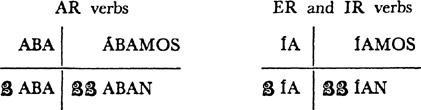
Examples:
COMPRAR, to buy
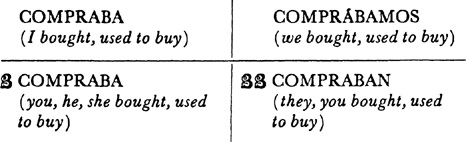
VENDER, to sell
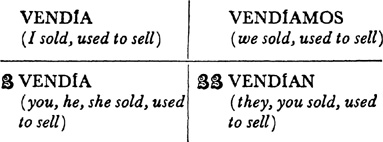
Notice that there is no difference between the first person and the third man form in the singular.
AR verbs
Following is a list of infinitives converted into the preterite and imperfect tenses.
| INFINITIVES | PRETERITE | IMPERFECT |
| comprar, to buy | compré, I bought | compraba, I used to buy |
| estudiar, to study | estudié, I studied | estudiaba, I used to study |
| tomar, to take | tomé, I took | tomaba, I used to take |
| hablar, to speak | hablé, I spoke | hablaba, I used to speak |
| copiar, to copy | copié, I copied | copiaba, I used to copy |
| trabajar, to work | trabajé, I worked | trabajaba, I used to work |
| visitar, to visit | visité, I visited | visitaba, I used to visit |
ER and IR verbs
| INFINITIVES | PRETERITE | IMPERFECT |
| vender, to sell | vendí, I sold | vendía, I used to sell |
| correr, to run | corrí, I ran | corría, I used to run |
| ofrecer, to offer | ofrecí, I offered | ofrecía, I used to offer |
| escribir, to write | escribí, I wrote | escribía, I used to write |
| recibir, to receive | recibí, I received | recibía, I used to receive |
| decidir, to decide | decidí, I decided | decidía, I used to decide |
| salir, to go out | salí, I went out | salía, I used to go out |
1. Cover up the right-hand column.
2. Translate the verbs in the left-hand column.
3. Check your translations with those below.
| I had, used to have | tenía |
| I wanted, used to want | quería |
| I knew, used to know | sabía |
| we sold, used to sell | vendíamos |
| we had, used to have | teníamos |
| they were, used to be (estar) | estaban |
| they sang, used to sing | cantaban |
| they did, used to do | hacían |
| they worked, used to work | trabajaban |
| they bought, used to buy | compraban |
| he made, used to make | hacía |
| she could, used to be able to | podía |
| you went out, used to go out | salía |
| he said, used to say | decía |
| we took, used to take | tomábamos |
| we danced, used to dance | bailábamos |
| they wrote, used to write | escribían |
| they came, used to come | venían |
| she spoke, used to speak | hablaba |
| we spoke, used to speak | hablábamos |
| he used, used to use | usaba |
| she prepared, used to prepare | preparaba |
| I thought, used to think (opinion) | creía |
| they said, used to say | decían |
| we imported, used to import | importábamos |
| she described, used to describe | describía |
| I read, used to read | leía |
| she learned, used to learn | aprendía |
| I hoped, used to hope | esperaba |
| we deposited, used to deposit | depositábamos |
| you ate, used to eat | comía |
| we walked, used to walk | caminábamos |
| they took care of, used to take care of | cuidaban |
| I helped, used to help | ayudaba |
| he won, used to win | ganaba |
| she played, used to play (game) | jugaba |
Following are examples of the use of the preterite as compared to the imperfect. Remember that the preterite is used for a single completed action and is represented by a dot. The imperfect is used to express continuous or repeated action and is represented by a long line or a series of dashes.
| PRETERITE |
María tomó un taxi esta mañana. Mary took a taxi this morning. |
|
IMPERFECT — — — — |
María tomaba un taxi todas las mañanas. Mary used to take a taxi every morning. |
|
PRETERITE • |
Marta compró el pan. Martha bought the bread. |
|
IMPERFECT — — — — |
Marta siempre compraba el pan. Martha always bought the bread. |
|
PRETERITE • |
Luis preparó la lección. Louis prepared the lesson. |
|
IMPERFECT — — — — |
Luis siempre preparaba la lección. Louis always prepared the lesson. |
|
PRETERITE • |
Eduardo vino a la fiesta. Edward came to the party. |
|
IMPERFECT — — — — |
Eduardo venía a mi casa todas las tardes. Edward used to come to my house every afternoon. |
|
PRETERITE • |
Juan escribió un artículo. John wrote an article. |
|
IMPERFECT — — — — |
Juan escribía un artículo todos los días. John wrote (used to write) an article every day. |
|
PRETERITE • |
Mi tío pagó la cuenta. My uncle paid the bill. |
|
IMPERFECT — — — — |
Mi tío siempre pagaba las cuentas. My uncle always paid the bills. |
|
PRETERITE • |
Carlos jugó tenis. Charles played tennis. |
|
IMPERFECT — — — — |
Carlos jugaba tenis todos los días. Charles played (used to play) tennis every day. |
|
PRETERITE • |
Elena hizo la cama. Helen made the bed. |
|
IMPERFECT — — — — |
Elena hacía la cama todas las mañanas. Helen used to make the bed every morning. |
|
PRETERITE • |
Tuve dolor de cabeza. I had a headache. |
|
IMPERFECT — — — — |
Tenía un perro. I had (used to have) a dog. |
There are only three verbs that are irregular in the imperfect.
| 1. ser, to be | era, I was, used to be |
| 2. ir, to go | iba, I went, used to go, was going |
| 3. ver, to see | veía, I saw, used to see |
Use of QUE ERA, that it was, that you were, that he, she, it was
1. Alberto dijo que era terrible. Albert said that it was
terrible.
2. Dorotea dijo que era chistoso. Dorothy said that it was
funny.
3. Mi hermana dijo que era imposible. My sister said that it was
impossible.
4. Creí que era su tío. I thought that he was your uncle.
5. Creí que María era italiana. I thought that Mary was Italian.
SER, to be
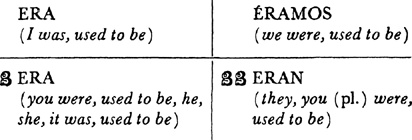
IR, to go
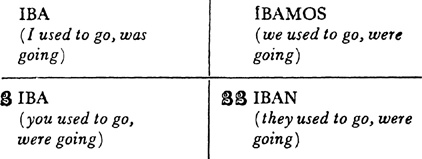
Voy a ver. I’m going to see.
Fuí a ver. I went to see.
Iba a ver. I was going to see.
Iba a comprar una casa. I was going to buy a house.
Iba a verlo. I was going to see him.
Iba a estudiar. I was going to study.
María iba a traerlo. Mary was going to bring it.
Juan iba a invitarla. John was going to invite her.
Íbamos a la playa. We were going to the beach.
Iban a México. They were going to Mexico.
Combine the words below in different ways to form as many sentences as you can. Be sure to use words from each of the columns in every sentence you form.
A
| 1 | 2 | 3 |
| Quería | comprar | el caballo (horse) |
| (I wanted) | jugar | tenis |
|
Carlos quería |
ir | al cine |
| (Charles wanted) | venir | a la clase |
| Queríamos | hacer | dulces |
| (we wanted) | tomar | la cena |
|
Querían |
quedarse (to stay) | en casa |
| (they wanted) | levantarse | temprano |
B
| 1 | 2 |
| Tenía (I used to have) | un perro (a dog) |
|
Alberto tenía (Albert used to have) |
un caballo (a horse) |
| Teníamos (We used to have) | una vaca (a cow) |
|
Tenían (They used to have) |
un gato (a cat) |
| gallinas (hens) | |
| una criada (a maid) | |
| un auto | |
| una secretaria |
C
| 1 | 2 |
| Me levantaba (I used to get up) | temprano |
|
Alberto se levantaba |
tarde |
| (Albert used to get up) | a las ocho |
| Nos levantábamos | a las cinco |
| (We used to get up) | a las nueve |
|
Se levantaban (They used to get up) |
a las diez |
| Me acostaba (I used to go to bed) | a las once |
| Nos acostábamos | muy tarde |
| (We used to go to bed) | muy temprano a las diez y media |
Translate the following sentences into Spanish.
Check your sentences with the translations below.
Combine the words below in different ways to form as many sentences as you can.
A
| 1 | 2 | 3 |
| Dije (I said) |
que era (that it was, that you were, that he was, that she was) |
delicioso |
|
José dijo (Joseph said) |
interesante maravilloso (marvelous) |
|
|
Quién dijo (Who said?) |
fantástico delgado (thin [masc.]) |
|
|
Dijimos (We said) |
que era (that it was, that you were, that he was, that she was) |
gordo (fat [masc.]) simpático |
|
Dijeron (They said) Creía (I thought, used to think) |
simpática alto (tall [masc.]) bonita (pretty) |
|
|
Pablo creía (Paul thought, used to think)
|
linda (lovely) |
B
| 1 | 2 | 3 |
| Voy a (I’m going to) |
llegar (get there) estar |
tarde en casa |
| Fuí a (I went to) |
ver comprar |
comprarlas pinturas (the paintings) |
| Iba a (I was going to) |
llevarla (take her) darle (give him) |
los boletos al cine |
|
Pablo iba a (Paul was going to)
|
venir trabajar hacer (make) |
el dinero al despacho el sábado |
| Íbamos a (We were going to) |
limpiar (clean) levantarse |
dulces la casa |
|
Iban a (They were going to)
|
sentarse (sit) | temprano en la hamaca (in the hammock) |
Translate the following sentences into Spanish. Write out each sentence in Spanish, using the columns above as a guide. Check your sentences with the correct translations below this exercise.
Check your sentences with the correct translations below.
The imperfect is a past tense that is used to express:
I HABITUAL ACTION (repeated action)
II CONTINUOUS ACTION
III QUALITIES (continuous)
IV DESCRIPTIONS (in the past)
I
HABITUAL ACTION (repeated)
II
CONTINUOUS ACTION
III
QUALITIES
IV
DESCRIPTIONS
hay, there is, there are, is there? are there?
hubo (preterite), there was, there were, was there? were there?
había (imperfect), there used to be, did there used to be?
ha habido, there has been, there have been, has there been? have there been?
va a haber, there is going to be, there are going to be, is there going to be? are there going to be?
here
is a special verb form in Spanish that must be used when you wish to
give a command.
The endings for the command form of the verb are:
E for AR verbs
A for ER and IR verbs
EXAMPLES:
|
hablar, to speak |
hable, speak |
hable despacio, por favor, speak slowly, please |
|
contestar, to answer |
conteste, answer |
conteste el teléfono, por favor, answer the phone, please |
|
abrir, to open |
abra, open |
abra la ventana, por favor, open the window, please |
Pronouns are added on to the verbs in the command form.
EXAMPLES:
|
levantarse, to get up |
levántese, get up |
levántese temprano, get up early |
|
escribir, to write |
escríbame, write to me |
escríbame pronto, write to me soon |
Radical changing verbs have the same changes in the command form as they have in the present tense.
E = IE
O = UE
EXAMPLES:
| INFINITIVE | PRESENT | COMMAND | COMMON EXPRESSION |
| cerrar (to close) | cierro (I close) | cierre (close) | cierre la ventana (close the window) |
| sentarse (to sit down) | me siento (I sit down) | siéntese (sit down) | siéntese, por favor (sit down, please) |
| contar (to count) | cuento (I count) | cuente (count) | cuente conmigo (count on me [with me]) |
| soltar (to let go) | suelto (I let go) | suelte (let go) | suélteme (let go of me) |
Most of the nonconformist verbs have the same irregularities in the command form as they have in the first person singular of the present tense.
| INFINITIVE | PRESENT | COMMAND | COMMON EXPRESSION |
| venir, | vengo, | venga, | venga acá, |
| to come | I come | come | come here |
| tener, | tengo, | tenga, | tenga esto, |
| to have | I have | have | have this, take this |
| poner, | pongo, | ponga, | póngalo en la mesa, |
| to put | I put | put | put it on the table |
| hacer, | hago, | haga, | haga esto, |
| to do | I do | do | do this |
| salir, | salgo, | salga, | salga de la casa, |
| to go out | I go out | go out | go out (get out) of the house |
| oír, | oigo, | oiga, | oiga, |
| to hear, to listen | I hear, listen | hear, listen | listen |
| traer, | traigo, | traiga, | tráigamelo, |
| to bring | I bring | bring | bring me it, it to me |
| andar, | ando, | ande, | ande, |
| to walk, to go | I walk, I go | walk, go | oh, go on |
| decir, | digo, | diga, | no me diga, |
| to say, to tell | I say, tell | say, tell | don’t tell me |
| caerse, | me caigo, | cáigase, | no se caiga, |
| to fall down | I fall down | fall down | don’t fall down |
Pronouns are attached to the command form except when the command is negative.
| AFFIRMATIVE | NEGATIVE |
| dígame, tell me | no me diga, don’t tell me |
| siéntese, sit down | no se siente, don’t sit down |
| suéltelo, let go of it | no lo suelte, don’t let go of it |
| póngalo, put it | no lo ponga, don’t put it |
| tráigamelo, bring it to me (me it) | no me lo traiga, don’t bring it to me |
| levántese, get up | no se levante, don’t get up |
| báñese, bathe, take a bath | no se bañe, don’t take a bath |
| acuéstese, go to bed | no se acueste, don’t go to bed |
You have learned that there are three kinds of verbs in Spanish:
1. Regular Verbs
2. Radical Changing Verbs
3. Nonconformist Verbs
The first person singular present of all these verbs is identical to the command, except for the final letter. Always try to associate the command with the first person present.
EXAMPLES:
REGULAR VERBS
| INFINITIVE | PRESENT | COMMAND |
| tomar, to take | tomo, I take | tome |
| vender, to sell | vendo, I sell | venda |
| escribir, to write | escribo, I write | escriba |
RADICAL CHANGING VERBS
| INFINITIVE | PRESENT | COMMAND |
| cerrar, to close | cierro, I close | cierre |
| contar, to count | cuento, I count | cuente |
| recordar, to remember | recuerdo, I remember | recuerde |
NONCONFORMIST VERBS
| INFINITIVE | PRESENT | COMMAND |
| venir, to come | vengo, I come | venga |
| hacer, to do | hago, I do | haga |
| traer, to bring | traigo, I bring | traiga |
If you associate the command with the present tense, you can’t go wrong.
There are only a very few exceptions to this rule and they are:
“Dar” (to give) and “estar” (to be) are regular in the command, although they are nonconformist verbs. However, they did not deign to be completely regular, since they belong to the select nonconformist club, so they both have accents.
| dar, to give | dé, give | démelo, give it to me |
| estar, to be | esté, be | esté contento, be happy |
“Ir” (to go) and “ser” (to be) are completely irregular:
| ir, to go | voy, I go | vaya, go | vaya a la tienda, go to the store |
| ser, to be | soy, I am | sea, be | no sea indiscreto, don’t be indiscreet |
This whole lesson can be reduced to three points.
1. The command is like the first person singular present, except for the final letter.
2. The commands that are not like the first person singular present are:
| estar | dar | ir | ser |
| (esté) | (dé) | (vaya) | (sea) |
3. In the command, pronouns are attached to the verbs except when the command is negative.
AR verbs
| INFINITIVE | COMMAND |
| tomar, to take | tome |
| hablar, to speak | hable |
| trabajar, to work | trabaje |
| entrar, to come in | entre |
| pasar, to pass | pase |
| bailar, to dance | baile |
| terminar, to finish | termine |
| estacionar, to park | estacione |
| comprar, to buy | compre |
| anunciar, to advertise | anuncie |
| dibujar, to draw | dibuje |
| cambiar, to change | cambie |
| cantar, to sing | cante |
| arreglar, to arrange | arregle |
| caminar, to walk | camine |
| enseñar, to show, to teach | enseñe |
ER and IR verbs
| INFINITIVE | COMMAND |
| vender, to sell | venda |
| correr, to run | corra |
| comprender, to understand | comprenda |
| aprender, to learn | aprenda |
| leer, to read | lea |
| comer, to eat | coma |
| beber, to drink | beba |
| decidir, to decide | decida |
| escribir, to write | escriba |
| permitir, to allow | permita |
| resistir, to resist | resista |
| vivir, to live | viva |
| describir, to describe | describa |
NONCONFORMIST VERBS
| INFINITIVE | PRESENT | COMMAND |
| venir, to come | vengo, I come | venga |
| tener, to have | tengo, I have | tenga |
| hacer, to do | hago, I do | haga |
| traer, to bring | traigo, I bring | traiga |
| salir, to go out | salgo, I go out | salga |
| caer, to fall | caigo, I fall | caiga |
| oír, to hear | oigo, I hear | oiga |
| poner, to put | pongo, I put | ponga |
| decir, to say | digo, I say | diga |
Pronounce the following words aloud. They have a certain ring to them that makes them pleasant to pronounce. Learn these words as you would learn a poem. Pronounce them vigorously and you will see that it is enjoyable to say them.
tráigamelo, bring it to me (bring me it)
hágamelo, do it for me (do me it)
dígamelo, tell me (tell me it)
cómpremelo, buy it for me (buy me it)
mándemelo, sent it to me (send me it)
enséñemelo, show it to me (show me it)
démelo, give it to me (give me it)
PLURAL COMMAND
If you give a command to more than one person, add the letter “n” to the singular command.
| INFINITIVE | SINGULAR COMMAND | PLURAL COMMAND |
| comprar | compre | compren |
| tomar | tome | tomen |
| hablar | hable | hablen |
| traer | traiga | traigan |
| venir | venga | vengan |
Combine the words below in different ways to form as many sentences as you can. Be sure to use words from each of the columns in every sentence you form.
A
| 1 | 2 |
| Compre (Buy) | unas aspirinas, por favor |
| Compren (pl.) | jabón (soap) |
| unas toallas (some towels) | |
| una docena de huevos (a dozen eggs) | |
| media docena de naranjas (a half dozen oranges) | |
| azúcar (sugar) | |
| sal (salt) | |
| pimienta (pepper) |
B
| 1 | 2 |
| Siéntese (Sit down, sit) | en el sofá, por favor |
| No se siente (Don’t sit down, don’t sit) | en el sillón (on the armchair) |
| en la silla (on the chair) | |
| en la hamaca (on the hammock) | |
| junto a mí (next to me) | |
| en la primera fila (on the first row) |
C
| 1 | 2 |
| Venga (Come) | a la clase |
| Vengan (pl.) | a mi casa |
| No venga (Don’t come) | al despacho |
| No vengan (pl.) | al club |
| Vaya (Go) | a la playa |
| Vayan (pl.) | a la tienda, por favor |
| No vaya (Don’t go) | al correo, por favor |
| No vayan (pl.) | a vernos (to see us) |
| pronto (soon, right away) |
Translate the following sentences into Spanish. Write out each sentence in Spanish, using the columns above as a guide. Check your sentences with the translations below this exercise.
Check your sentences with the translations below.
Combine the words below in different ways to form as many sentences as you can. Be sure to use words from each of the columns in every sentence you form.
A
| 1 | 2 |
| Tráigame (Bring me) | un vaso de agua |
| No me traiga (Don’t bring me) | los libros |
| Tráigale (Bring him, her) | el boleto |
| No le traiga (Don’t bring him, her) | un regalo (a present) |
| unos helados (some ice cream) | |
| Llévele (Take him, her) | unas toallas (some towels) |
| unas flores | |
| unas revistas |
B
| 1 | 2 |
| Déme (Give me) | el dinero (the money) |
| No me dé (Don’t give me) | cincuenta centavos (fifty cents) |
| Déle (Give him, her) | la caja (the box) |
| No le dé (Don’t give him, her) | los guantes (the gloves) |
| lo que quiera (what he, she wants) | |
| dulces | |
| el paquete (the package) |
Translate the following sentences into Spanish. Write out each sentence in Spanish, using the columns above as a guide. Check your sentences with the translations below this exercise.
Check you sentences with the translations below.
SPELLING CHANGES IN THE COMMAND
(orthographic changes)
Verbs that end in “gar” in the infinitive, end in “gue” in the command. This change is made in order to retain the hard sound of the “g.” The “gue” is pronounced “gue” as in “guest.”
| INFINITIVE | COMMAND |
| pagar, to pay | pague |
| llegar, to arrive | llegue |
| investigar, to investigate | investigue |
| castigar, to punish | castigue |
| entregar, to deliver | entregue |
| apagar, to put out (the light) | apague |
| *jugar, to play (a game) | juegue |
* Notice that “jugar” is radical changing. The “u” changes to “ue.”
Verbs that end in “car” in the infinitive end in “que” in the command. This change is made in order to retain the hard “k” sound.
The “que” is pronounced “ke” as in “kept.”
| INFINITIVE | COMMAND |
| sacar, to take out | saque |
| tocar, to play (an instrument) | toque |
| criticar, to criticize | critique |
| practicar, to practice | practique |
| marcar, to mark | marque |
| explicar, to explain | explique |
| indicar, to indicate, to point out | indique |
| lubricar, to lubricate | lubrique |
CER verbs
You have learned that the command is like the first person singular present except for the final letter. This is true of “cer” verbs, which end in “zco” in the first person present.
| INFINITIVE | PRESENT | COMMAND |
| conocer, to know | conozco, I know | conozca |
| obedecer, to obey | obedezco, I obey | obedezca |
| ofrecer, to offer | ofrezco, I offer | ofrezca |
| establecer, to establish | establezco, I establish | establezca |
The command form is called the “imperative” in English.
Spanish grammarians call it the “subjunctive used as imperative.” I prefer to use the word “command” because it conveys the meaning clearly and because it is easy to remember.
COMMON USES OF THE COMMAND
| Levántese. Get up. | Tráigamelo. Bring it to me. |
| Siéntese. Sit down. | Apúrese. Hurry up (from “apurarse,” to hurry). |
| Párese. Stand up (from “pararse,” to stand up). | Dése prisa. Hurry up (give yourself haste). |
| Pase. Come in (Pass). | Limpie la casa. Clean the house. |
| Pase adelante. Come in (Pass forward). | Présteme. Lend me (from “prestar,” to lend). |
| Hágalo. Do it. | Échemelo. Toss it to me (from “echar,” to throw, to toss). |
| Venga acá. Come here. | Cállese. Hush up, shut up (from “callarse,” to hush). |
| Levántelo. Lift it. | Conteste el teléfono. Answer the phone. |
| Váyase. Go away. | Enséñemelo. Show it to me. |
| Suélteme. Let go of me. | Préstemelo. Lend it to me. |
| Suéltelo. Let go of it, him. | Hable despacio. Speak slowly. |
| Déjeme. Leave me, let me (from “dejar,” to leave, to let) | Mire. Look (from “mirar,” to look at). |
| Póngalo en la mesa. Put it on the table. | Mire, que bonito. Look, how pretty. |
| Ponga la mesa. Set the table. | Permítame presentar. Allow me to present. |
| Póngaselo. Put it on. | Tome asiento. Take a seat. |
| Démelo. Give it to me. | Quédese otro ratito. Stay a little while longer. |
| Escríbame. Write to me. | No se moleste. Don’t bother, don’t trouble yourself. |
| Prométame. Promise me. | Mándeme. Send me. |
| Enséñemelo. Show it to me. | Oiga. Listen. |
| Quédese. Stay. | Dígamelo. Tell me (it). |
| Dispénseme. Pardon me. | Dígame. Tell me. |
| Apague la luz. Turn out the light. | Permítame. Allow me. |
| Cierre la ventana. Close the window. | |
| Tómelo. Take it (medicine, food, vehicle). | |
| Cuídese. Take care of yourself. | |
| Salude a Carlos. Say hello to Charles. |
ow
let’s see how well you can distinguish the imperfect and the preterite
tenses. Translate the following sentences into Spanish. Write the
translations in the blanks below the sentences. You should be able to
complete this test in ten minutes.
I wrote a letter.
He had a car.
She used to visit us often.
She used to do the work very well.
We bought a house.
The house had a terrace.
He used to take a taxi every morning.
He was very charming.
She sold the house.
I was going to do it.
We were going to sell the house.
He said that it was terrible.
He had a dog.
He wanted to play tennis.
We were going to the beach.
He used to swim very well.
She was very pretty.
The dress was lovely.
He loved his mother.
I saw him this morning.
Check your answers with those below. If you have more than 5 errors, review Lesson 39.
Now test yourself on the command. Fill in the blanks below with the Spanish equivalent of the English commands.
Check your answers with those below.
he
he verb endings for the present subjunctive and the command are
absolutely identical in all verbs. I am very happy to tell you that
since you know the command you also know the present subjunctive. The
only thing you will have to learn now is the use of the subjunctive.
The subjunctive is used after certain definite expressions:
|
I want you to I want him, her, it to |
|
I hope that you will I hope that he, she, it will |
|
I doubt that you will I doubt that he, she, it will |
|
I fear that you will I fear that he, she, it will I am afraid that you, he, she, it will |
|
I prefer that you, he, she, it |
|
I am sorry, I regret that you, he, she, it will |
Remember that in the command and in the subjunctive “ar” verbs end in “e,” “er” and “ir” verbs end in “a”.
AR verbs, E
ER and IR verbs, A
Remember also that the subjunctive and the first person singular present are alike except for the final letter.
Combine the words below in different ways to form as many sentences as you can. Be sure to use words from each of the columns in every sentence you form.
A
| 1 | 2 | 3 |
| Quiero que (I want you, him, her to) |
compre venda |
un sombrero la casa |
|
Alberto quiere que (Albert wants you, him, her to)
|
escriba termine |
el artículo el trabajo |
| Espero que (I hope that you, he, she will) |
lea (read) mande (send) |
el poema el paquete |
|
Eduardo espera que (Edward hopes that you will)
|
conteste (answer) venga |
la carta a la fiesta |
Translate the following sentences into Spanish. Write out each sentence in Spanish, using the columns above as a guide. Check your sentences with the translations below this exercise.
Check your sentences with the translations below.
The most important thing to remember about the subjunctive is that:
THE FIRST PERSON SINGULAR PRESENT (indicative) AND THE SUBJUNCTIVE ARE ALIKE, EXCEPT FOR THE FINAL LETTER.
| INFINITIVE | PRESENT (INDICATIVE) | COMMAND, SUBJUNCTIVE |
| hablar, to speak | hablo, I speak | hable |
| terminar, to finish | termino, I finish | termine |
| caminar, to walk | camino, I walk | camine |
| mandar, to send | mando, I send | mande |
| manejar, to drive | manejo, I drive | maneje |
| lavar, to wash | lavo, I wash | lave |
| ayudar, to help | ayudo, I help | ayude |
| prometer, to promise | prometo, I promise | prometa |
| barrer, to sweep | barro, I sweep | barra |
| sorprender, to surprise | sorprendo, I surprise | sorprenda |
| aprender, to learn | aprendo, I learn | aprenda |
| asistir, to attend | asisto, I attend | asista |
| decidir, to decide | decido, I decide | decida |
| pensar, to think | pienso, I think | piense |
| cerrar, to close | cierro, I close | cierre |
| contar, to tell, to count | cuento, I tell | cuente |
| recordar, to remember | recuerdo, I remember | recuerde |
| tener, to have | tengo, I have | tenga |
| venir, to come | vengo, I come | venga |
| hacer, to do, make | hago, I do | haga |
| salir, to go out | salgo, I go out | salga |
| poner, to put | pongo, I put | ponga |
| traer, to bring | traigo, I bring | traiga |
| oír, to hear | oigo, I hear | oiga |
| conocer, to know | conozco, I know | conozca |
| obedecer, to obey | obedezco, I obey | obedezca |
| ofrecer, to offer | ofrezco, I offer | ofrezca |
| merecer, to deserve | merezco, I deserve | merezca |
| ver, to see | veo, I see | vea |
REFLEXIVE VERBS
| INFINITIVE | PRESENT (INDICATIVE) | subjunctive |
| levantarse, to get up | me levanto, I get up | se levante |
| acostarse, to go to bed | me acuesto, I go to bed | se acueste |
| enfermarse, to get sick | me enfermo, I get sick | se enferme |
| asustarse, to get frightened | me asusto, I get frightened | se asuste |
| mejorarse, to get better | me mejoro, I get better | se mejore |
| irse, to go away | me voy, I go away | se vaya |
| quedarse, to stay | me quedo, I stay | se quede |
| casarse, to get married | me caso, I get married | se case |
Pronouns ALWAYS go before the verb in the present subjunctive.
EXAMPLES:
|
WITH REFLEXIVE VERBS |
|
|
Quiero que se levante. |
I want you to get up. |
|
Quiero que se acueste. |
I want you to go to bed. |
|
Quiero que se bañe. |
I want you bathe. |
|
Espero que se mejore. |
I hope he’ll get better. |
|
No quiero que se canse. |
I don’t want you to get tired. |
|
Quiero que se aliste. |
I want you to get ready. |
EXAMPLES:
|
WITH DIRECT AND INDIRECT OBJECT PRONOUNS |
|
|
Quiero que lo haga. |
I want you to do it. |
|
Quiero que lo vea. |
I want you to see it. |
|
Quiero que lo traiga. |
I want you to bring it. |
|
Quiero que me lo dé. |
I want you to give it to me. |
|
Quiero que me lo traiga. |
I want you to bring it to me. |
|
Espero que lo invite. |
I hope that you will invite him. |
|
Espero que la invite. |
I hope that you will invite her. |
Combine the words below in different ways to form as many sentences as you can. Be sure to use words from each of the columns in every sentence you form.
A
| 1 | 2 |
| Quiero que (I want you, him, her to) | lo haga (do it) |
| Espero que (I hope you, he, she will) | lo traiga (bring it) |
| Dudo que (I doubt that you, he, she will) | lo diga (say it) |
| Temo que (I fear that you, he, she will) | lo vea (see it) |
| Prefiero que (I prefer that you, he, she) | me lo mande (send it to me) |
| me lo compre (buy it for me) | |
| me lo dé (give it to me) | |
| me lo preste (lend it to me) | |
| me lo explique (explain it to me) |
B
| 1 | 2 |
| Quiero que (I want you, him, her to) | se levante (get up) |
| No quiero que (I don’t want you, him, her to) |
se acueste (go to bed) se quede (stay) |
| Elena quiere que (Helen wants you, him, her to) |
se mejore (get better) se divierta (have a good time) |
| Espero que (I hope that you, he, she will) | se vaya (go away) |
| Pedro espera que (Peter hopes that you he, she will) | se case (get married) |
| se enferme (get sick) | |
| se asuste (get frightened) |
Translate the following sentences into Spanish. Write out each sentence in Spanish, using the columns above as a guide. Check your sentences with the translations below this exercise.
Check your sentences with the translations below.
PRESENT SUBJUNCTIVE ENDINGS
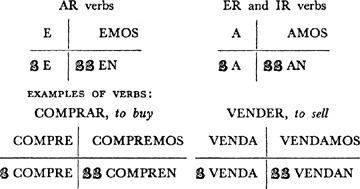
Irregular verbs have the same endings. ALL verbs in the present subjunctive have regular endings.
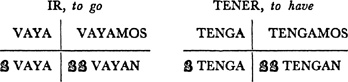
Combine the words below in different ways to form as many sentences as you can. Be sure to use words from each of the columns in every sentence you form.
A
| 1 | 2 |
|
Quiere que (You want, he, she wants. Do you want? Does he, she
want?)
|
cante (me, you, him, her to sing)
canten (them to sing)
|
|
Quieren que (They want; Do they want?)
|
escriba (me, you, him, her to write) |
|
Pedro quiere que (Peter wants)
|
escribamos (us to write)
escribamon (them to write)
|
|
Alberto quiere que (Albert wants)
|
cantemos (us to sing) |
| lo haga (me, you, him, her to do it) | |
| lo hagamos (us to do it) | |
|
lo hagan (them to do it)
|
B
| 1 | 2 |
|
Espera que (You, he, she hopes that)
|
lo haga (I, you, he, she will do it) |
|
Esperan que (They hope that)
|
lo hagamos (we will do it)
lo hagan (they will do it)
|
|
Pablo espera que (Paul hopes that)
|
escriba pronto (I, you, he, she will write soon) |
Translate the following sentences into Spanish. Write out each sentence in Spanish, using the columns above as a guide.
Check your sentences with the translations on the next page.
You have learned several expressions that must be followed by the subjunctive in this lesson. No doubt you have noticed that all these expressions involve two people; ONE PERSON who fears, wants, doubts, hopes, or prefers that ANOTHER PERSON will do something.
Don’t confuse these subjunctive expressions that involve TWO people with the expressions that you have already learned that involve only ONE person.
ONE PERSON—INFINITIVE
TWO PERSONS—SUBJUNCTIVE
Notice that when the action involves one person you use the verb alone (quiero). But when the action involves two people the verb is followed by “que” (quiero que).
“Es” when followed by an adjective or a noun and the word “que” requires the subjunctive.
EXAMPLES:
Use the following words to fill in the blanks below.
Es que lo haga.
(It’s that he do it, that he does it, that he should do it.)
Es que lo hagan.
(It’s that they do it, that they should do it.)
Translate the following sentences into Spanish. Remember that “es” followed by an adjective or a noun and the word “que” requires the subjunctive.
Check your sentences with the translations below.
Another expression that requires the subjunctive is:
“que,” let, may (with the subjunctive).
EXAMPLES:
Que cante. Let him sing. Let her sing.
Que venga. Let him come. Let her come.
Que lo haga. Let him do it. Let her do it.
Que haga lo que quiera. Let him do what he wants. Let her do what she wants.
Que lo compre. Let him buy it. Let her buy it.
Que lo piense. Let him, her think it over.
Que salga. Let him go out. Let her go out.
Que tenga suerte. May he, she have luck.
Que llegue a tiempo. May he, she get there on time.
Que vuelva pronto. May he come back soon.
Que canten. Let them sing.
Que vengan. Let them come.
Que lo hagan. Let them do it.
Que lo piensen. Let them think it over.
Que tengan suerte. May they have luck.
The expression “May they” (que) belongs to a whole subjunctive family that expresses hope, desire, or a sincere wish that heaven be on your side.
THE FAMILY OF HOPE
This last expression was borrowed from the Moors who lived in Spain for eight centuries (711–1492).
EXAMPLES:
REQUEST, PREFERENCE, COMMAND
In Spanish an expression that states that somebody wants you to do something requires the subjunctive. This ranges from the most delicate request or preference to the most authoritative command.
Notice that the above expressions involve two people.
Notice also that all the verbs above are followed by “que” and that they are all commands in one degree or another. “Dice que es bonito” (He says that it’s pretty) is not a command; therefore it does not belong to the above group.
Combine the words below in different ways to form as many sentences as you can. Be sure to use words from each of the columns in every sentence you form.
A
| 1 | 2 |
| Que (Let) |
cante (him, her sing) llore (him, her cry) venga (him, her come) salga (him, her go out) lo haga (him, her do it) lo traiga (him, her bring it) entre (him, her come in) vaya (him, her go) se quede (him, her stay) juegue (him, her play) |
B
| 1 | 2 | 3 |
| Espero que | compre | la casa |
| (I hope that) | venda | el auto |
| Ojalá que | vengan | a la fiesta |
| (I certainly hope that) | vea (see) | a su hijo |
| Dios quiera que | encuentre (find) | (her son) |
| (God want that) | el dinero |
C
| 1 | 2 | 3 |
|
Dice que |
mande | el dinero |
| (He, she says that) | (you should send) | el paquete |
|
Dicen que |
vaya | al despacho |
| (They say that) | (you should go) | al club |
| termine | el trabajo | |
| (you should finish) | la carta |
Translate the following sentences into Spanish. Write out each sentence in Spanish, using the columns above as a guide. Check your sentences with the translations below this exercise.
Check your sentences with the translations below.
Remember that “dice” is followed by the subjunctive ONLY when it is used as a command.
THE INDEFINITE OR UNKNOWN FAMILY
When you speak of an indefinite or unknown person, place, or thing you must use the subjunctive.
EXAMPLES:
PERSONS UNKNOWN
THINGS AND PLACES UNKNOWN
THE SUBJUNCTIVE EXPRESSES ACTION THAT HAS NOT TAKEN PLACE
CUANDO (when), followed by action in the future, requires the subjunctive.
EXAMPLES:
When “cuando” is not followed by action in the future it does not require the subjunctive. “When he did it” (cuando lo hizo) is an accomplished fact. The action has taken place, therefore it is not expressed in the subjunctive. The subjunctive is used to express the uncertainty of an action that has not taken place.
HASTA QUE (until) requires the subjunctive when followed by action in the future. Hasta que venga. Until he comes; Hasta que lo haga, Until he does it.
SUBJUNCTIVE
Quédese hasta que termine el trabajo. Stay until you finish the work.
NOT SUBJUNCTIVE
Se quedó hasta que terminó el trabajo. He stayed until he finished the work. This sentence is not in the subjunctive because “hasta que” is NOT followed by action in the future.
AUNQUE (even though, even if) requires the subjunctive when
followed by action in the future.
Aunque venga. Even if he comes; Aunque
vaya. Even if he goes.
CONTAL QUE (provided that) requires the subjunctive.
Con tal que se quede. Provided that he
stays.
PARA QUE (so that) requires the subjunctive
when it expresses the purpose of an action.
Lo cuidamos para que no se enferme. We take care of
him so that he won’t get sick.
THE “MAYBE” FAMILY
All expressions that mean “maybe” are followed by the subjunctive.
PROBABILITY
Expressions of probability are followed by the subjunctive.
NO CREO QUE (I don’t think that) is ALWAYS followed by the subjunctive.
CREO QUE (I think that) is NEVER followed by the subjunctive.
EXAMPLES:
| Subjunctive 1. | No creo que compre la casa. I don’t think he’ll buy the house. |
| Not subjunctive 2. | Creo que va a comprar la casa. I think that he is going to buy the house. |
| Subjunctive 1. | No creo que estudie. I don’t think he studies. |
| Not subjunctive 2. | Creo que estudia mucho. I think he studies a lot. |
PAST SUBJUNCTIVE ENDINGS
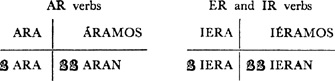
When an expression that requires the subjunctive is in the present tense, it requires the present subjunctive; when it is in the past tense it requires the past subjunctive.
| PRESENT INDICATIVE | PRESENT SUBJUNCTIVE |
|---|---|
| Quiero que compre la casa. | I want you to buy the house. |
| PAST IMPERFECT | PAST SUBJUNCTIVE |
| Quería que comprara la casa. | I wanted you to buy the house. |
The following expressions require the past subjunctive because they are in the past. These expressions are usually used in the imperfect as below:
The following expressions usually indicate single completed action, so they are in the preterite.
The plural third person PRETERITE and the PAST subjunctive are alike except for the ending.
| THIRD PERSON PRETERITE (PL.) | PAST SUBJUNCTIVE |
|
TUVIERON (they had) |
TUVIERA |
|
ESTUVIERON (they were) |
ESTUVIERA |
|
ANDUVIERON (they walked) |
ANDUVIERA |
|
HICIERON (they did, made) |
HICIERA |
|
PUSIERON (they put) |
PUSIERA |
|
SUPIERON (they knew) |
SUPIERA |
|
TRAJERON (they brought) |
TRAJERA |
|
DIJERON (they said) |
DIJERA |
|
CAYERON (they fell) |
CAYERA |
|
OYERON (they heard) |
OYERA |
|
FUERON (they went) |
FUERA |
Combine the words below in different ways to form as many sentences as you can. Be sure to use words from each of the columns in every sentence you form.
A
| 1 | 2 | 3 |
| Quería que (I, you, he, she wanted) |
trabajara (you, him, her to work; |
mañana anoche |
| Esperaba que (I, you, he, she hoped that) |
you, he, she would work; you, he, she should work) |
esta mañana esta tarde |
| 1 | 2 | 3 |
|
Dijo que (You, he, she said that)
|
fuera (you, him, her to go; |
a la fiesta al cine |
| Queríamos que (We wanted) |
you, he, she would go; you, he, she should go) |
al club a la clase |
|
Querían que (They wanted)
|
vendiera (you, him, her to sell; |
la casa el auto |
| Esperábamos que (They hoped that) |
you, he, she would sell; you, he, she should sell) |
el edificio (the building) |
| Dijimos que (We said that) |
trajera (you, him, her to bring; |
el dinero los libros |
|
Dijeron que (They said that)
|
you, he, she would bring; you, he, she should bring) |
a su primo la guitarra |
|
se levantara (you, him, her to get up; you, he, she would get up; you, he, she should get up) |
||
|
se lo diera (you, him, her to give it to me; you, he, she would give it to me; you, he, she should give it to me) |
Translate the following sentences into Spanish. Write out each sentence in Spanish, using the columns above as a guide. Check your sentences with the correct translations below this exercise.
Check your sentences with the translations below.
When you speak of indefinite or unknown persons or things in the past use the past subjunctive.
EXAMPLES:
Remember that the subjunctive is used when an action has not taken place. If an action has taken place, you do not use the subjunctive.
If the following expressions refer to the past, they are followed by the past subjunctive PROVIDED THAT THEY DO NOT EXPRESS AN ACTION THAT HAS TAKEN PLACE.
1. HASTA QUE (until)
EXAMPLE:
We wanted him to stay until he finished the work. Queríamos
que se quedara hasta que terminara el trabajo.
2. AUNQUE (even though, even if)
EXAMPLE:
We wanted to play tennis even if it rained. Queríamos jugar
tenis aunque lloviera. (from the verb “llover” to
rain)
3. CON TAL QUE (provided that)
EXAMPLE:
She wanted him to do it, provided he would do it well.
Quería que lo hiciera, contal que lo hiciera
bien.
4. PARA QUE (so that)
EXAMPLE:
We told him to leave early so that he would get here on
time. Le dijimos que saliera temprano para que
llegara a tiempo.
5. SI (if)
When you express an “iffy” wish, that is, a wish which begins with the word “if” (si), the verb which follows “if” must always be in the past subjunctive.
EXAMPLES:
If I were king!
¡Si fuera rey!
If he would (only) do it!
¡Si lo hiciera!
If I (only) had the money!
¡Si tuviera el dinero!
If I (only) could!
¡Si pudiera!
If you would understand!
¡Si comprendiera!
The conditional of “hablar” is:
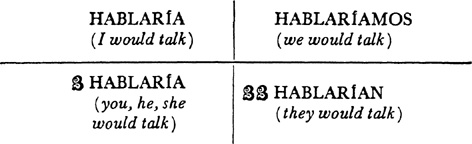
To form the conditional of “ar,” “er,” and “ir” verbs, add the following endings to the COMPLETE INFINITIVE:
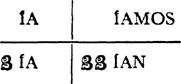
EXAMPLES:
COMPRAR, to buy
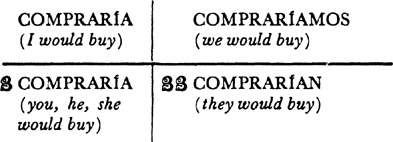
VENDER, to sell
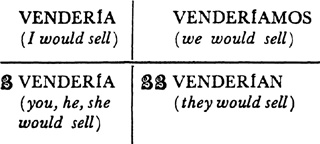
IR, to go
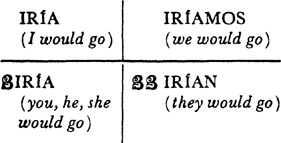
LEER, to read
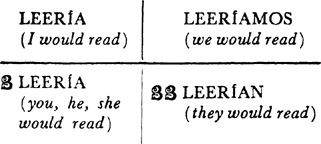
The conditional is used with the past subjunctive in the following way:
CONDITIONAL + (IF) PAST SUBJUNCTIVE
IRÍA a México…………………SI FUERA posible.
I would go to Mexico………………if it were possible.
This order can be reversed:
(IF) PAST SUBJUNCTIVE + CONDITIONAL
SI FUERA posible, …………………IRÍA a México
If it were possible,………………I would go to Mexico
EXAMPLES:
There are a few verbs that are irregular in the conditional.
| INFINITIVE | CONDITIONAL |
| tener, to have | tendría, I would have |
| venir, to come | vendría, I would come |
| poner, to put | pondría, I would put |
| poder, to be able to | podría, I would be able to |
| saber, to know | sabría, I would know |
| hacer, to do | haría, I would do |
| querer, to want | querría, I would want |
| decir, to say | diría, I would say |
| salir, to go out | saldría, I would go out |
Notice that these verbs are all nonconformist verbs.
You have learned the present perfect tense (indicative).
EXAMPLES:
He estudiado. I have studied
Ha estudiado. You have studied.
Hemos estudiado. We have studied.
Han terminado. They have finished.
In Spanish when you say “I HOPE THAT you have studied” the “have studied” is subjunctive.
I hope that you have studied. Espero que haya estudiado.
I hope that he has finished. Espero que haya terminado.
Whenever you say that you hope (in the present) that something happened (in the past) you use the compound subjunctive.
IN THE PRESENT
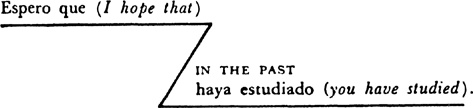
AUXILIARY VERB “HABER”
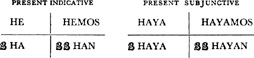
PRESENT PERFECT INDICATIVE
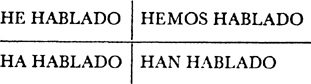
PRESENT PERFECT SUBJUNCTIVE
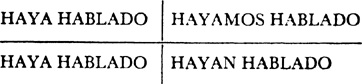
AR verb

ER verb

Notice that the participles (comprado, vendido) do not change. Only the auxiliary changes.
The subjunctive present perfect is used with the following expressions.
PAST PERFECT INDICATIVE

PAST PERFECT SUBJUNCTIVE

The past perfect subjunctive is used in the following construction:
I WOULD HAVE IF I HAD
HUBIERA SI HUBIERA
EXAMPLES:
Notice that the Spanish translation is:
I WOULD HAVE IF I HAD
HUBIERA SI HUBIERA
The order of this construction may be reversed.
IF I HAD I WOULD HAVE
SI HUBIERA HUBIERA
EXAMPLES:
Combine the words below in different ways to form as many sentences as you can. Be sure to use words from each of the four groups in every sentence you form.
| A | – |
|---|---|
| 1 | 2 |
| HUBIERA (I, you, he, she would have) | ido (gone), estudiado (studied) |
| HUBIÉRAMOS (We would have) | terminado (finished), escrito (written) |
|
HUBIERAN (They would have) |
|
| 3 | 4 |
| SI HUBIERA (if I, you, he, she had) | tenido un auto (had a car), tenido tiempo (had time) |
| SI HUBIÉRAMOS (If we had) | podido (been able to), sabido (known) |
|
SI HUBIERAN (if they had) |
|
| B | – |
| 1 | 2 |
| SI HUBIERA (If I, you, he, she had) | tenido un auto (had a car), tenido tiempo (had time) |
| SI HUBIÉRAMOS (If we had) | podido (been able to), sabido (known) |
|
SI HUBIERAN (If they had) |
|
| 3 | 4 |
| HUBIERA (I, you, he, she would have) | ido (gone), estudiado (studied) |
| HUBIERAMOS (we would have) | terminado (finished), escrito (written) |
|
HUBIERAN (they would have) |
Translate the following sentences into Spanish.
Check your sentences with the translations below.
RADICAL CHANGING VERBS II
here
are some verbs in which the letter “e” changes to “i” in the stem (root,
body) of the verb.
PRESENT TENSE
SERVIR, to serve
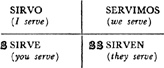
The “e” changes to “i” except in the first person plural.
THE FIRST PERSON PLURAL DOES NOT CHANGE.
In the present tense of the following verbs the letter “e” changes to “i,” except in the first person plural.
PRESENT TENSE
| 1. compito |
compite |
competimos |
compiten |
| 2. pido |
pide |
pedimos |
piden |
| 3. me despido |
se despide |
nos despedimos |
se despiden |
| 4. impido |
impide |
impedimos |
impiden |
| 5. repito |
repite |
repetimos |
repiten |
| 6. mido |
mide |
medimos |
miden |
| 7. derrito |
derrite |
derretimos |
derriten |
| 8. frío |
fríe |
freímos |
fríen |
| 9. me visto |
se viste |
nos vestimos |
se visten |
| 10. me desvisto |
se desviste |
nos desvestimos |
se desvisten |
| 11. me río |
se ríe |
nos reímos |
se ríen |
| 12. me sonrío |
se sonríe |
nos sonreímos |
se sonríen |
In the preterite of these verbs the letter “e” changes to “i” in the third man form singular and plural.
SERVIR, to serve
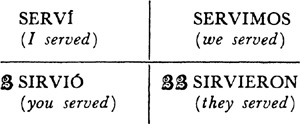
PRETERITE
| 1. competí |
compitió |
competimos |
compitieron |
| 2. pedí |
pidió |
pedimos |
pidieron |
| 3. me despedí |
se despidió |
nos despedimos |
se despidieron |
| 4. impedí |
impidió |
impedimos |
impidieron |
| 5. repetí |
repitió |
repetimos |
repitieron |
| 6. medí |
midió |
medimos |
midieron |
| 7. gemí |
gimió |
gemimos |
gimieron |
| 8. derretí |
derritió |
derretimos |
derritieron |
| 9. me vestí |
se vistió |
nos vestimos |
se vistieron |
| 10. me desvestí |
se desvistió |
nos desvestimos |
se desvistieron |
| 11. me reí |
se rió |
nos reímos |
se rieron |
| 12. me sonreí |
se sonrió |
nos sonreímos |
se sonrieron |
Combine the words below in different ways to form as many sentences as you can. Be sure to use words from each of the three columns in every sentence you form.
A
| 1 | 2 | 3 |
|
Me reí (I laughed) |
cuando ví (when I saw) |
al payaso (clown) |
|
Pedro se rió (Peter laughed)
|
cuando vió (when he saw)
|
la caricatura (the cartoon) |
| Nos reímos | cuando vimos | la fotografía |
|
Se rieron
|
cuando oyeron
|
el chiste |
|
Alberto se rió
|
cuando leyó
|
el artículo |
|
Juan se rió
|
cuando vió
|
el sombrero |
|
Me sonreí (I smiled) |
cuando lo ví (when I saw him) |
anoche con Juan |
|
Elena se sonrió
|
cuando habló
|
el nene (baby) |
| Nos sonreímos | cuando vimos | con Marta |
|
Se sonrieron
|
cuando lo vieron
|
Translate the following sentences into Spanish. Write out each sentence in Spanish, using the columns above as a guide. Check your sentences with the translations below this exercise.
Check your sentences with the translations below.
Combine the words below in different ways to form as many sentences as you can. Be sure to use words from each of the columns in every sentence you form.
A
| 1 | 2 |
| Me vestí (I dressed) | pronto |
|
El niño se vistió (The child [boy] dressed)
|
esta mañana en el dormitorio |
| Nos vestimos (We dressed) | después del desayuno |
|
Se vistieron
|
en cinco minutos |
| Me visto (I dress) | muy despacio (slowly) |
|
El niños se viste
|
solos |
|
Los niños se visten
|
B
| 1 | 2 | 3 |
| Mido (I measure) | la tela | antes de cortarla |
|
Alberto mide (Albert measures)
|
(the material) las tablas |
(before cutting it) en la carpintería |
| Medí (I measured) | (the boards) | (in the carpenter shop) |
|
¿Midió usted (Did you measure?) |
la tela el olán |
para las cortinas (for the curtains) |
| Medimos | (the ruffle) | para la blusa |
|
Midieron
|
la seda (the silk) la lana (the wool) |
para el vestido para el saco |
Remember that in the command and in the present subjunctive “ar” verbs end in “e” and “er” and “ir” verbs end in “a.”
Remember also that irregularities in the present tense are carried over to the command and the present subjunctive.
| PRESENT INDICATIVE | COMMAND AND PRESENT SUBJUNCTIVE |
| sirvo, I serve | sirva, serve |
| pido, I ask for | pida, ask for |
| repito, I repeat | repita, repeat |
| mido, I measure | mida, measure |
Remember that irregularities in the preterite are carried over into the past subjunctive.
| PRETERITE | past subjunctive |
| sirvió, you served | sirviera |
| midió, you measured | midiera |
| repitió, you repeated | repitiera |
| pidió, you asked for | pidiera |
RADICAL CHANGING VERBS I
In these verbs the “e” changes to “ie” or the “o” changes to “ue” in the present, but the preterite is regular (as explained in Lesson 30).
| pensar, to think | pienso, I think |
| volar, to fly | vuelo, I fly |
RADICAL CHANGING VERBS II
In these verbs the “e” changes to “i” in the present and in the third man singular and plural of the past (as explained at the beginning of this lesson).
RADICAL CHANGING VERBS III
These verbs combine the present tense of Radical Changing Verbs I with the past of Radical Changing Verbs II. That is, in these verbs the “e” changes to “ie” in the present (except for the first person plural) and the “e” changes to “i” in the third man singular and plural of the past (preterite).
PREFERIR, to prefer
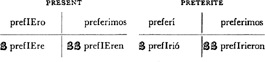
| PRESENT SUBJUNCTIVE AND COMMAND | PAST SUBJUNCTIVE |
| prefiera | prefiriera |
The following verbs belong to Radical Changing Verbs III and have the same irregularities as “preferir” above.
| sentir, to feel | convertir, convert |
| consentir, to consent, to spoil | sugerir, to suggest |
| arrepentirse, to repent | referir, to refer |
| requerir, to require | digerir, to digest |
| divertirse, to have a good time | herir, to wound |
| hervir, to boil | invertir, to invest |
| pervertir, to pervert | mentir, to tell a lie |
There are two verbs in Radical Changing Verbs III that change from “o” to “ue” in the present, and from “o” to “u” in the third man singular and plural of the past.
DORMIR, to sleep
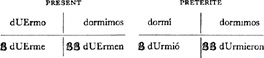
| PRESENT SUBJUNCTIVE AND COMMAND | PAST SUBJUNCTIVE |
| duerma | durmiera |
MORIR, to die
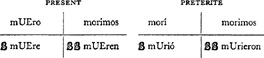
| PRESENT SUBJUNCTIVE AND COMMAND | PAST SUBJUNCTIVE |
| muera | muriera |
LIST OF RADICAL CHANGING VERBS I
Following is a list of Radical Changing Verbs I. It contains all the common and fairly common Radical Changing Verbs I. Only verbs that are seldom used have been omitted.
“Ar” verbs in which the “e” changes to “ie.”
PENSAR to think
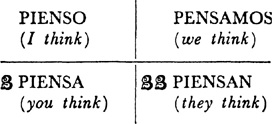
E = IE
| apretar, to squeeze | pensar, to think |
| atravesar, to cross (street) | quebrar, to break |
| calentar, to heat | recomendar, to recommend |
| cerrar, to close | regar, to irrigate, to sprinkle |
| confesar, to confess | regimentar, to regiment |
| desconcertar, to disconcert | remendar, to mend |
| despertar, to wake up | reventar, to burst |
| encerrar, to lock in | sembrar, to sow, to seed |
| enterrar, to bury | temblar, to tremble |
| gobernar, to govern | tentar, to tempt, to touch |
| helar, to freeze | sentar, to seat |
| manifestar, to manifest |
“Er” verbs in which the “e” changes to “ie”
SAMPLE VERB:
PERDER, to lose
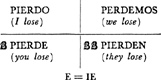
| ascender, to ascend, climb | defender, to defend |
| atender, to attend (a person) | descender, to descend, go down |
| concernir, to concern | encender, to light (a fire) |
| entender, to understand | perder, to lose |
| extender, to extend | tender, to hang out (clothes) |
| heder, to stink |
“Ar” verbs in which the “o” changes to “ue”
SAMPLE VERB:
ENCONTRAR, to find
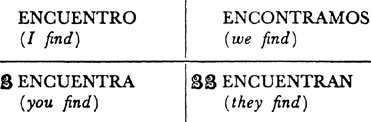
O = UE
| acordar, to remind | mostrar, to show |
| acostar, to put to bed | probar, to taste, to test |
| apostar, to bet | recordar, to remember |
| aprobar, to approve | renovar, to renew |
| colar, to strain (juice) | rodar, to roll |
| comprobar, to prove | soltar, to let loose |
| consolar, to console | sonar, to sound |
| contar, to count, tell | soñar, to dream |
| costar, to cost | tostar, to toast |
| demostrar, to demonstrate | tronar, to thunder |
| descontar, to discount | volar, to fly |
| encontrar, to find, to encounter |
“Er” verbs in which the “o” changes to “ue”
O = UE
| conmover, to move (emotionally) | morder, to bite |
| moler, to grind | mover, to move |
There are some radical changing verbs that end in “gar.” All verbs that end in “gar” in the infinitive end in “gué” in the first person singular of the past.
FREGAR, to scrub
E = IE
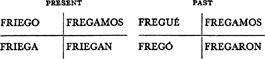
CEGAR, to blind
E = IE
PRESENT
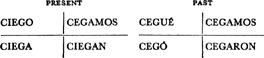
NEGAR, to deny
E = IE
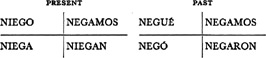
SOSEGAR, to calm, to quiet
E = IE
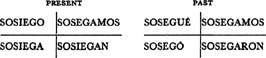
COLGAR, to hang
O = UE
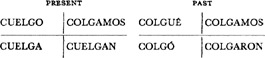
ROGAR, to beg, to implore
O = UE
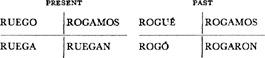
“Volcar” ends in “qué” in the first person singular of the past.
VOLCAR, to overturn
O = UE
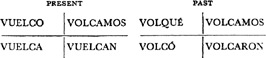
There are some radical changing verbs that end in “zar” in the infinitive. In ALL verbs which end in “zar” in the infinitive the “z” changes to “c” in the first person singular of the past and in the present subjunctive.
COMENZAR, to begin, to start
E = IE
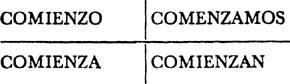
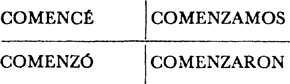
“Empezar” also means to begin and is interchangeable with “comenzar.” “Empezar” (to begin) and “tropezar” (to stumble) have the same irregularities as “comenzar,” above.
ALMORZAR, to have lunch
O = UE
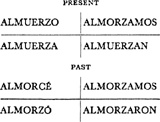
“Esforzar” (to make an effort) and “forzar” (to force) have the same irregularities as “almorzar” above.
Radical Changing Verbs II and III are listed earlier in this lesson.
IRREGULAR PAST PARTICIPLES
THE “PONER” FAMILY
| INFINITIVE | PAST PARTICIPLE |
| poner, to put | PUESTO, put |
| exponer, to expose | EXPUESTO, exposed |
| suponer, to suppose | SUPUESTO, supposed |
| proponer, to propose | PROPUESTO, proposed |
| oponer, to oppose | OPUESTO, opposed |
| imponer, to impose | IMPUESTO, imposed |
| componer, to repair, to compose | COMPUESTO, repaired |
| descomponerse, to get itself out of order | DESCOMPUESTO, gotten out of order |
PRESENT PERFECT TENSE
he puesto, I have put
he expuesto, I have exposed
he supuesto, I have supposed
he propuesto, I have proposed
he opuesto, I have opposed
he impuesto, I have imposed
he compuesto, I have repaired
se ha descompuesto, it has gotten out of order
THE “VOLVER” FAMILY
| INFINITIVE | PAST PARTICIPLE |
| volver, to return | VUELTO, returned |
| devolver, to return (a thing) | DEVUELTO, returned |
| revolver, to mix, to stir | REVUELTO, mixed |
| envolver, to wrap | ENVUELTO, wrapped |
| desenvolver, to unwrap | DESENVUELTO, unwrapped |
PRESENT PERFECT TENSE
he vuelto, I have returned
he devuelto, I have returned (a thing)
he revuelto, I have mixed
he envuelto, I have wrapped
he desenvuelto, I have unwrapped
THE “ESCRIBIR” FAMILY
| INFINITIVE | PAST PARTICIPLE |
| escribir, to write | ESCRITO, written |
| describir, to describe | DESCRITO, described |
| subscribir, to subscribe | SUBSCRITO, subscribed |
| inscribir, to inscribe | INSCRITO, inscribed |
PRESENT PERFECT TENSE
he escrito, I have written
he descrito, I have described
he subscrito, I have subscribed
he inscrito, I have inscribed
OTHER IRREGULAR PAST PARTICIPLES
| INFINITIVE | PAST PARTICIPLE |
| abrir, to open | ABIERTO, opened |
| cubrir, to cover | CUBIERTO, covered |
| descubrir, to discover | DESCUBIERTO, discovered |
| imprimir, to print | IMPRESO, printed |
| resolver, to solve, to resolve | RESUELTO, solved, resolved |
| disolver, to dissolve | DISUELTO, dissolved |
| freír, to fry | FRITO, fried |
| morir, to die | MUERTO, died |
| romper, to tear, to break | ROTO, torn |
| ver, to see | VISTO, seen |
| decir, to say | DICHO, said |
| hacer, to do, to make | HECHO, done, made |
| deshacer, to undo | DESHECHO, undone |
| deshacerse de, to get rid of | DESHECHO DE, gotten rid of |
| satisfacer, to satisfy | SATISFECHO, satisfied |
PRESENT PERFECT TENSE
he abierto, I have opened
he cubierto, I have covered
he descubierto, I have discovered
he impreso, I have printed
he resuelto, I have solved, resolved
he disuelto, I have dissolved
he frito, I have fried
ha muerto, he has died
he roto, I have torn
he visto, I have seen
he dicho, I have said
he hecho, I have done, made
he deshecho, I have undone
me he deshecho de, I have gotten rid of
he satisfecho, I have satisfied
Remember that the past participle is also used as an adjective (with masculine, feminine, singular, and plural endings).
EXAMPLES:
un huevo frito, a fried egg
huevos fritos, fried eggs
La puerta está abierta. The door is open.
Está satisfecho. He is satisfied.
Está satisfecha. She is satisfied.
Está muerto. He is dead.
Está muerta. She is dead.
un paquete envuelto, a wrapped package
Las puertas están abiertas. The doors are open.
Están satisfechos. They are satisfied.
unos paquetes envueltos, some wrapped packages
When verbs end in “uir” the letter “y” is inserted in the following manner:
CONSTRUIR, to build, to construct
PRESENT
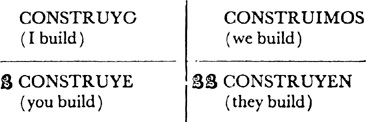
PRETERITE
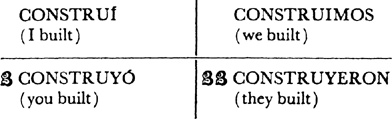
PRESENT SUBJUNCTIVE
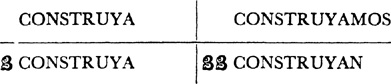
PAST SUBJUNCTIVE

PRESENT PARTICIPLE:
construyendo, building
estoy construyendo, I am building
In the following verbs the “y” is inserted as in the sample verb above.
| reconstruir, to reconstruct | excluir, to exclude |
| destruir, to destroy | incluir, to include |
| distribuir, to distribute | huir, to flee, to run away |
| instruir, to instruct | concluir, to conclude |
| substituir, to substitute | atribuir, to attribute |
| contribuir, to contribute | constituir, to constitute |
| disminuir, to diminish | diluir, to dilute |
Impersonal verbs are verbs in which no person acts. These verbs are used only in the singular third man form.
LLOVER, to rain
| PRESENT |
LLUEVE, it rains; LLUEVE MUCHO, it rains a lot |
| PRETERITE |
LLOVIÓ, it rained; LLOVIÓ MUCHO, it rained a lot |
| IMPERFECT | LLOVÍA, it used to rain |
| FUTURE | VA A LLOVER, it is going to rain |
| FUTURE | LLOVERÁ, it will rain |
| PRESENT PERFECT | HA LLOVIDO, it has rained |
| PRESENT PROGRESSIVE | ESTÁ LLOVIENDO, it is raining |
| PAST PROGRESSIVE |
ESTABA LLOVIENDO, it was raining NEVAR, to snow |
| PRESENT | NIEVA, it snows |
| PRETERITE | NEVÓ, it snowed |
| IMPERFECT | NEVABA, it used to snow |
| FUTURE | VA A NEVAR, it is going to snow |
| FUTURE | NEVARÁ, it will snow |
| PRESENT PERFECT | HA NEVADO, it has snowed |
| PRESENT PROGRESSIVE | ESTÁ NEVANDO, it is snowing |
| PAST PROGRESSIVE |
ESTABA NEVANDO, it was snowing HABER, to be |
| PRESENT | HAY, there is, there are, is there? are there? |
| PRETERITE | HUBO, there was, there were, was there? were there? |
| IMPERFECT | HABÍA, there used to be, did there used to be? |
| FUTURE | VA A HABER, there is going to be, there are going to be, is there going to be? are there going to be? |
| FUTURE | HABRÁ, there will be, will there be? |
| PRESENT PERFECT | HA HABIDO, there has been, there have been |
| PRESENT SUBJUNCTIVE | HAYA |
| PAST SUBJUNCTIVE | HUBIERA |
“Deber” is a regular verb
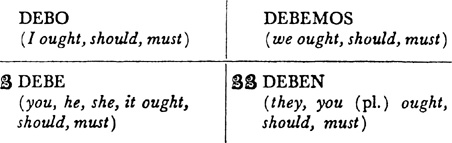
“Deber” is an auxiliary verb that must be followed by an infinitive.
Debo estudiar. I ought to study.
Pablo debe estar en Cuba. Paul must be in Cuba.
Debemos ir al concierto. We should go to the concert.
Deben pagar la cuenta. They should pay the bill.
Debe ser muy difícil. It must be very difficult.
No debe ser fácil. It must not be easy.
Debe haber ido al despacho. He must have gone to the office.
Debe haber estudiado. He must have studied.
The passive voice is used much more in English than it is in Spanish.
In English you say, “I was invited to a party,” and you don’t say who invited you. In Spanish we prefer an active subject, so we use the figurative “they” and say, “They invited me to a party.” “Me invitaron a una fiesta.” This still doesn’t say who invited you, but the implication that “they” invited you gives the sentence a much needed subject.
EXAMPLES:
The ships were painted. Pintaron los barcos. (“They” painted the ships.)
The rooms were cleaned. Limpiaron los cuartos. (“They” cleaned the rooms.)
The clothes were washed. Lavaron la ropa. (“They” washed the clothes.)
The house was bought. Compraron la casa. (“They” bought the house.)
| nada, nothing | ninguno, no one |
| nadie, nobody | jamás, never |
The word “no” when it appears before a noun:
| MASCULINE | FEMININE |
| ningún | ninguna |
| ningunos | ningunas |
EXAMPLES:
| ningún hombre, no man | ninguna mujer, no woman |
| ningunos hombres, no men | ningunas mujeres, no women |
In Spanish the double negative is the correct grammatical construction for sentences beginning with the word “no.”
EXAMPLES:
No ví nada. I didn’t see anything (I didn’t see nothing).
No oí nada. I didn’t hear anything (I didn’t hear nothing).
No ví a nadie. I didn’t see anyone (I didn’t see no one).
No hablé con ninguno. I didn’t talk to anyone (I didn’t talk to no one).
No hice nada. I didn’t do anything (I didn’t do nothing).
n
Spanish there is an intimate form of address that is used with members
of your family and close friends. In this case the pronoun “usted”
(you) becomes “tú” (thou) and the verbs change their
endings.
In order to change verbs into the intimate form ADD THE LETTER “S” TO THE SINGULAR THIRD MAN IN ALL TENSES (except the preterite and the command).
| FORMAL | INTIMATE | |
| PRESENT | usted habla | tú hablas, you speak |
| IMPERFECT | usted hablaba | tú hablabas, you used to speak |
| FUTURE TENSE | usted hablará | tú hablarás, you will speak |
| CONDITIONAL | usted hablaría | tú hablarías, you would speak |
| PRES. SUBJUNCTIVE | hable | hables |
| PAST SUBJUNCTIVE | hablara | hablaras |
In compound tenses add the letter “s” to the auxiliary verb
| FORMAL | INTIMATE | |
| PRES. PERFECT | usted ha hablado, you have spoken | tú has hablado, you have spoken |
| PAST PERFECT | usted había hablado, you had spoken | tú habías hablado, you had spoken |
| PRES. PROGRESSIVE | usted está hablando, you are speaking | tú estás hablando, you are speaking |
| PAST PROGRESSIVE | usted estaba hablando, you were speaking | tú estabas hablando, you were speaking |
| FUTURE | usted va a hablar, you are going to speak | tú vas a hablar, you are going to speak |
ER and IR verbs
| FORMAL | INTIMATE | |
| PRESENT | usted vende | tú vendes, you sell |
| IMPERFECT | usted vendía | tú vendías, you used to sell |
| FUTURE TENSE | usted venderá | tú venderás, you will sell |
| CONDITIONAL | usted vendería | tú venderías, you would sell |
| PRES. SUBJUNCTIVE | venda | vendas |
| PAST SUBJUNCTIVE | vendiera | vendieras |
To form the intimate preterite of “ar” verbs remove “ar” from the infinitive and add “aste.”
EXAMPLES:
tú hablaste, (intimate) you talked
tú compraste, (intimate) you bought
To form the intimate preterite of “er” and “ir” verbs remove the “er” or “ir” and add “iste.”
EXAMPLES:
tú vendiste, (intimate) you sold
tú escribiste, (intimate) you wrote
To form the intimate command of “ar” verbs remove “ar” and add the letter “a.”
| habla, speak | compra, buy |
To form the intimate command of “er” and “ir” verbs remove the “er” or the “ir” and add “e.”
| vende, sell | escribe, write |
Remember that subject pronouns are very frequently dropped in Spanish. “Tú” is dropped more often than not because the ending of the verb makes it clear who the subject is.
You can either say, “Tú hablas muy bien” (You speak very well) or simply “Hablas muy bien.”
The intimate form has an archaic English equivalent (thou, thee, thine), but it has not been used here since it is not used in present-day speech.
The actual translation of “Tú hablas” is “Thou speakest.”
Only one nonconformist verb is irregular in the present tense intimate form: “usted es” becomes “tú eres.” All the rest of the nonconformist verbs follow the regular rule in the present: Add the letter “s” to the singular, third man form.
EXAMPLES:
tú haces, you do; tú vienes, you come; tú tienes, you have
To form the intimate preterite of nonconformist verbs remove the letter “o” from the singular third man form of the preterite and add “iste.”
EXAMPLES:
| FORMAL | INTIMATE |
| usted tuvo, you had | tú tuviste, you had |
| usted estuvo, you were | tú estuviste, you were |
| usted vino, you came | tú viniste, you came |
| usted puso, you put | tú pusiste, you put |
In “fué,” you remove the “é” and add “iste”:
usted fué, you went; tú fuiste, you went
In “cayó,” “oyó,” “leyó” and all other verbs that end in “yo” remove the “yo” and add “iste” (accent the í).
EXAMPLES:
| FORMAL | INTIMATE |
| usted cayó, you fell | tú caíste, you fell |
| usted leyó, you read | tú leíste, you read |
| usted oyó, you heard | tú oíste, you heard |
To form the intimate command of nonconformist verbs drop the “ga” from the formal command.
| FORMAL COMMAND | INTIMATE COMMAND |
| venga, come | ven, come |
| salga, go out | sal, go out |
| diga, say | di, say |
| ponga, put | pon, put |
| tenga, have (take) | ten, have (take) |
| traiga, bring | trae, bring |
| caiga, fall | cae, fall |
The “i” changes to “e” in the intimate form of the verbs “trae” and “cae.”
To form the negative of the intimate command add “s” to the formal command.
| FORMAL COMMAND | INTIMATE NEGATIVE COMMAND |
| venga, come | no vengas, don’t come |
| salga, go out | no salgas, don’t go out |
| diga, say | no digas, don’t say |
| ponga, put | no pongas, don’t put |
| tenga, have (take) | no tengas, don’t have |
| traiga, bring | no traigas, don’t bring |
| caiga, fall | no caigas, don’t fall |
Four verbs do not follow the rule:
| FORMAL COMMAND | INTIMATE COMMAND | INTIMATE NEGATIVE COMMAND |
| oiga, hear, listen | oye, hear, listen | no oigas, don’t hear |
| haga, do, make | haz, do, make | no hagas, don’t do |
| vaya, go | vé, go | no vayas, don’t go |
| sea, be | sé, be | no seas, don’t be |
“Con usted” (with you) has an intimate form: “contigo” (with thee).
The intimate equivalent for LO, LA, LE is TE.
| FORMAL | INTIMATE |
| lo ví, I saw you (masc.) | te ví, I saw you (thee) |
| le dí, I gave you | te dí, I gave you (thee) |
| la invité, I invited you (fem.) | te invité, I invited you |
MI (sing.), MIS (pl.), my
SU (sing.), SUS (pl.), your, his, her, their, its
NUESTRO (our) has masculine, feminine, singular, and plural endings:
| NUESTRO | NUESTROS |
| NUESTRA | NUESTRAS |
EXAMPLES:
mi casa, my house
mis casas, my houses
su casa, your, his, her, their house
sus casas, your, his, her, their houses
nuestras casas, our houses
nuestro auto, our car
nuestros autos, our cars
MÍO (mine), SUYO (yours, his, hers, theirs) and NUESTRO (ours) have masculine, feminine, singular, and plural endings.
Mine:
| mío | míos |
| mía | mías |
Yours, his, hers, theirs:
| suyo | suyos |
| suya | suyas |
Ours:
| nuestro | nuestros |
| nuestra | nuestras |
EXAMPLES:
El libro es mío. The book is mine.
La blusa es mía. The blouse is mine.
Los libros son míos. The books are mine.
Las blusas son mías. The blouses are mine.
El libro es suyo. The book is yours.
La blusa es suya. The blouse is yours.
Los libros son suyos. The books are yours.
Las blusas son suyas. The blouses are yours.
Es mío. It’s mine (referring to a masculine thing).
Es mía. It’s mine (referring to a feminine thing).
El dinero es nuestro. The money is ours.
Ese hijo mío. That son of mine.
ITO, ITA, ITOS, ITAS are diminutive endings in Spanish.
| el sombrero, the hat | el sombrerito, the little hat |
| la casa, the house | la casita, the little house |
| los sombreros, the hats | los sombreritos, the little hats |
| las mesas, the tables | las mesitas, the little tables |
The diminutive is often used in Spanish as an expression of endearment.
EXAMPLES:
abuelo, grandfather
mi abuelito, my grandfather (an endearing term)
ojos, eyes
ojitos, sweet eyes, pretty eyes (a term of endearment)
un gato, a cat
un gatito, a kitten, a cute little cat
una casa, a house
una casita, a cute little house, a charming little house
RULE I: When a word ends in N, S, or a vowel it receives the stress on the next to the last syllable.
EXAMPLES:
entran, EN–tran (stress the e)
sombreros, som–BRE–ros (stress the e)
dentista, den–TIS–ta (stress the i)
posible, po–SI–ble (stress the i)
loco, LO–co (stress the first o)
RULE II: When a word does not end in N, S, or a vowel it receives the accent on the last syllable.
EXAMPLES:
tractor, trac–TOR (stress the o)
postal, pos–TAL (stress the a)
Any word that does not follow either Rule I or Rule II is an abnormal word and therefore must have a written accent.
EXAMPLES:
público, pú–bli–co
dramático, dra–má–ti–co
árbol, ár–bol
azúcar, a–zú–car
conversación, con–ver–sa–ción
café, ca–fé
The letters A, E, O form syllables whether used alone or in combination with any other letter.
EXAMPLES:
lc–o
cre–e
The letters I and U form syllables when they are not combined with any vowel.
EXAMPLES:
popular, po–pu–lar
capital, ca–pi–tal
When I and U are combined with another vowel they do not form separate syllables.
EXAMPLES:
ciudad, ciu–dad
oigo, oi–go
familia, fa–mi–lia
traigo, trai–go
If you are a beginner, do not read the following rules until you have mastered lesson 40.
Accents are used to distinguish two identical words that have different meanings.
EXAMPLES:
| de, of, from | dé, give |
| el, the | él, he |
| mi, my | mí, me |
| si, if | sí, yes |
Some words require accents when they are used in exclamations or in questions.
|
USED IN EXCLAMATIONS OR QUESTIONS |
USED OTHERWISE |
| ¿Cómo? How? | como, how, as, like |
| ¡Cómo duele! How it hurts! | |
| ¿Qué? What? | que, what, that, than |
| ¡Qué lindo! How lovely! | |
| ¿Dónde está? Where is it? | donde, where |
| ¿Cuándo? When? | cuando, when |
| ¿Cuál es? Which is it? | cual, which |
 **
**
Acabar de (plus infinitive), to have just
Acabo de llegar, I have just arrived
Adiós, good-by
A pesar de, in spite of
¡Apúrese! Hurry up! (Mex.)
Bueno, O.K., all right
Buenos días, good morning
Buenas noches, good evening, good night
¡Buena suerte! Good luck!
Buenas tardes, good afternoon
Claro, of course (clear)
Claro que no, of course not
Cómo no, of course (how not)
Como usted quiera, as you wish, as you like
Con mucho gusto, with much pleasure, I’d be delighted
Con razón, no wonder (with reason)
¿Cuánto va a durar? How long is it going to last?
Cuidado, take care, watch out, look out
Cuídese, take care of yourself
Dar la mano, to shake hands (to give the hand)
Dejar de (plus infinitive), to stop
Dejó de verlo, she stopped seeing him
De nada, you are welcome (of nothing)
¡Dése prisa! Hurry up! (Give yourself haste!)
Despacio, slow (road sign)
¿De veras? Really? Is that so?
Dicho y hecho, no sooner said than done
Duerma bien, sleep well
Echar la culpa, to blame (to throw the fault)
Échemelo, toss it to me
El gusto es para mí, the pleasure is mine
Encantado (masc.), encantada (fem.), delighted, enchanted
Es muy divertido, it’s very amusing
Espantoso, ghastly
Espero que se divierta, I hope you’ll have a good time
Espero que se mejore, I hope you, he she will get better
Está a cargo de, he’s in charge of
Esta vez, this time
¡Figúrese! Just imagine! (figure!)
Gracias, thank you
güero, (masc.), güera, (fem.), blond (slang, Mex.)
Hacer caso, to pay attention (to make a case)
Hecho a mano, hand made
Haga caso, pay attention (make a case
Hágalo pronto, do it right away
Hágame un favor, do me a favor
Hasta luego, good-by, so long (till later)
¡Imagínese! Just imagine!
La echo de menos, I miss her
Lléveselo, take it away
Lo echo de menos, I miss you (masc.), him, it
Lo siento, I’m sorry, I feel it
Lo volví a ver, I saw him again
Más o menos, more or less
Más vale tarde que nunca, better late than never
Me alegro, I’m glad
Me alegro de verlo (verla), I’m glad to see you
Me cayó en gracia, it amused me
Me da lástima, I feel sorry for him, her, it (it gives me pity)
Me divertí, I had a good time
Me duele, it hurts me
Me duele la cabeza, my head aches (my head hurts me)
Me hace falta, I miss you, him, her, it
Mejor dicho, better said
Meter la pata. to stick your foot in it
Mire, look
Muchas gracias, thank you very much
Mucho gusto, how do you do (on being introduced)
No es justo, it isn’t fair (it isn’t just)
No hay de que, you are welcome (there is not for what)
No importa, it doesn’t matter
No le hace, it doesn’t matter
No lo haga, don’t do it, stop it
No me ande con esas, don’t come around with that, don’t give me that stuff
¡No me lo diga! Don’t tell me!
No se moleste, don’t bother, don’t trouble yourself
No se preocupe, don’t worry
No se tarde, don’t be long
Nos vemos, I’ll be seeing you (we’ll be seeing each other)
No tiene razón, you’re wrong (you haven’t reason)
Otra vez, again
Para peores cuentas, to make things worse
Parece mentira, it doesn’t seem possible (it seems like a lie)
Parece que va a llover, it looks as if it’s going to rain
Pase adelante, come in
Peligro, danger (road sign)
Permítame, allow me
Permítame presentarle a mi amigo, allow me to present my friend (to you)
Plata, slang for money (silver)
Poco a poco, little by little
Por nada, you are welcome
Por supuesto, of course (supposed)
Quédese, stay
¡Qué extraño! How strange!
¿Qué hay de nuevo? What’s new?
Qué lástima, what a shame, what a pity
¿Qué le hace? What does it matter?
¿Qué le parece? What do you think of that!
¿Qué pasó? What happened, what’s up?
¡Qué raro! How strange! (How rare!)
¿Qué se le ofrece? What can I offer you? (What can be offered to you?)
¡Qué sorpresa! What a surprise!
Qué va, of course not
Rascacielos, skyscraper (sky scratcher)
Salió bien, it came out well (it went out well)
Salud, (health), God bless you (a word you say when someone sneezes, and also a toast)
Seguro, sure
Se me hizo tarde, I’m late (it made itself late for me)
Se me olvidó, I forgot, I forgot it
¿Se puede? May I? May I come in?
Siéntese, por favor, sit down, please
Sin falta, without fail
¿Tan pronto? So soon?
¿Tan temprano? So early?
Tengo un compromiso, I have an appointment
Tiene razón, you’re right (you have reason)
Todo el mundo, everybody (all the world)
Tráigamelo, bring it to me
Tratar de (plus infinitive) to try to
Traté de verlo, I tried to see him
Unas veces, sometimes
Volver a (plus infinitive), to do again
Volví a hacerlo, I did it again
Ya, already, now
Ya lo creo, of course (now I believe it)
Ya no, no more, any more
Ya no puedo, I can’t any more
Ya no puedo nadar, I can’t swim any more
Ya terminé, I’m through now (I already finished)
Ya vino, he’s here now (he already came)
Ya voy, I’m coming (I’m going now)
There are thousands of colorful idiomatic expressions and proverbs in Spanish. Unfortunately, space permits us only a few of these. But I hope these few will tickle your fancy.
Dar gato por liebre, to cheat (to give a cat instead of a hare)
Dejarlo plantado, to stand him up (to leave him planted), to leave him waiting (a date)
Echar la casa por la ventana, to spend a lot of money on a party (to throw the house out the window)
Echar una cana al aire, to sow wild oats (to throw a white hair to the winds)
Está entre la espada y la pared, he’s between the devil and the deep blue sea (he’s between the sword and the wall)
Habla hasta por los codos, he, she talks all the time (he talks even through his elbows)
Lo cogió con las manos en la masa, she caught him red-handed (she caught him with his hands in the bread dough)
Le tomó el pelo, she pulled his leg (she took him by the hair)
Le vió la oreja, she made a fool of him (she saw his donkey ear)
Ni a tiros, not under any circumstance
No lo haría ni a tiros, I wouldn’t do it under any circumstance (I wouldn’t do it even by bullets, I wouldn’t do it even if bullets were singing at my heels)
Sabe a gloria, it’s delicious (it tastes like heaven, glory)
Se metió en camisa de once varas, he bit off more than he could chew (he got into an eleven yard shirt)
Se puso como fiera, he got furious (he got like a wild beast)
Soltar una carcajada, to laugh, to guffaw (to release a belly laugh)
Un rompecabezas, a puzzle (a head breaker, a skull cracker)

The words in this vocabulary have been listed according to the English alphabet.
a, to, at (time); a la una, at one
o’clock; a las dos, at two o’clock
abajo, down, downstairs
abdominal, abdominal
abogado, m. lawyer
abominable, abominable
abrazar, to hug, to embrace
abrazo, m. hug, embrace
abreviación, f. abbreviation
abrigo, m. coat
abril, m. April
abrir, to open
absolutamente, absolutely
absoluto, -a, absolute
absorber, to absorb
abstención, f. abstention
abstener, to abstain
abstinencia, f. abstinence
abstracción, f. abstraction
abstracto, -a, abstract
abuela, f. grandmother
abuelo, m. grandfather
abundancia, f. abundance
abundante, abundant
abusivo, -a, abusive
acabo (de), I have just; acabo de ver, I have just seen
académico, -a, academic
accesible, accessible
accidental, accidental
accidente, m. accident
acción, f. action
aceituna, f. olive
acelerador, m. accelerator
aceptable, acceptable
aceptar, to accept
acera, f. sidewalk
acercarse, to get close
acompañamiento, m. accompaniment
acordar, to remind
acordarse, to remember
acordeón, m. accordion
acostarse, to go to bed, to lie down
acrobático, -a, acrobatic
actividad, f. activity
activo, -a, active
acto, m. act
actor, m. actor; actor de cine, movie actor
actriz, f. actress
acuático, -a, aquatic
acumulación, f. accumulation
acumulando, accumulating
acumular, to accumulate
acusación, f. accusation
acusar, to accuse
adaptable, adaptable
adelante, forward; pase adelante, come in
adhesión, f. adhesion
adhesivo, -a, adhesive; tela adhesiva, adhesive tape
adjetivo, m. adjective
administración, f. administration
admirable, admirable
admiración, f. admiration
admirar, to admire
admisible, admissible
adolescencia, f. adolescence
adolescente, adolescent
adopción, f. adoption
adorable, adorable
adoración, f. adoration
adorar, to adore
adulación, f. adulation
adversario, m. adversary
adversidad, f. adversity
aeronáutico, -a, aeronautic
aeropuerto, m. airport
afable, affable
afeitarse, to shave
afinidad, f. affinity
afirmación, f. affirmation
afirmar, to affirm
afortunado, -a, fortunate
agencia, f. agency
agente, m. agent
agilidad, f. agility
agitación, f. agitation
agitar, to agitate
agnóstico, -a, agnostic
agonía, f. agony
agosto, m. August
agradable, agreeable, nice
agradecer, to be grateful for
agradecimiento, m. gratitude, appreciation
agresivo, -a, aggressive
agresor, m. aggressor
agricultura, f. agriculture
agua, f. water; el agua, the water (use masc. article)
aire, m. air
ajv, m. garlic
al, to the, at the, on the; al cuarto para las tres, at a (the) quarter to three; al contrario, on the contrary; al fin, finally
Alberto, Albert
alcalde, m. mayor
alcohol, m. alcohol
alegórico, -a, allegorical
alegrarse, to be glad; me alegro, I’m glad
alfombra, f. the rug
Alicia, Alice
alistarse, to get ready
almohada, f. pillow
armamento, m. armament
almorzar, to have lunch
almuerzo, m. lunch
alquilar, to rent
alternativo, alternative
alto, -a, tall
amarillo, -a, yellow
ambición, f. ambition
ambicioso, -a, ambitious
ambulancia, f. ambulance
América, America; América del Sur, South America; América Latina, Latin America
amigo, -a, friend
amor, m. love
amoroso, -a, amorous
amputación, f. amputation
amputar, to amputate
analogía, f. analogy
anatomía, f. anatomy
andar, to walk
anduve, I walked
anémico, -a, anemic
ángel, m. angel
angélico, -a, angelic
animación, f. animation
animal, m. animal
animar, to animate
aniversario, m. anniversary
año, m. year
anoche, last night
antena, f. antenna
antenoche, night before last
antes (de), before
anticipación, f. anticipation
anticipando, anticipating
anticipar, to anticipate
antier, day before yesterday
antiséptico, m. antiseptic
antología, f. anthology
Antonio, Anthony
anual, annual
anunciar, to advertise, to announce
anuncio, m. advertisement
apagar, to put out (light)
aparente, apparent
apio, m. celery
aplaudiendo, applauding
aplaudir, to applaud
apostar, to bet
apreciación, f. appreciation
apreciar, to appreciate
aprehender, to arrest
aprender, to learn
apretar, to squeeze
aprieto, m. a jam, a tight spot; aprieto, I squeeze
aprisa, fase
aprobar, to approve
aproximación, f. approximation
aproximar, to approximate
apuesta, f. bet
apurarse, to hurry
apúrese, hurry up
árbol, m. tree
archivar, to file (letters)
archivo, m. file (letters)
ardor, m. ardor
Argentina, f. Argentina
argumento, m. plot (of a play, book, etc.)
aristocracia, f. aristocracy
aristocrático, -a, aristocratic
aromático, -a, aromatic
arqueología, f. archeology
arquitecto, m. architect
arquitectura, f. architecture
arreglar, to arrange
arreglo, m. arrangement
arrepentirse, to repent
arrogancia, f. arrogance
arrogante, arrogant
arroz, m, rice
arsenal, m. arsenal
arsénico, m. arsenic
artículo, m. article
artificial, artificial
artista, m., f., artist
artístico, -a, artistic
ascender, to ascend, to climb
asiento, m. seat
asistencia, f. assistance, attendance
asistido, attended
asistiendo, attending
asistir, to attend
asociación, f. association
asociar, to associate
aspecto, m. aspect
aspiración, f. aspiration
aspirar, to aspire
aspirina, f. aspirin
astringente, m. astringent
astronomía, f. astronomy
astuto, -a, astute
asustarse, to get frightened; no se asuste, don’t get frightened
atacar, to attack
atención, f. attention
atender, to attend, to take care of
Atlántico, m. Atlantic
atómico, -a, atomic
atractivo, -a, attractive
atraer, to attract
atravesar, to cross
atreverse, to dare
atribuir, to attribute
atributo, m. attribute
atrocidad, f. atrocity
auditor, m. auditor
aunque, even though
aureomicina, f. aureomycin
ausencia, f. absence
austeridad, f. austerity
auténtico, -a, authentic
auto, m. auto
autobiografía, f. autobiography
autobús, m. bus
autocrático, -a, autocratic
automático, -a, automatic
automóvil, m. automobile
autor, m. author
autoridad, f. authority
autorización, f. authorization
avenida, f. avenue
aventura, f. adventure
aversión, f. aversion
aviación, f. aviation
avión, m. airplane
ay, alas; ay, equivalent of “oh”; ay no, oh no; ay sí, oh yes
ayer, yesterday
ayudar, to help, to aid
azúcar, sugar
azul, blue
bailado, danced
bailando, dancing
bailar, to dance
baile, m. dance
bajar, to go or come down, to get off, to get down
bajarse, to get down, get off vehicles
ballet, m. ballet
bañarse, to bathe (yourself)
banco, m. bank
banda, f. band
baño, m. bath, bathroom; cuarto de baño, bathroom; baño de sol, sun bath
barato, -a, cheap
barco, m. ship
barrer, to sweep
batir, to beat (eggs, foods)
beber, to drink
begonia, f. begonia
beisbol, m. baseball
beneficial, beneficial
benevolencia, f. benevolence
besar, to kiss
beso, m. kiss
biblioteca, f. library
bicicleta, f. bicycle
bien, well
biftec, m. beefsteak
bilioso, -a, bilious
biografía, f. biography
blanco, -a, white
blusa, f. blouse
boleto, m. ticket; billete, ticket (in Spain)
bolsa, f. bag, purse
bonito, -a, pretty
botella, f. bottle
botica, f. drugstore
brazo, m. arm
bridge, m. bridge (game)
brutal, brutal
brutalidad, f. brutality
bruto, m. brute
buen, good
bueno, -a, good; bueno, all right, O.K.
bufanda, f. scarf
burocracia, f. bureaucracy
burocrático, -a, bureaucratic
buzón, m. mailbox
caballero, m. gentleman
caballo, m. horse
cabe, it fits (in a place)
caber, to fit, to have room for
cabeza, f. head; dolor de cabeza, headache
cable, m. cable
cablegrama, m. cablegram
caer, to fall
caerse, to fall down
café, m. coffee; color café, brown
cafeína, f. caffeine
caigo, I fall
caja, f. box
calamidad, f. calamity
calcetines, m. socks
calculación, f. calculation
calcular, to calculate
calendario, m. calendar
calentar, to heat
caliente, hot
calle, f. street
calor, m. heat; tengo calor, I’m warm
cama, f. bed
cámara, f. camera
camarón, m. shrimp
cambiado, -a, changed
cambiar, to change, to exchange
cambiarse, to change (clothes)
cambio, m. change
camelia, f. camellia
caminado, walked
caminar, to walk
camino, m. road
camión, m. truck, bus (Mex.)
camisa, f. shirt
campo, m. country, field
cana, f. a white hair
Canadá, Canada
canal, m. canal
canario, m. canary
canasta, f. basket, canasta (card game)
cancelar, to cancel
canción, f. song
candor, m. candor
cansado, -a, tired
cansarse, to get tired
cantado, -a, sung
cantando, singing
cantar, to sing
canto, m. song
capacidad, f. capacity
capital, f. capital
capitalista, capitalist
capitulación, f. capitulation, surrender
cara, f. face
caramba, gee whiz
cárcel, f. jail
cardinal, cardinal
carga, f. load
cargar, to load
cargo, m. charge; a cargo de, in charge of
caricatura, f. cartoon
caridad, f. charity
Carlos, Charles
carnal, carnal
carne, f. meat
carnero, m. mutton
carnicería, f. butcher shop
caro, -a, expensive
carpintería, f. carpenter’s shop
carretera, f. highway
carta, f. letter
casa, f. house, home; en casa, at home
Casa Blanca, White House
casarse, to get married
caso, m. case; hacer caso, to pay attention
castidad, f. chastity
castigar, to punish
catarro, m. a cold
catastrófico, -a, catastrophic
catedral, f. cathedral
católico, -a, catholic
catorce, fourteen
causa, f. cause
causado, -a, caused
causar, to cause
cáustico, -a, caustic
cavidad, f. cavity
cayó, fell
cebolla, f. onion
cegar, to blind
celebración, f. celebration
celebrando, celebrating
celebrar, to celebrate
celebridad, f. celebrity
cena, f. supper, dinner, evening meal
cenar, to dine, to have supper
censor, m. censor
centavo, m. cent
central, central
cepillar, to brush
cepillarse, to brush (hair, teeth, etc.)
cepillo, m. brush
cerca (de), close to, near
cereal, m. cereal
ceremonial, ceremonial
ceremonioso, -a, ceremonious
cerrado, -a, closed
cerrar, to close, shut
chaleco, m. vest
chiles, m. peppers
chimenea, f. fireplace
chiquito, -a, small, little
chiste, m. joke
chistoso, -a, funny
chocolate, m. chocolate
chofer, m. driver (taxi), chauffeur
chuleta, f. chop; chuleta de puerco, pork chop
cielo, m. sky
cien, one hundred
ciencia, f. science
científico, -a, scientific
ciento, a hundred
cierro, I close, shut
cigarrillo, m. cigarette
cigarro, m. cigarette
cinco, five
cincuenta, fifty
cine, m. movies, movie, moving picture
cinturón, m. belt
circo, m. circus
circulación, f. circulation
circular, to circulate
circunferencia, f. circumference
circunspecto, -a, circumspect
circunstancia, f. circumstance
cita, f. appointment, date
ciudad, f. city
civilización, f. civilization
claridad, f. clarity
claro, of course; claro, -a, clear, light; azul claro, light blue
clase, f. class
clásico, -a, classical
clasificación, f. classification
cliente, m. client
clima, m. climate
club, m. club
coagulación, f. coagulation
coagular, to coagulate
coautor, m. coauthor
cocaína, f. cocaine
cocina, f. kitchen, cooking
cocinar, to cook
cocinera, f. cook
coctel, m. cocktail
codo, m. elbow
coherencia, f. coherence
coincidencia, f. coincidence
colaboración, f. collaboration
colaborador, m. collaborator
coloborar, to collaborate
colar, to strain
colección, f. collection
colectivo, -a, collective
colegio, m. school
colgar, to hang
coliflor, f. cauliflower
Colombia, Columbia
colonia, f. colony
colonial, colonial
color, m. color
colorado, -a, red
colosal, colossal
columna, f. column
combinación, f. combination
combinar, to combine
comedia, f. play, comedy
comedor, m. dining room
comentario, m. comment, commentary
comenzado, -a, begun
comenzar, to begin
comer, to eat
comercial, commercial
cometer, to commit
cómico, -a, comical, funny
comida, f. meal, lunch, daytime dinner
comisión, f. commission
como, as, I eat
cómo, how; ¿cómo está? how are you? how is he, she?; ¿cómo se dice? how do you say?; cómo no, of course
compacto, -a, compact
compadecer, to sympathize with, to feel sorry for
compañia, f. company (commercial)
comparable, comparable
comparar, to compare
comparativamente, comparatively
comparativo, -a, comparative
compasión, f. compassion
compatibilidad, f. compatibility
compatible, compatible
compensación, f. compensation
compensar, to compensate
competente, competent
competir, to compete
compilación, f. compilation
compilar, to compile
completamente, completely
completo, -a, complete
complexión, f. complexion
complicar, to complicate
componer, to fix, to compose
composición, f. composition
compra, f. purchase
comprado, -a, bought
comprando, buying
comprar, to buy
comprender, to understand
comprendido, -a, understood
comprendiendo, understanding
compresión, f. compression
comprobar, to prove
compromiso, m. appointment, date
compulsión, f. compulsion
comunicación, f. communication
comunidad, f. community
comunista, m., f. communist
con, with; con tal que, provided; con frecuencia, with frequence, often
concentración, f. concentration
concentrar, to concentrate
concepción, f. conception
concernir, to concern
concesión, f. concession
conciencia, f. conscience
concierto, m. concert
conclusión, f. conclusion
condensación, f. condensation
condensado, -a, condensed
condensar, to condense
condición, f. condition
condicional, conditional
conductor, m. conductor
concluir, to conclude
conferencia, f. lecture, conference
confesar, to confess
confesión, f. confession
confeti, m. confetti
confidencial, confidential
confirmación, f. confirmation
confirmar, to confirm
conflicto, m. conflict
confundir, to confuse
confusión, f. confusion
congestión, f. congestion
conglomeración, f. conglomeration
congregación, f. congregation
conjugación, f. conjugation
conmigo, with me
conmover, to move emotionally
conoce, know, knows (people); ¿conoce? do you know?
conocer, to know (people, places), to be introduced to
conocido, known; bien conocido, well known
conocimiento, m. knowledge
conozco, I know (people, places)
consecuencia, f. consequence
consecutivo, -a, consecutive
consentir, to consent, to spoil a person
conservación, f. conservation
conservar, to conserve
conservativo, -a, conservative
consideración, f. consideration
considerar, to consider
consistir, to consist
consolación, f. consolation
consolar, to console
consolidación, f. consolidation
consolidar, to consolidate
consonante, f. consonant
constante, constant
constantemente, constantly
constelación, f. constellation
constitución, f. constitution
constitucional, constitutional
constituir, to constitute
construcción, f. construction
construir, to build, to construct
consuelo, m. consolation; consuelo, I console
consultante, m. consultant
contacto, m. contact
contagioso, -a, contagious
contaminación, f. contamination
contaminar, to contaminate
contar, to count, to recount, to tell, to depend on
contemplación, f. contemplation
contemplar, to contemplate
contener, to contain
contento, -a, happy
contestado, -a, answered
contestar, to answer
contigo, with thee
continental, continental
continente, m. continent
contingente, m. contingent
continuación, f. continuation
continuar, to continue
contradicción, f. contradiction
contraer, to contract
contrario, -a, contrary; al contrario, on the contrary
contrato, m. contract
contribución, f. contribution
contribuir, to contribute
convalecencia, f. convalescence
convencer, to convince
convencido, -a, convinced
convención, f. convention
convencional, conventional
conveniencia, f. convenience
conveniente, convenient
conversación, f. conversation
conversando, conversing
conversar, to converse
conversión, f. conversion
convertir, to convert
convicción, f. conviction
convulsión, f. convulsion
cooperación, f. co-operation
cooperando, co-operating
cooperar, to co-operate
coordinación, f. co-ordination
coordinar, to co-ordinate
copia, f. copy
copiando, copying
copiar, to copy
coqueta, f. coquette
coral, m. coral
corbata, f. necktie, cravat
cordial, cordial
cordialidad, f. cordiality
corral, m. corral
corrección, f. correction
correcto, -a, correct
corredor, m. corridor, hall
correo, m. post office, mail; correc aéreo, air mail
correr, to run
correspondencia, f. correspondence
corrupción, f. corruption
cortar, to cut
cortarse, to cut yourself
cortés, courteous
cortesía, f. courtesy
cortina, f. curtain, drape
cosa, f. thing
coser, to sew
cosmético, m. cosmetic
costar, to cost
creación, f. creation
creador, m. creator
creativo, -a, creative
crecer, to grow
crecimiento, m. growth
credencial, m. credential
creer, to believe, to think (opinion)
crema, f. cream
creo, I think, I believe; creo que st, I think so; creo que no, I don’t think so; ¿qué cree usted? what do you think?
criada, f. maid
criatura, f. creature
criminal, m. criminal
cristal, m. crystal
crítica, f. criticism, review of a play, book, etc.
criticar, to criticize
cromático, -a, chromatic
crueldad, f. cruelty
cuál, which
cuándo, when
cuánto, -a, how much?; ¿cuánto tiempo? how long?; ¿cuánto cuesta? how much does it cost?
cuántos, -as, how many?
cuarenta, forty
cuarto, m. room, quarter
cuarto, -a, fourth
cuatro, four
cuatrocientos, four hundred
cubano, -a, Cuban
cubrir, to cover
cuchara, f. spoon
cuchillo, m. knife
cuenta, f. bill, restaurant check, account
cuento, m. story; cuento, I tell
cuidado, be careful, take care
cuidar, to take care of
cuidarse, to take care of yourself
culinario, -a, culinary
culminación, f. culmination
culminar, to culminate
culpa, f. fault, blame
culpar, to blame
cultivación, f. cultivation
cultivado, -a, cultivated
cultivando, cultivating
cultivar, to cultivate
cultura, f. culture
cultural, cultural
cumpleaños, m. birthday
cuñada, sister-in-law
cuñado, brother-in-law
curable, curable
curar, to cure
curiosidad, f. curiosity
curioso, -a, curious
curva, f. curve
dalia, f. dahlia
daño, m. harm; hacer daño, to be bad for, to do harm
dar, to give
de, of, from, about; de veras, really
dé, give (command)
debajo (de), under, underneath
deber, ought, should, must; deber, m. duty
debilidad, f. weakness
decadencia, f. decadence
decadente, decadent
decencia, f. decency
decente, decent
decidido, decided
decidiendo, deciding
decidir, to decide
decimal, m. decimal
décimo, -a, tenth
decir, to say, to tell
decisión, f. decision
decisivo, -a, decisive
declaración, f. declaration
declarar, to declare
decoración, f. decoration
decorar, to decorate
dedicación, f. dedication
dedicar, to dedicate
dedo, m. finger
deducción, f. deduction
defectivo, -a, defective
defecto, m. defect
defender, to defend
defensivo, -a, defensive
deficiente, deficient
definición, f. definition
definitivo, -a, definitive
degeneración, f. degeneration
degradación, f. degradation
dejar, to leave, to let, to allow
del, of the, from the, about the
delgado, -a, thin
deliberación, f. deliberation
deliberar, to deliberate
delicioso, -a, delicious
demandando, suing
demandar, to sue
démelo, give it to me
democracia, f. democracy
democrático, -a, democratic
demostrar, to demonstrate
dental, dental
dentista, dentist
denunciación, f. denunciation
denunciar, to denounce
departamento, m. apartment, department
depender, to depend
deplorable, deplorable
depositado, deposited
depositar, to deposit
depresión, f. depression
derecha, right; a la derecha, on the right-hand side, to the right
derecho, straight, straight ahead
derivativo, derivative
derretir, to melt
desaparecer, to disappear
desastroso, -a, disastrous
desayuno, m. breakfast
descansar, to rest
descender, to descend, to go down
desconcertar, to disconcert
descontar, to discount
describiendo, describing
describir, to describe
descripción, f. description
descriptivo, -a, descriptive
descubrir, to discover
descuento, m. discount
desenvolver, to unwrap
deshacerse (de), to get rid of
desinfectante, m. disinfectant
desobedecer, to disobey
desobediencia, f. disobedience
desolación, f. desolation
despacio, slowly
despedirse (de), to take leave of
despertar, to wake up
después (de), after; después, afterward
desquitarse, to get even, to retaliate
destructivo, -a, destructive
destruir, to destroy
desvestirse, to undress
detener, to detain
deterioración, f. deterioration
deteriorar, to deteriorate
determinación, f. determination
determinar, to determine
detestable, detestable
detestación, f. detestation
detestar, to detest
detrás (de), behind
devoción, f. devotion
devolver, to return (a thing)
di, say
di, I gave
dia, m. day
diabético, diabetic
diablo, m. devil
diagnóstico, m. diagnosis
diagrama, m. diagram
dialecto, m. dialect
diario, daily, diary
dibujar, to draw
dibujo, m. drawing
dicción, f. diction
diccionario, m. dictionary
dice, say, says
dicho, said, told; un dicho, m. a saying; dicho y hecho, said and done
diciembre, m. December
dictador, m. dictator
dictando, dictating
dictar, to dictate
diez, ten
diez y nueve, nineteen
diez y seis, sixteen
diez y siete, seventeen
diferencia, f. difference
diferente, different
difícil, difficult
difidencia, f. diffidence
dificultades, f. difficulties, trouble
dígame, tell me
digerir, to digest
digestible, digestible
digestión, f. digestion
digestivo, digestive
dignidad, f. dignity
digo, I say, tell
dije, I said, told
dijo, said, told
dilema, m. dilemma
diligencia, f. diligence
diligente, diligent
diluir, to dilute
dimensión, f. dimension
diminutivo, -a, diminutive
dinámico, -a, dynamic
dinero, m. money
Dios, God
diplomacia, f. diplomacy
diplomático, -a, diplomatic
dirección, f. address, direction
directo, -a, direct
director, m. director
direciorio, m. directory
dirigible, m. dirigible
disciplina, f. discipline
disciplinario, -a, disciplinary
disco, m. phonograph record
discreción, f. discretion
discrepancia, f. discrepancy
discreto, -a, discreet
discurso, m. speech
discusión, f. discussion
discutido, discussed
discutir, to discuss, to argue
diseñar, to design
diseño, m. design
disolver, to dissolve
disminuir, to diminish
disponer, to dispose
distancia, f. distance
distinción, f. distinction
distintivo, -a, distinctive
distinto, -a, different, distinct
distracción, f. distraction
distraer, to distract
distribución, f. distribution
distribuir, to distribute
distrito, m. district
diversidad, f. diversity
diversión, f. entertainment
divertirse, to have a good time; me diverti, I had a good time
dividido, divided
dividicndo, dividing
dividir, to divide
divinidad, f. divinity
división, f. division
divorciar, to divorce
divorcio, m. divorce
doce, twelve
docena, f. dozen
doctor, m. doctor
doctrina, f. doctrine
dólar, m. dollar
dólares, m. dollars
doler, to hurt; me duele, it hurts
dolor, m. pain, ache
dogmático, dogmatic
dominación, f. domination
dominante, dominant
dominar, to dominate
domingo, m. Sunday
donde, where
dónde, where?
dormir, to sleep
dormirsc, to go to sleep
dormitorio, m. bedroom
Dorotea, Dorothy
dos, two
doscientos, two hundred
doy, I give
drama, m. drama
dramático, -a, dramatic
drástico, -a, drastic
duda, f. doubt
dudar, to doubt
duele, hurts; me duele, it hurts me
dulce, sweet
dulces, m. (pl.) candy
duplicación, f. duplication
duplicar, to duplicate
durable, durable
durante, during
durar, to last
echar, to pour, to throw, to toss, to dump, to put out, to throw out
échemelo, toss it to me
economía, f. economy
económico, -a, economic, economical
economista, economist
edición, f. edition
edificio, m. building
editor, m. editor
editorial, m. editorial
Eduardo, Edward
educacional, educational
educado, -a, educated
educador, m. educator
efectivo, -a, effective
efecto, m. effect
efervescencia, f. effervescence
eficacia, f. efficacy, efficiency
eficiente, efficient
el, m. the
él, he; con él, with him
elasticidad, f. elasticity
elástico, elastic
elección, f. election
electo, -a, elect, chosen
electoral, electoral
electricidad, f. electricity
eléctrico, -a, electric
elefante, m. elephant
elegancia, f. elegance
elegante, elegante
elemental, elemental
Elena, Helen
elevación, f. elevation
elevador, m. elevator
eliminación, f. elimination
ella, she; con ella, with her
ellos, -as, they; con ellos, with them
elocuencia, f. eloquence
elocuente, eloquent
emblema, m. emblem
emborracharse, to get drunk
emergencia, f. emergency
eminente, eminent
emisario, m. emissary
emoción, f. emotion
emocional, emotional
en, in, on, at (places); en casa, at home
encantado, -a, enchanted
encantar, to enchant, to love; me encanta el jamón, I love ham
encender, to light (a fire, cigarette)
encerrar, to lock in
enciclopédico, encyclopedic
encima (de), on top of
encontrar, to meet, to find, to encounter
encuentro, m. encounter; encuentro, I find, meet, encounter
energía, f. energy
enero, m. January
enfermarse, to get sick
enfermo, -a, sick
enfriarse, to get cold
engordarse, to get fat
enigmático, -a, enigmatic
enojado, -a, angry
Enrique, Henry
ensalada, f. salad
entender, to understand
entendido, understood
enterarse, to find out
enterrar, to bury
entiendo, I understand
entrante, entering, coming, next; el año entrante, next year
entrar, to enter, to go in, to come in
entrega, f. delivery; entrega inmediata, special delivery
entregar, to deliver
entretener, to entertain
entrevista, f. interview
entrevistar, to interview
entusiasmarse, to get enthusiastic
entusiasmo, m. enthusiasm
envidia, f. envy
envidiar, to envy
envolver, to wrap
envuelto, -a, wrapped
epigrama, m. epigram
episcopal, episcopal
equivalente, equivalent
equivocarse, to make a mistake
era, was, were; used to be; it was, it used to be
erótico, -a, erotic
error, m. error
es, is. (you) are, it is
escalera, f. staircase, ladder
escaparse, to escape, to get away
escribiendo, writing
escribir, to write
escrito, written
escritorio, m. desk
escuela, f. school
escultura, f. sculpture
ese, -a, that
esencia, f. essence
esencial, essential
eso, -a, that; eso es, that’s it
espada, f. sword
espalda, f. back
España, Spain
español, Spanish, Spanish man; española, Spanish woman
espantoso, -a, ghastly
espárragos, m. asparagus
especial, special
especialidad, f. specialty
especialista, specialist
especialmente, specially, especially
esperado, hoped, waited, expected
esperar, to hope, to wait, to expect
espía, m., f. spy
espiritual, spiritual
esplendor, m. splendor
esposa, f. wife
esposo, m. husband
esquina, f. corner
esta, f. this
ésta, this one
está, is (you) are
estaba, was, used to be
estabilidad, f. stability
estable, (adj.) stable
establecer, to establish
establecimiento, m. establishment
estación, f. station, season of the year
estacionar, to park (car)
estado, m. state
estado, been
Estados Unidos, United States
estamos, we are
estampilla, f. stamp
están, they are, you (pl.) are
estar, to be
estas, f. these
estatura, f. stature
este, m. this, east
éste, this one
estilo, m. style
estimulación, f. stimulation
estimular, to stimulate
estómago, m. stomach
estos, m. these
estoy, I am
estrangulación, f. strangulation
estrangular, to strangle
estructura, f. structure
estudiando, studying
estudiante, student
estudiar, to study
estudio, m. study (noun)
estúpido, -a, stupid
estuve, I was
eternidad, f. eternity
ético, ethical
evadir, to evade, avoid
evangélico, -a, evangelic
evangelista, evangelist
evaporación, f. evaporation
evaporado, -a, evaporated
evaporar, to evaporate
evasión, f. evasion
evasivo, -a, evasive
evidencia, f. evidence
evidente, evident
exacto, -a, exact
exageración, f. exaggeration
exagerar, to exaggerate
examinar, to examine
exasperación, f. exasperation
exasperar, to exasperate
excavación, f. excavation
excavar, to excavate
exceder, to exceed
excelencia, f. excellence
excelente, excellent
excéntrico, -a, eccentric
excepción, f. exception
excepcional, exceptional
excesivo, -a, excessive
exclamación, f. exclamation
exclamar, to exclaim
excluir, to exclude
exclusivo, -a, exclusive
exhibición, f. exhibition
exhibir, to exhibit
exigir, to demand
existencia, f. existence
existido, existed
existir, to exist
exito, m. success
exótico, -a, exotic
expedición, f. expedition
experiencia, f. experience
experimentación, f. experimentation
experimental, experimental
experimentar, to experiment
explicable, explicable, explainable
explicar, to explain
exploración, f. exploration
explorado, -a, explored
explorar, to explore
explosión, f. explosion
explosivo, m. explosive
exponer, to expose
exportación, f. export, exportation
exportando, exporting
exportar, to export
exposición, f. exposition
expresar, to express
expresión, f. expression
expresivo, -a, expressive
extender, to extend
extendiendo, extending
extensión, f. extension
extensivo, -a, extensive
exterior, exterior; cuarto exterior, outside room
exterminación, f. extermination
exterminar, to exterminate
extracto, m. extract
extraer, to extract
extraordinario, -a, extraordinary
extraño, -a, strange
extremidad, f. extremity
exuberancia, f. exuberance
fábrica, f. factory
fabricar, to manufacture
fabuloso, -a, fabulous
facial, facial
fácil, easy
facilidad, f. facility, ease
factor, m. factor
falda, f. skirt
falta, f. lack, want; sin falta, without fail; hacer falta, to miss, to lack
faltar, to lack, to miss
familia, f. family
familiaridad, f. familiarity
famoso, -a, famous
fantástico, -a, fantastic
farmacia, f. drugstore
fascinación, f. fascination
fascinar, to fascinate
fatal, fatal
fatalidad, f. fatality
favor, m. favor; por favor, please
favorable, favorable
favorecer, to favor
febrero, m. February
federación, f. federation
federal, federal
felicidad, f. happiness
felicitar, to congratulate
feo, -a, ugly
fermentación, f. fermentation
fermentar, to ferment
ferrocarril, m. railroad
fertilidad, f. fertility
fervor, m. fervor, enthusiasm
festival, m. festival
festividad, f. festivity, feast
fidelidad, f. fidelity, faithfulness
fiesta, f. feast, party
figura, f. figure
figurarse, to imagine, to figure out
figúrese, imagine! imagine that!
filantrópico, -a, philanthropic
filarmónico, -a, philharmonic
filete, m. steak, filet
filosofía, f. philosophy
fin, m. end; fin de semana, week end
final, final
finalidad, f. finality
finalmente, finally
firma, f. signature
firmar, to sign
fisico, -a, physical
fisiología, f. physiology
flauta, f. flute
flexibilidad, f. flexibility
flexible, flexible
flor, f. flower
flores, f. flowers
florista, m., f. florist
flotando, floating
flotar, to float
fluctuación, f. fluctuation
fluctuar, to fluctuate
fondo, m. slip (underwear)
fonético, -a, phonetic
fonógrafo, m. phonograph
formación, f. formation
formar, to form
formal, formal
formalidad, f. formality
formidable, formidable, terrific
formulación, f. formulation
formular, to formulate
fortuna, f. fortune; por fortuna, fortunately
foto, f. photograph, snapshot
fotografía, f. photograph
fotografiar, to photograph
fotográfico, a, photographic
fracasar, to fail
fracaso, m. failure
fractura, f. fracture
fragmentario, -a, fragmentary
fragmento, m. fragment
francamente, frankly
Francia, France
frase, f. sentence
fraternal, fraternal, brotherly
fraternidad, f. fraternity, brotherhood
frecuencia, f. frequence, frequency
frecuente, frequent
fregar, to scrub
freír, to fry
frente, front; en frente de, in front of
frente, f. forehead
fresco, -a, fresh
frijoles, m. beans
frío, m. cold; tengo frío, I’m cold
frito, -a, fried; un huevo frito, a fried egg
frivolidad, f. frivolity
frugal, frugal, thrifty
frugalidad, f. frugality, thriftiness
frutas (pl.), f. fruit
fuera, were; si fuera, if it were
fuí, I was, I went
fugitivo, -a, fugitive
fumar, to smoke
fumigar, to fumigate
fundamental, fundamental
funeral, m. funeral
furioso, -a, furious
furor, m, furor, rage
furtivo, -a, furtive
futbol, m. football
futilidad, f. futility
futuro, -a, future
gabardina, f. gabardine, raincoat
galante, gallant, attentive to ladies
galleta, f. cracker, cookie
gallina, f. hen
ganado, earned, won, gained
ganado, m. cattle
ganar, to earn, to win, to gain
ganas, f. desire, yen; tengo ganas de (plus infinitive), I feel like—
garage, m. garage
garantía, f. guaranty
gardenias, f. gardenias
gasolina, f. gasoline
gato, m. cat; gata, f. cat
gelatina, f. gelatine, Jello
generación, f. generation
generador, m. generator
general, m. general
generalidad, f. generality
generalmente, generally, usually
generoso, -a, generous
gente, f. people
geografía, f. geography
geográfico, -a, geographic
geología, f. geology
geometría, f. geometry
glicerina, f. glycerine
gloria, f. glory
glorioso, -a, glorious
glosario, m. glossary
gobernar, to govern
gobierno, m. government
golf, m. golf
gordo, -a, fat
gorila, m. gorilla
gozar, to enjoy
gracia, f. grace, charm
gracias, f. thanks
gracioso, -a, graceful, amusing
graduación, f. graduation
gradual, gradual
graduar, to graduate
gramatical, grammatical
grande, large, big
gris, gray
gritar, to shout, to scream
grito, m. shout, scream
grupo, m. group
guantes, m. gloves
guapo, -a, handsome
guitarra, f. guitar
guitarrista, m., f. guitarist
gustar, to be pleasing, to like; me gusta, I like, I like it; le gusta, you like, he, she likes; ¿le gusta? do you like? does he, she like?; me gustó, I liked it
gusto, m. pleasure
gutural, guttural
ha, you have (aux. verb)
había, there was, there were, was there? were there?; there used to be, did there used to be?; had (aux. verb)
habla, you speak; he, she speaks
hablado, talked
hablando, talking, speaking
hablar, to talk, to speak
hace, do, does, make, makes; hace color, it’s hot; hace frío, it’s cold; hace, ago; hace una hora, an hour ago
hacer, to do, to make
hacienda, f. large farm, ranch
hago, I do, make
hamaca, f. hammock
hambre, hunger; tengo hambre, I’m hungry
han, they have (aux. verb)
hasta, until, till
hay, there is, there are
hay que, one must
haz, do, make
he, I have (aux. verb)
hecho, done, made; dicho y hecho, no sooner said than done; hecho, m. fact
heder, to stink
helado, m. ice cream
helar, to freeze
hemos, we have (aux. verb)
hereditario, -a, hereditary
herir, to wound
hermana, f. sister
hermano, m. brother
heroína, f. heroine
hervir, to boil
hice, I did, made
hielo, m. ice
hija, f. daughter
hijo, m. son
hipnótico, -a, hypnotic
hipocresía, f. hypocrisy
histérico, -a, hysterical
histórico, -a, historical
hizo, did, made
hombre, m. man
hombro, m. shoulder
honor, m. honor
honorable, honorable
hora, f. hour
horizontal, horizontal
horno, m. oven; al horno, baked
horrible, horrible, terrible
horror, m. horror
horticultura, f. horticulture
hospital, m. hospital
hospitalidad, f. hospitality
hostilidad, f. hostility
hotel, m. hotel
hoy, today
hubiera, were; si hubiera, if there were
hubo, there was, there were, was there? were there?
huevo, m. egg
huir, to flee, to run away
humanidad, f. humanity
humor, m. humor
iba, went, used to go, was going
idea, f. idea
ideal, ideal
idealista, m., f. idealist
idéntico, -a, identical
identidad, f. identity
ideología, f. ideology
idioma, m. language
idiomático, -a, idiomatic
iglesia, f. church
ignorancia, f. ignorance
ignorante, ignorant
ilegal, illegal
ilimitable, illimitable
ilusión, f. illusion
ilustración, f. illustration
imaginable, imaginable
imaginación, f. imagination
imaginar, to imagine
imaginario, -a, imaginary
imaginarse, to imagine
imaginativo, -a, imaginative
imagínese, just imagine!
imitación, f. imitation
imitar, to imitate
impaciencia, f. impatience
impaciente, impatient
imparcial, impartial
imparcialidad, f. impartiality
impedir, to impede
impenetrable, impenetrable
imperativo, -a, imperative
imperceptible, imperceptible
imperfecto, -a, imperfect
imperial, imperial
imperioso, -a, imperious
impermeable, m. raincoat
impertinencia, f. impertinence
impertinente, impertinent
impetuoso, -a, impetuous
implemento, m. implement
implicación, f. implication
imploración, f. imploration
implorar, to implore, to beg
imponer, to impose
importa, it matters; no importa, it doesn’t matter, it makes no difference
importancia, f. importance
importante, important
importar, to matter
imposibilidad, f. impossiblity
imposible, impossible
impotente, impotent
impregnable, impregnable
impresión, f. impression
imprimir, to print
improbable, improbable
improvisación, f. improvisation
improvisar, to improvise
imprudente, imprudent
impulsivo, -a, impulsive
inalterable, inalterable
inauguración, f. inauguration
inaugurar, to inaugurate
incalculable, incalculable
incendiario, -a, incendiary
incentivo, m. incentive
incesante, incessant
incidencia, f. incidence
incidente, m. incident
incisivo, -a, incisive
inclinación, f. inclination
incluir, to include
incomparable, incomparable
incompatible, incompatible
incompetente, incompetent
inconsistente, inconsistent
inconveniente, inconvenient
incorrecto, -a, incorrect
increíble, incredible, unbelievable
incurable, incurable
indecente, indecent
independencia, f. independence
independiente, independent
indicación, f. indication
indicar, to indicate
indicativo, indicative
indiferencia, f. indifference
indiferente, indifferent
indigestión, f. indigestion
indirecto, -a, indirect
indiscreción, f. indiscretion
indiscreto, -a, indiscreet
individualidad, f. individuality
indolencia, f. indolence
indolente, indolent
indulgencia, f. indulgence
indulgente, indulgent, lenient
industrial, industrial
industrioso, -a, industrious
inefable, ineffable, unutterable
inestimable, invaluable
inevitable, inevitable
inexplicable, unexplainable
infalible, infallible
infección, f. infection
inferior, inferior
inferioridad, f. inferiority
infernal, infernal
infidelidad, f. infidelity, unfaithfulness
infierno, m. hell
infinidad, f. infinity
infinitivo, m. infinitive
inflación, f. inflation
inflamable, inflammable
inflamación, f. inflamation
inflar, to inflate, to puff up
influencia, f. influence
información, f. information
informal, informal
informar, to inform
informativo, -a, informative
ingeniero, m. engineer
ingenioso, -a, ingenious
inglés, English, Englishman
inherente, inherent
iniciación, f. initiation
inicial, initial
iniciar, to initiate
inimitable, inimitable
inmensidad, f. immensity
inmenso, -a, immense
inmoralidad, f. immorality
inmortalidad, f. immortality
inocencia, f. innocence
inoculación, f. inoculation
inocular, to inoculate
inquietarse, to get restless, to be worried
insaciable, insatiable
inscribir, to inscribe
inscripción, f. inscription
insecto, m. insect
inseparable, inseparable
insignificancia, f. insignificance
insignificante, insignificant
insinuación, f. insinuation
insinuar, to insinuate
insistencia, f. insistence
insistente, insistent
insistiendo, insisting
insistir, to insist
insolencia, f. insolence
insolente, insolent
inspección, f. inspection
inspector, m. inspector
inspiración, f. inspiration
inspirar, to inspire
instalación, f. installation
instalar, to install
instante, m. instant
instintivo, -a, instinctive
instinto, m. instinct
institución, f. institution
instituto, m. institute
instrucción, f. instruction
instructivo, -a, instructive
instructor, m. instructor
instruir, to instruct
instrumental, instrumental
insuficiente, insufficient
insultar, to insult
insulto, m. insult
intangible, intangible
integridad, f. integrity
intelecto, m. intellect
intelectual, intellectual
inteligencia, f. intelligence
inteligente, intelligent
intención, f. intention
intencional, intentional
intensidad, f. intensity
interesante, interesting
interesantísimo, most interesting
interior, interior
interminable, interminable, endless
interminablemente, interminably
intermitente, intermittent
internacional, international
interpretación, f. interpretation
interpretar, to interpret
interrogativo, -a, interrogative
interrumpir, to interrupt
intervención, f. intervention
intestinal, intestinal
íntimamente, intimately
íntimo, -a, intimate
intolerable, intolerable
intolerancia, f. intolerance
intolerante, intolerant
intransitivo, -a, intransitive
introducción, f. introduction
intuición, f. intuition
intuitivo, -a, intuitive
invadir, to invade
invasión, f. invasion
invención, f. invention
inventar, to invent
inventivo, inventive
inventor, m. inventor
invertir, to invest
investigar, to investigate
investigación, f. investigation
investigador, m. investigator
invierno, m. winter
invisible, invisible
invitación, f. invitation
invitar, to invite
involuntario, -a, involuntary
inyección, f. injection
ir, to go
ironía, f. irony
irónico, -a, ironic
irracional, irrational
irreparable, irreparable
irreprochable, irreproachable
irresistible, irresistible
irresoluto, -a, irresolute
irreverente, irreverent
irrevocable, irrevocable
irrigación, f. irrigation
irrigar, to irrigate
irritable, irritable
irritación, f. irritation
irritar, to irritate
irse, to go away
Isabel, Elizabeth
italiano, -a, Italian
itinerario, m. itinerary
izquierda, left; a la izquierda, on the left-hand side, to the left
jabón, m. soap
jamás, never
jamón, m. ham
jardín, m. garden
jefe, m. chief, boss
José, Joseph
joven, young
jovial, jovial
joyería, f. jewelry store
Juan, John
judicial, judicial
juego, m. game; juego, I play
jueves, m. Thursday
jugar, to play (a game), to gamble
jugo, m. juice
jugué, I played
Julieta, Juliet
julio, m. July
junio, m. June
junto, -a, next to
juntos, -as, together
justicia, f. justice
justo, -a, just, fair; no es justo, it isn’t fair
la, f. it, her, you, the
laborioso, -a, laborious
laceración, f. laceration
lacerar, to lacerate, to hurt
lamentable, lamentable, deplorable
lamentación, f. lamentation
lamentar, to lament, to regret
lámpara, f. lamp
lana, f. wool
lancha, f. launch, boat
lápiz, m. pencil
largo, -a, long
las, f. you (pl.), them, the (pl.)
lástima, f. pity, shame
lastimarse, to hurt yourself
laudable, laudable, praiseworthy
lavandería, f. laundry
lavar, to wash
lavarse, to wash (yourself)
le, (to, for) him, her, you
lección, f. lesson
leche, f. milk
lechuga, f. lettuce
leer, to read
legal, legal
legión, f. legion
legislativo, -a, legislative
legumbre, m. vegetable
leído, read (past part.)
les, (to, for) you (pl.), them
levantarse, to get up
leyendo, reading
leyó, he, she, you read (pret.)
liberación, f. liberation
liberal, liberal
libertad, f. liberty
librería, f. bookstore
libro, m. book
licencia, f. license
liebre, f. hare
limitación, f. limitation
limitar, to limit
limonada, f. lemonade
limpiar, to clean
lindo, -a, lovely
linimento, m. liniment
lío, m. a scrape, trouble
lista, f. list
listo, -a, ready
literal, literal
literario, -a, literary
literatura, f. literature
litográfico, -a, lithographic
llamar, to call
llamarse, to be called
llave, f. key
llegar, to arrive, to get here, to get there
llegué, I arrived, got here, got there
llevar, to wear, to carry, to take (someone or something someplace)
llorar, to cry
llover, to rain
lo, m. it, him, you
local, local
localidad, f. locality, location
loco, -a, crazy
los, m. you (pl.), them, the (pl.)
lubricación, f. lubrication
lubricante, lubricant
lubricar, to lubricate
lucrativo, -a, lucrative
luego, later, afterward; hasta luego, so long, till later
Luis, Louis, Lewis
luminoso, -a, luminous
luna, f. moon
lunes, m. Monday
luz, f. light
madre, f. mother
maestra, f. teacher
mágico, -a, magic
magnético, -a, magnetic
magnífico, -a, magnificent
mal, badly, ill
malicia, f. malice
malicioso, -a, malicious
malo, -a, bad
mamá, f. mom, mama
mañana, tomorrow
mandado, sent
mandado, m. errand
mandando, sending
mandar, to send
mande, send (command); mándeme, send me
manejar, to drive (car), to manage
manifestación, f. manifestation, declaration
manifestar, to state, to declare
manipulación, f. manipulation
manipular, to manipulate
mano, f. hand
mansión, f. mansion
mantel, m. tablecloth
mantener, to support (financially)
mantequilla, f. butter
manual, manual
manufactura, f. manufacture
máquina, f. machine, typewriter
maravilloso, -a, marvelous
marcar, to mark
marchando, marching
marchar, to march
marearse, to get seasick
María, Mary
marina, f. navy
Marta, Martha
martes, m. Tuesday
marzo, m. March
más, more
masa, f. bread dough
material, material
materialista, m., f. materialist
maternal, maternal
maternidad, f. maternity
matriculación, f. registration
matricular, to matriculate, to register
matrimonial, matrimonial
mayo, m. May
mayor, eldest, major
mayoría, f. majority
me, me, myself
mecánico, m. mechanic
medias, f. stockings
medicina, f. medicine
medicinal, medicinal
mádico, -a, medical
medio, -a, half; a las dos y media, at two-thirty (at two and a half)
medir, to measure
meditación, f. meditation
meditar, to meditate
mejor, better; el mejor, the best
mejorarse, to get better
melodía, f. melody
melodioso, -a, melodious
melodramático, -a, melodramatic
mención, f. mention
menos, less
mental, mental
mentas, f. mints
mentir, to lie
mentira, f. (a) lie
menú, m. menu
mercado, m. market
mercenario, -a, mercenary
merecer, to deserve
merezco, I deserve
mermelada, f. marmalade
mes, m. month; (pl.) meses
mesa, f. table
metal, m. metal
metálico, -a, metallic
metalúrgico, -a, metallurgic
meterse, to put yourself into, to get yourself into
meticuloso, -a, meticulous
metódico, -a, methodical
metodista, methodist
mexicano, -a, Mexican
México, Mexico
mi, my
mí, me; para mí, for me
microscópico, -a, microscopic
miedo, m. fear; tengo miedo, I’m afraid
mientras, while; mientras tante, meanwhile
miércoles, m. Wednesday
mil, thousand
millón, m. million
mina, f. mine
mineral, m. mineral
miniatura, f. miniature
ministro, m. minister
minuto, m. minute
mío, -a, mine
mire, look (command)
mis, (pl.) my
miserable, miserable
misión, f. mission
misterioso, -a, mysterious
moderación, f. moderation
modernista, modernist
moler, to grind
molestar, to bother; no se moleste, don’t bother, don’t trouble yourself
momento, m. moment
monástico, -a, monastic
monetario, -a, monetary
mono, -a, monkey
monograma, m. monogram
monotonía, f. monotony
monstruoso, -a, monstrous
monumental, monumental
monumento, m. monument
moral, moral
moralidad, f. morality
moralista, m., f. moralist
morder, to bite
moreno, -a, brunette
morir, to die
mortal, mortal
mortalidad, f. mortality
mosaico, m. mosaic, tile
mostrar, to show
motivo, m. motive
motor, m. motor
mover, to move
moviendo, moving
muchacha, f. girl
muchacho, m. boy
mucho, -a, much, a great deal
muchos, many
muela, f. molar tooth; tengo dolor de muela, I have a toothache
muestra, f. sample
mujer, f. woman
multiplicación, f. multiplication
mundo, m. world; todo el mundo, everybody
munición, f. ammunition
municipal, municipal
municipalidad, f. municipality
mural, m. mural
murmurando, murmuring
murmurar, to murmur
museo, m. museum
musica, f. music
musical, musical
muy, very
muy bien, very well
nacer, to be born
nací, I was born
nacimiento, m. birth
nación, f. nation
nacional, national
nacionalidad, f. nationality
nada, nothing; de nada, you are welcome; por nada, you are welcome
nadando, swimming
nadar, to swim
nadie, nobody
naranja, f. orange
narcótico, m. narcotic
narrativo, narrative
nativo, -a, native
natural, natural
naturalista, m., f. naturalist
naturalmente, naturally
naval, naval
navegable, navigable
navegación, f. navigation
navegar, to navigate
Navidad, f. Christmas
nebuloso, -a, nebulous
necesario, -a, necessary
necesidad, f. necessity
necesitar, to need
negar, to deny
negativo, negative
negligente, negligent
negocios, m. (pl.) business
negro, -a, black
nena, f. baby girl
nene, m. baby boy
nervioso, -a, nervous
neurótico, -a, neurotic
neutral, neutral
nevar, to snow
nicotina, f. nicotine
nieta, f. granddaughter
nieto, m. grandson
nieve, f. snow
niñas, f. girls
ningún, -a, no; ningún hombre, no man
ninguno, no one
niños, m. children, boys
no, no
noble, noble
noche, f. night
noches de luna, moonlight nights
nombre, m. name
normal, normal
normalmente, normally
nos, us, ourselves
nosotros, -as, we, us; con nosotros, with us
nostálgico, -a, nostalgic
nota, f. note
notable, notable, outstanding
notar, to note, to notice
notario, m. notary
notario público, m. notary public
noticiario, m. newsreel
noticias, f. news
novecientos, nine hundred
novela, f. novel
novelista, m., f. novelist
noveno, -a, ninth
noventa, ninety
noviembre, m. November
nuestro, -a, our, ours
nueve, nine
Nueva York, New York
nuevo, -a, new
número, m. number
numeroso, -a, numerous
nunca, never
nutrición, f. nutrition
nutritivo, -a, nutritive, nutritious
O
o, either, or
obedecer, to obey
obediencia, f. obedience
obesidad, f. obesity, fatness
obituario, m. obituary
objetivo, objective
obligación, f. obligation
obligar, to obligate, to compel, to force
obscenidad, f. obscenity
obscuridad, f. darkness
obscuro, -a, dark
observación, f. observation
observar, to observe
obsesión, f. obsession
obstrucción, f. obstruction
obtener, to obtain
ocasión, f. occasion
ocasional, occasional
occidente, m. Occident, West
ochenta, eighty
ocho, eight
ochocientos, eight hundred
octavo, -a, eighth
octubre, m. October
oculista, m., f. oculist
ocupación, f. occupation
ocupado, -a, occupied, busy
ocupar, to occupy
ocurrencia, f. occurrence
ocurrir, to occur
odiar, to hate
odio, m. hate, hatred
odioso, -a, odious, hateful
ofender, to offend
ofendido, offended
ofendiendo, offending
ofensivo, -a, offensive
oficial, official
oficina, f. office
ofrecer, to offer
ofrecido, offered
ofreciendo, offering
ofrezco, I offer
oí, I heard
oído, heard
oiga, listen, hear (command)
oigo, I hear
oír, to hear
ojalá, I certainly hope, I certainly hope so
olán, m. ruffle
olvidar, to forget; se me olvidó, I forgot
omnipotencia, f. omnipotence
once, eleven
ópera, f. opera
operador, m. operator
operación, f. operation
operar, to operate
opinión, f. opinion
oponer, to oppose
oportunista, m., f. opportunist
oposición, f. opposition
opresión, f. oppression
opresivo, -a, oppressive
opresor, m. oppressor
óptico, -a, optic
optimista, m., f. optimist
opulencia, f. opulence
orador, m. orator
oral, oral
ordinario, -a, ordinary
oreja, f. ear
orgánico, -a, organic
organista, m., f. organist
organización, f. organization
órgano, m. organ
orientación, f. orientation
oriental, oriental
oriente, Orient, East
original, original
originalidad, f. originality
ornamental, ornamental
orquesta, f. orchestra
ortopédico, orthopedic
otoño, m. autumn
otro, -a, another, other; el otro día, the other day
otros, -as, other, others
ovación, f. ovation
oye, hear, hears, listen
oyendo, hearing
oyó, you, he, she heard; did you, he, she hear?
paciencia, f. patience
paciente, patient
pacífico, -a, pacific; Pacífico, m Pacific
pacifista, m., f. pacifist
padre, m. father
pagado, -a, paid
pagando, paying
pagar, to pay
pagué, I paid
país, m. country (nation)
pájaro, m. bird
palabra, f. word
palacio, m. palace
palmeras, f. palm trees
pan, m. bread; pan tostado, toast
panorama, m. panorama
pantalla, f. movie screen, lamp shade
pantalones, m. trousers
papá, m. dad
papas, f. potatoes
papel, m. paper, role in a play
paquete, m. package
para, for
parafina, f. paraffin
paraguas, m. umbrella
paralítico, -a, paralytic
pararse, to stand up, to stop
parcial, partial
pardo, brown
parecer, to seem like
parecerse, to resemble
pared, f. wall
parientes, m. relatives
París, Paris
parlamentario, -a, parliamentary
parque, m. park
parrilla, f. grill; a la parrilla, grilled, broiled
participación, f. participation
participar, to participate
pasado, -a, last, past; el sábado pasado, last Saturday; pasado mañana, day after tomorrow
pasados por agua, soft-boiled; huevos pasados por agua, soft-boiled eggs
pasar, to pass, to spend (time), to happen
pase, pass (command); pase, come in; pase adelante, come in
pasión, f. passion
pasivo, -a, passive
pastor, m. shepherd
pastoral, pastoral
pata, animal foot; meter la pata, to stick your foot in it
patentar, to patent
patente, f. patent
paternal, paternal
patio, m. patio, courtyard
pato, m. duck
patología, f. pathology
patriógico, -a, patriotic
payaso, m. clown
pedal, m. pedal
pedestal, m. pedestal
pedir, to order, to ask for
peinarse, to comb (yourself)
peine, m. comb
película, f. film
peligro, m. danger
pelo, m. hair
penetración, f. penetration
penetrar, to penetrate
penicilina, f. penicillin
pensar, to think
pensión, f. pension
peor, worse; el peor, the worst
perceptivo, -a, perceptive
perder, to lose
perezoso, -a, lazy
perfección, f. perfection
perfectamente, perfectly
perfecto, -a, perfect
perforación, f. perforation
perforado, -a, perforated
perforar, to perforate
perfume, m. perfume
periódico, m. newspaper
periodista, m., f. journalist
permanencia, f. permanence
permanente, permanent
premítame, allow me, permit me
permitido, permitted
permitir, to permit, to allow
pero, but
perro, m. dog
persecución, f. persecution
perseverancia, f. perseverance
persistencia, f. persistence
persona, f. person
personal, personal
personalidad, f. personality
personalmente, personally, in person
persuadiendo, persuading
persuadir, to persuadc
persuasión, f. persuasion
perversidad, f. perversity
pesar, m. sorrow; a pesar de, in spite of
pesar, to weigh
pesarse, to weigh yourself
pescado, m. fish; pescado (past part.), fished
pescando, fishing
pescar, to fish
pesimista, pessimist
peso, m. weight
petición, f. petition
pianista, m., f. pianist
pianc, m. piano
pie, m. foot
pienso, I think
pierna, f. leg
pimienta, f. pepper
piña, f. pineapple
pintar, to paint
pintoresco, -a, picturesque
pintura, f. painting
pipa, f. pipe
piso, m. floor, story (building)
plan, m. plan
planchaduría, f. dry cleaners
planchar, to iron
planta, f. plant
plantar, to plant
plástico, plastic
plato, m. plate
platónico, platonic
platos, m. plates, dishes
plausible, plausible
playa, f. beach
pleuresía, f. pleurisy
pluma, f. pen
plural, plural
plutocrático, -a, plutocratic
pobre, poor
poco, -a, a little, a little bit; poco a poco, little by little
poder, to be able
podía, I could, used to be able
poema, m. poem
política, f. politics
político, -a, political
pollo, m. chicken; pollo frito, fried chicken
pomposo, -a, pompous
pon, put
poner, to put, to set, to lay
ponerse, to put on; ponerse a (plus inf.), to begin, to start to
pongo, I put, set, lay (present)
popular, popular
popularidad, f. popularity
populoso, -a, populous
por, by, for
poroso, -a, porous
porque, because
por qué, why
portal, m. portal
portarse, to behave
posesión, f. possession
posesivo, possessive
posibilidad, f. possibility
posible, possible
posiblemente, possibly
posición, f. position
positivo, -a, positive
postal, postal
postre, m. dessert
potencial, potential
potente, potent
practicar, to practice
práctico, -a, practical
precedencia, f. precedence
precedente, m. precedent
precio, m. price
precioso, -a, precious
precipitación, f. precipitation
precipitar, to precipitate, to hasten
precisión, f. precision
predilecto, preferred, favorite
predominación, f. predominance
predominar, to predominate
prefacio, m. preface
preferencia, f. preference
preferible, preferable
preferir, to prefer
pregunta, f. question
preguntar, to ask
prehistórico, -a, prehistoric
prematuro, -a, premature
premeditación, f. premeditation
premeditar, to premeditate
premio, m. prize
preocupación, f. preoccupation
preocupado, -a, worried
preocupar, to worry
preparación, f. preparation
preparado, -a, prepared
preparando, preparing
preparar, to prepare
preponderancia, f. preponderance
preposición, f. preposition
presentable, presentable
presentación, f. presentation
presentar, to present
presente, present
preservación, f. preservation
preservar, to preserve
presidente, m. president
prestar, to lend
pretensión, f. pretense
pretérito, -a, preterite, past
prevención, f. prevention
primario, -a, primary
primavera, f. spring
primer, m. first
primero, -a, first
primitivo, -a, primitive
primo, -a, cousin
principal, principal
principalmente, principally, mainly
prisa, haste; tengo prisa, I’m in a hurry
probable, probable
probablemente, probably
probar, to taste, to prove, to test
problema, m. problem
proceder, to proceed
procesión, f. procession
proclamación, f. proclamation
proclamar, to proclaim
prodigioso, -a, prodigious
producción, f. production
producir, to produce
productivo, -a, productive
producto, m. product
profanidad, f. profanity
profecía, f. prophecy
profesión, f. profession
profesional, professional
profesor, m. professor
profético, -a, prophetic
proficiente, proficient
programa, m. program
progresando, progressing
progresar, to progress
progreso, m. progress
progresivo, -a, progressive
prohibir, to prohibit
prolífico, -a, prolific
prometer, to promise
prominente, prominent
pronto, soon
pronunciación, f. pronunciation
pronunciar, to pronounce
propagación, f. propagation
propina, f. tip (money)
proponer, to propose
proporción, f. proportion
proposición, f. proposition
propulsión, f. propulsion
prosaico, -a, prosaic
prosperidad, f. prosperity
protección, f. protection
protector, m. protector
protostación, f. protestation
protestar, to protest
provincia, f. province
provincial, provincial
provisión, f. provision
provisional, provisional
provocativo, -a, provocative
proximidad, f. proximity
proyectar, to project
proyecto, m. project
prudente, prudent
prueba, f. proof
psicología, f. psychology
publicación, f. publication
públicamente, publicly
publicar, to publish
publicidad, f. publicity
publicista, m. publicist
público, -a, public
publiqué, I published
pude, I could
pueblo, m. town
puedo, I can
puerco, m. pork, pig
puerta, f. door
puesto, put; un puesto, a post, a stand
pugilista, m. pugilist
puntual, punctual
puré, m. purée; puré de papas, mashed potatoes
puro, m. cigar
puro, -a, pure
puse, I put, set, lay (past)
que, that, than
qué, what, how; qué bonito, how lovely
quebrar, to break
quedarse, to stay, to remain
quédese, stay (command)
quejarse, to complain
quemarse, to burn yourself
querer, to want; querer a, to love
quería, I, you, he, she wanted;
quería a, I, you, he, she loved
queso, m. cheese
quién, who?
quiero, I want; quiero a, I love
quince, fifteen
quinientos, five hundred
quinina, f. quinine
quinto, -a, fifth
quise, I wanted
quitarse, to take off
quizá, maybe
quizás, maybe
rábanos, m. radishes
racial, racial
racional, rational
radiación, f. radiation
radiador, m. radiator
radiante, radiant
radical, radical
radio, m. or f. radio; por radio, by radio
rancho, m. ranch
rápidamente, rapidly
rápido, -a, rapid
raro, -a, strange, rare
rascacielos, m. skyscraper
rascarse, to scratch (yourself)
razón, f. reason; con razón, no wonder; tiene razón, you are right
reacción, f. reaction
reaccionario, -a, reactionary
realidad, f. reality
rebelión, f. rebellion
recepción, f. reception
receptivo, -a, receptive
recibido, received
recibiendo, receiving
recibir, to receive
reciente, recent
recitación, f. recitation
recitando, reciting
recitar, to recite
reclamación, f. complaint
reclamar, to reclaim, to complain
recomendación, f. recommendation
recomendar, to recommend
reconocer, to recognize
reconocimiento, m. recognition
reconstruir, to reconstruct
recordar, to remember
recreación, f. recreation
recuerdo, m. souvenir, remembrance
recuerdo, I remember
recuperación, f. recuperation
recuperar, to recuperate
reducción, f. reduction
reducir, to reduce
reelección, f. re-election
referir, to refer
reflector, m. reflector
reflexión, f. reflection
reflexivo, reflexive
reforma, f. reform
reformación, f. reformation
reformar, to reform
refrescar, to refresh
refresco, m. refreshment
refrigeración, f. refrigeration
refrigerador, m. refrigerator
regalo, m. gift, present
regar, to irrigate, to sprinkle
regeneración, f. regeneration
regenerar, to regenerate
regimentar, to regiment
región, f. region
regional, regional
registración, f. registration
registrar, to register
regresado, returned
regresar, to return
regularidad, f. regularity
reírse, to laugh
relación, f. relation
relativo, -a, relative
religión, f. religion
religioso, -a, religious
reloj, m. clock, watch
remendar, to mend
remuneración, f. remuneration
Renacimiento, Renaissance
renovar, to renew
renta, f. rent, income
renuncia, f. resignation
renunciar, to resign
reparación, f. reparation
reparar, to repair
repetición, f. repetition
repetir, to repeat
representación, f. representation
representar, to represent
reproducción, f. reproduction
reproducir, to reproduce
repugnancia, f. repugnance
repugnante, repugnant
repulsivo, -a, repulsive
requerir, to require
resbalarse, to slip, to slide
reservación, f. reservation
reservista, m., f. reservist
resfriarse, to catch cold
residencial, residential
resistido, resisted
resistir, to resist
resolución, f. resolution
resolver, to solve, to resolve
resonancia, f. resonance
respectivo, -a, respective
respetable, respectable
responsabilidad, f. responsibility
responsable, responsible
restaurante, m. restaurant
retener, to retain
retroactivo, -a, retroactive
reunión, f. reunion
revelación, f. revelation
reventar, to burst
revista, f. magazine
revolución, f. revolution
revolucionario, -a, revolutionary
revolver, to mix
revuelto, scrambled; huevos revueltos, scrambled eggs
ridículo, -a, ridiculous
río, m. river
rival, rival
robar, to steal, to rob
Roberto, Robert
robo, m. theft, robbery
rodar, to roll
rogar, to beg
rojo, -a, red
romántico, -a, romantic
romper, to tear, to break
ropa, f. clothes, clothing; ropa interior, underwear
rosa, f. rose
rosario, m. rosary
rosbif, m. roast beef
rotación, f. rotation
rubio, -a, blond
ruborizarse, to blush
rueda, f. wheel
rumba, f. rumba
rumor, m. rumor
rural, rural
rústico, -a, rustic
rutina, f. routine
sábado, m. Saturday
sábanas, f. sheets
sabe, know, knows
saber, to know
sabía, I, you, he, she knew
sacado, -a, taken out
sacar, to take out
saco, m. suit jacket, sack
sacramento, m. sacrament
sacrificar, to sacrifice
sal, go out (intimate command)
sal, f. salt
sala, f. living room
salario, m. salary
salgo, I go out, leave (a place)
salir, to go out, to come out, to leave (a place), to turn out
saltar, to jump
salud, f. health, to your health, God bless you
saludar, to greet
saludo, m. greeting
salvación, f. salvation
salvar, to save
sandwich, m. sandwich
saqué, I took out
sarape, m. Mexican blanket
sarcástico, -a, sarcastic
sardina, f. sardine
sardónico, -a, sardonic
satánico, -a, satanic
satisfacción, f. satisfaction
satisfacer, to satisfy
saturación, f. saturation
saturar, to saturate
se, yourself, himself, herself, itself, yourselves, themselves, to you, to him, to her, to them, to it
sé, I know
secarse, to dry (yourself)
sección, f. section
secretaria, f. secretary
secretario, m. secretary
sector, m. sector
secundario, -a, secondary
sed, f. thirst; tengo sed, I’m thirsty
seda, f. silk
sedativo, m. sedative
seducción, f. seduction
segundo, m. second
segundo, -a, second (adj.)
seguro, sure
seis, six
seiscientos, six hundred
selección, f. selection
semana, f. week; semana pasada, last week
sembrar, to plant
seminario, m. seminary
señor, Mr., sir, gentleman
señorita, Miss, young girl
sensación, f. sensation
sensacional, sensational
sensual, sensual
sentar, to seat
sentarse, to sit down
sentimental, sentimental
sentir, to feel, to be sorry; lo siento, I’m sorry
separación, f. separation
separar, to separate
septiembre, m. September
séptimo, -a, seventh
ser, to be
serenidad, f. serenity
sermón, m. sermon
servicio, m. service
servilleta, f. napkin
servir, to serve
sesenta, sixty
sesión, f. session
setecientos, seven hundred
setenta, seventy
severidad, f. severity
sexto, -a, sixth
si, if
sí, yes
siempre, always
siéntese, sit down (command)
siete, seven
significancia, f. significance
significante, significant
silla, f. chair
sillón, m. armchair
simpático, -a, charming
simplicidad, f. simplicity
sinceridad, f. sincerity
sinfonía, f. symphony
sinfónico, -a, symphonic
singular, singular
sistema, m. system
situación, f. situation
situar, to situate
sobre, m. envelope; (prep.) over, above
sobrina, f. niece
sobrino, m. nephew
sociabilidad, f. sociability
sociable, sociable
social, social
socialista, m., f. socialist
sociedad, f. society
sociología, f. sociology
sofá, m. sofa
sol, m. sun
solitario, -a, solitary
solo, -a, alone
sólo, only (adv.)
solución, f. solution
soltar, to let loose
sombrero, m. hat
somos, we are
son, are
sonar, to sound
soñar, to dream
sonreírse, to smile
sopa, f. soup
sorprender, to surprise
sorpresa, f. surprise
sosegar, to calm, to quiet
sostener, to maintain, to sustain
soy, I am
su, your, his, her, their
suave, soft
subir, to go up, to climb, to get on
subirse, to get on, to climb, to get on vehicles
subscribir, to subscribe
subscripción, f. subscription
substancia, f. substance
substituir, to substitute
substituto, -a, substitute; m. substitute
substraer, to subtract
subversivo, -a, subversive
suegra, mother-in-law
suegro, father-in-law
sueldo, m. salary
suelto, m. loose change; suelto, I let loose
sueño, m. dream, sleepiness; sueño, I dream; tengo sueño, I’m sleepy
suerte, f. luck
suéter, m. sweater
suficiente, sufficient, enough
sufrido, suffered
sufriendo, suffering
sufrimiento, m. suffering
sufrir, to suffer
sugerir, to suggest
sumario, m. summary
supe, I knew, I found out
superficial, superficial
superintendente, m. superintendent
superior, superior
superlativo, superlative
superstición, f. superstition
supersticioso, -a, superstitious
suplementario, supplementary
suplemento, m. supplement
suplicar, to beg, to supplicate
suponer, to suppose
suposición, f. supposition
supuesto, supposed; por supuesto, of course
sur, south
susceptibilidad, f. susceptibility
susceptible, susceptible
suspender, to suspend
suyo, yours, his, hers, its
tabla, f. board
tacto, m. tact, touch
talón, m. heel, stub
tal vez, maybe
también, also, too
tan, so; tan bonito, so pretty
tangente, m. tangent
tangible, tangible
tango, m. tango
tanto, -a, so much
tantos, -as, so many
taquilla, f. box office
tarde, f. afternoon; tarde, late
tarjeta, f. card; tarjeta postal, post card
taxi, m. taxi
taza, f. cup; una taza de café, a cup of coffee
te, thee
té, m. tea
teatro, m. theater
técnico, -a, technical
tela, f. material, fabric
teléfono, m. telephone
telegrafista, m., f. telegraph operator
telegrama, m. telegram
televisión, f. television
temblar, to tremble
temer, to fear
temperamento, m. temperament
temperancia, f. temperance
temperatura, f. temperature
temporario, -a, temporary
temprano, early
ten, have, take (intimate)
tenacidad, f. tenacity
tendencia, f. tendency
tender, to hang out (clothes)
tenedor, m. fork
tener, to have; tener que, to have to
tengo, I have
tenis, m. tennis
tenor, m. tenor
tensión, f. tension
tentar, to tempt, to touch
tercer, third
tercero, -a, third
terminado, finished
terminal, terminal
terminar, to finish
terraza, f. porch, veranda
terrible, terrible
terror, m. terror
testamento, m. testament, will
teutónico, Teutonic
tía, f. aunt
tiempo, m. time; a tiempo, on time
tienda, f. store
tiene, have, has
tierra, f. earth
timbre, m. doorbell, buzzer
tinta, f. ink
tintorería, f. dyers, cleaners and dyers
tío, m. uncle
típico, -a, typical
tiro, m. shot, bullet
toalla, f. towel
tobillo, m. ankle
tocado, -a, played
tocando, playing (instrument)
tocar, to play (instrument), to ring, to knock on the door
tocino, m. bacon
todavía, still, yet
todo, everything; todo, -a, all, every
todos, -as, all, every; todos los días, every day
tolerable, tolerable
tolerancia, f. tolerance
tolerante, tolerant
tolerar, to tolerate
tomado, taken
tomando, taking
tomar, to take
Tomás, Thomas
tomate, m. tomato
tónico, m. tonic
tópico, m. topic
toqué, I played (an instrument), rang, knocked on the door
tortura, f. torture
tos, f. cough
tostado, -a, toasted
tostar, to toast
total, total
trabajado, worked
trabajado, working
trabajar, to work
trabajo, m. work
tracción, f. traction
tractor, m. tractor
tradición, f. tradition
tradicional, traditional
traducir, to translate
trae, bring, brings
traer, to bring, to wear
tráfico, m. traffic
trágico, -a, tragic
traiga, bring (command)
tráigamelo, bring it to me
traigo, I bring, wear
traje, m. suit
traje, I brought, wore
tranquilidad, f. tranquillity
tranquilo, -a, tranquil, peaceful
transacción, f. transaction
transatlántico, -a, transatlantic
transcripción, f. transcription
transformación, f. transformation
transformar, to transform
transitivo, transitive
transparente, transparent
transportación, f. transportation
transportar, to transport
tratar (de), to try (to)
travieso, -a, mischievous
trece, thirteen
treinta, thirty
tren, m. train
tres, three
trescientos, three hundred
tributario, m. tributary
tributo, m. tribute
trigonometría, f. trigonometry
trinidad, f. trinity
trío, m. trio
triste, sad
triunfar, to triumph
triunfo, m. triumph
trivial, trivial
tronar, to thunder
tropical, tropical
trópico, m. tropics
trueno, m. thunder
tú, thou
tu, your (thine)
tumor, m. tumor
turbulencia, f. turbulence
turista, m., f. tourist
tutor, m. tutor
tuve, I had
últimamente, lately
un, a, an
unanimidad, f. unanimity
unidad, f. unity, unit
universal, universal
universidad, f. university
uno, -a, one
unos, -as, some
urgencia, f. urgency
urgente, urgent
usar, to use
uso, m. the use
usted, you
ustedes, (pl.) you
utilidad, f. utility
va, go, goes
va a, you are going to—, he, she is going to—; are you going to—? is he, she going to—? you go to—, he, she goes to—; do you go to—? does he, she go to—?
vaca, f. cow
vacación, f. vacation
vacilación, f. hesitation
vacilar, to hesitate
vainilla, f. vanilla
vale, it is worth, is it worth?
valor, m. value, bravery
vals, m. waltz
vámonos, let’s go
vamos a, we are going to—, let’s go to—
van a, you (pl.) are going to, are you (pl.) going to? they are going to, are they going to?
vapor, m. steam, vapor, steamship
variable, variable
variación, f. variation
variado, -a, varied
variar, to vary
variedad, f. variety
varios, -as, several
vaselina, f. vaseline
vaso, m. glass; un vaso de leche, a glass of milk
ve, see, sees
vé, go
veces, f. occasions, times; unas veces, sometimes; dos veces, two times, twice; muchas veces, many times, often
vecino, -a, neighbor
vegetación, f. vegetation
vehemencia, f. vehemence
vehemente, vehement
veinte, twenty
veinticinco, twenty-five
veinticuatro, twenty-four
veintidós, twenty-two
veintinueve, twenty-nine
veintiocho, twenty-eight
veintiséis, twenty-six
veintisiete, twenty-seven
veintitrés, twenty-three
veintiuno, twenty-one
velocidad, f. speed, velocity
ven, come (intimate)
vender, to sell
vendido, sold
vendiendo, selling
venerable, venerable
veneración, f. veneration
venga, come, come here
vengo, I come
venir, to come
ventana, f. window
ventilación, f. ventilation
ventilado, -a, ventilated
ventilador, m. ventilator, electric fan
ventilar, to ventilate
veo, I see
ver, to see
veracidad, f. veracity
verano, m. summer
verde, green
versatilidad, f. versatility
verse, to appear, to look (in appearance)
versión, f. version
vertical, vertical
vestido, m. dress
vestirse, to dress (yourself)
veterinario, m. veterinary
vez, f. occasion, time; una vez, once, one time; tal vez, maybe; en vez de, instead of; otra vez, again
ví, I saw
viajado, traveled
viajar, to travel
viaje, m. trip
viajero, -a, traveler
vibración, f. vibration
vibrar, to vibrate
vicio, m. vice
vicioso, -a, vicious
victorioso, -a, victorious
vida, f. life
viejo, -a, old
viendo, seeing
viene, come, comes, are coming, is coming
viento, m. wind
viernes, m. Friday
vieron, you (pl.) saw, they saw
vigilancia, f. vigilance
vigor, m. vigor
vigoroso, -a, vigorous
vimos, we saw
vine, I came
vió, you saw, he saw, she saw
violencia, f. violence
violeta, f. violet
violín, m. violin
violinista, m., f. violinist
virilidad, f. virility
virtuoso, -a, virtuous
virulencia, f. virulence
visibilidad, f. visibility
visible, visible
visión, f. vision
visionario, m. visionary
visita, f. visitor, (the) visit; visitas, f. visitors, company
visitando, visiting
visitar, to visit
vista, view
visto, seen
visual, visual
vital, vital
vitalidad, f. vitality
vitamina, f. vitamin
vivacidad, f. vivacity
vivido, lived
viviendo, living
vivir, to live
vocabulario, m. vocabulary
vocal, f. vowel; (adj.) vocal
volar, to fly
volcánico, -a, volcanic
volcar, to turn over, overturn
voluminoso, -a, voluminous
voluntario, m. volunteer, (adj.) voluntary
voluptuoso, -a, voluptuous
volver, to return, to do again; volver a ver, to see again
volverse, to become
vota, he, she votes
votando, voting
votar, to vote
voto, m. vote
voy, I go, I’m going
voy a, I’m going to—
vuelo, m. flight; vuelo, I fly
vulnerable, vulnerable
y, and
ya, now, already; ya no, no longer
yo, I
zanahoria, f. carrot
zapatería, f. shoe store
zapatos, m. shoes
zoología, zoology

Adjectives, agreement of, 15.1, 15.2, 23.1, 23.2; comparative and superlative, 25.1, 25.2; position of, 23.3
Andar, present tense, 31.1; past (preterite) tense, 31.2; uses of, 36.1
Caer, present tense, 31.1; past (preterite) tense, 31.2
Categories, list of Spanish equivalents of English words which end in or, 1.1, 1.2; al, 1.3, 1.4; ble, 1.5, 1.6; ic, 1.7; ent, ant, 1.8; ist, 2.1; ous, 2.2, 2.3; tion, sion, 2.4, 2.5; ty, 4.1, 4.2; ry, 5.1; em, am, om, 5.2; ce, 7.1, 7.2; cy, 7.3; in, ine, 10.1; ive, 11.1; y, 16.1; cle, 16.2; ct, 19.1; ure, ute, 20.1
Command, 40.1; regular command, 40.2; reflexive command, 40.3; radical-changing command, 40.4; command of nonconformist (irregular) verbs, 40.5, 40.6; irregular commands, 40.7; plural command, 40.8; exercises using, 40.9; cer verbs in the command, 40.10; common uses of, 40.11, 40.12
Common Spanish expressions, bm1.1, 31.1, 36.1, 40.1, 40.2
Comparative and superlative, 25.1, 25.2
Conditional tense, 42.1, 42.2; irregular, 42.3
Conocer, 37.1; uses of, 37.2, 37.3; exercises using, 37.4, 37.5
Dar, present tense, 31.1; past (preterite) tense, 35.1; exercises using, 35.2, 36.1; uses of, 36.2
Decir, present tense, 31.1; past (preterite) tense, 31.2; exercises using, 31.3, 36.1; uses of, 36.2
Direct object pronouns. See Pronouns
Está. See Estar
Estar, uses of in the present tense, 9.1, 9.2, 9.3, 20.1, 31.1; past (preterite) tense, 25.1, 31.2; conversation using in the past tense, 25.2, 25.3
Familiar (intimate) form of address
Future, how to express the future, 11.1, 12.1, 13.1; future tense, 12.2
Gustar, 37.1; exercises using, 37.2
Hacer, present tense, 31.1; past (preterite) tense, 31.2; singular past (preterite) tense, 26.1; exercises using, 31.3
Idiomatic and common Spanish expressions, bm1.1, 31.1, 36.1, 40.1, 40.2
Imperative. See Command
Imperfect tense, 39.1; exercises using, 39.2; use of, 39.3, 39.4; irregular imperfect tense, 39.5, 39.6
Indirect object pronouns. See Pronouns
Ir, present and past (preterite) tenses, 26.1, 26.2, 26.3, 31.1, 31.2; present tense, 31.3; uses of, 36.1; irse, 38.1, 38.2
Irregular verbs. See Nonconformist (irregular) verbs
Negatives and double negatives
Nonconformist (irregular) verbs, introduction to, 25.1; presentation of, 31.1; uses of, 31.2; list of, 31.3, 31.4; past (preterite) tense of, 31.5; present tense of, 31.6; past (preterite) tense endings of, 31.7; with object pronouns, 36.1; conversation using, 36.2; past participles of, 36.3; families of nonconformist verbs, 36.4
Nouns, how to form from first person present of verbs, 25.1, 25.2, 25.3, 25.4, 30.1
Oír, present tense, 31.1; past (preterite) tense, 31.2
Orthographic-changing verbs, 28.1, 43.1; in the command (imperative), 40.1, 40.2
Participle. See Past participle; see Present participle
Past participle, ar verbs, 27.1; er and ir verbs, 27.2; used as an adjective, 27.3; lists of irregular past participles, 44.1; irregular past participles used as adjectives, 44.2
Past perfect tense, 29.1; use of, 36.1, 36.2
Past (preterite) tense, ar singular, 3.1, 6.1; er and ir singular, 14.1; ar plural, 17.1; er and ir plural, 18.1; past of irregular (nonconformist) verbs, 31.1
Perfect. See Present perfect tense, Past perfect tense
Progressive. See Present progressive tense, Past progressive tense
Poder, present tense, 31.1; past (preterite) tense, 31.2; exercises using, 31.3, 31.4, 36.1, 36.2
Poner, present tense, 31.1; past (preterite) tense, 31.2; uses of, 38.1
Possessive pronouns, 45.1, 45.2
Present tense, singular, ar verbs, 22.1; singular, er and ir verbs, 23.1; plural, ar, er, ir verbs, 24.1; present tense of irregular (nonconformist) verbs, 31.1
Preterite. See Past (preterite) tense
Progress tests. See Tests
Pronouns, subject, 29.1; direct object pronouns, 32.1, 33.1, 33.2; exercises using, 32.2, 33.3; indirect object pronouns, 34.1, 35.1, 36.1; exercises using, 34.2, 34.3, 35.2; direct and indirect object pronouns combined, 35.3, 35.4; possessive pronouns, 45.1, 45.2; reflexive pronouns, 38.1; pronouns used in the command, 40.1; pronouns used in intimate form of address, 45.3
Pronunciation. See End papers
Querer, present tense, 31.1; past (preterite) tense, 31.2; used in the imperfect tense, 31.3; uses of, 31.4; exercises using, 31.5, 31.6, 36.1
Radical-changing verbs
radical-changing verbs I, 30.1, 43.1; e=ie, 30.2, 30.3; o=ue, 30.4; u=ue, 30.5; conversation using, 30.6; exercises using e=ie, o=ue, 30.7; how to form nouns from, 30.8; list of radical-changing verbs I, 43.2; radical-changing verbs II, 43.3; exercises using, 43.4; subjunctive of, 43.5; list of radical-changing verbs II, 43.6; radical-changing verbs III, 43.7; list of radical-changing verbs III, 43.8
Reflexives, pronouns, 38.1; subjunctives, 41.1; verbs, 38.2; uses of reflexive verbs, 38.3, 38.4; list of reflexive verbs, 38.5
Saber, present tense, 31.1; past (preterite) tense, 31.2; used in the imperfect tense, 31.3, 31.4; uses of, 36.1; exercises using, 36.2, 36.3
Salir, present tense, 31.1; past (preterite) tense, 31.2; exercises using, 31.3, 31.4; uses of, 36.1
Ser, use of, 20.1, 20.2; present tense, 31.1, past (preterite) tense, 31.2
Spelling, basic differences between Spanish and English, 1.1, 1.2, 7.1; spelling changes in verbs (orthographic), 28.1
Subjunctive
Present subjunctive, 41.1; endings, 41.2; reflexive subjunctives, 41.3; uses of, Part I, 41.4; uses of, Part II, 41.5, 41.6; expressing hope, 41.7; expressing request, preference, command, 41.8; expressing the indefinite or unknown, 41.9, 41.10; expressing possibility (the maybe family), 41.11; expressions which require, 41.12, 41.13, 41.14; exercises for practice, 41.15, 41.16;
Present perfect (compound) subjunctive, 42.1; expressions which require, 42.2;
Past subjunctive, 42.1; endings, 42.2; expressions which require, 42.3, 42.4, 42.5, 42.6; irregular verbs in the past subjunctive, 42.7; indefinite or unknown family, 42.8;
Conditional and past subjunctive, 42.1; past subjunctive expresses an “iffy” wish, 42.2, 42.3; exercises using, 42.4;
Past perfect subjunctive, 42.1; exercises using, 42.2, 42.3
Superlative and comparative, 25.1, 25.2
Tener, present tense, 31.1; past (preterite) tense, 25.1, 31.2; exercises using in present and past tenses, 31.3, 31.4; uses of, 31.5
Tenses and moods. See individual listings under Conditional tense; Future; Imperative; Imperfect tense; Past perfect tense; Past progressive tense; Past subjunctive; Past preterite tense; Present perfect subjunctive; Present perfect tense; Present progressive tense; Present subjunctive; Present tense; Progressive tense
Tests
Time, how to tell, 24.1, 24.2; expressions of, such as “yesterday,” etc., 32.1
Traer, present tense, 31.1; past (preterite) tense 31.2; exercises using, 36.1
Venir, present tense, 31.1; past (preterite) tense, 31.2; singular past (preterite) tense, 26.1; exercises using, 26.2, 31.3, 31.4
Ver, present tense, 31.1; past (preterite) tense, 31.2
Verbs
Tenses, see Tenses and moods; reflexive, see Reflexive; radical-changing, see Radical-changing verbs; spelling changes in verbs, see Orthographic-changing verbs; irregular verbs, see Nonconformist (irregular) verbs; verbs which end in uir, 44.1, 44.2; verbs which end in cir, 36.1; verbs which end in cer, 37.1; uses of verbs which end in cer, 37.2, 37.3; impersonal verbs, 44.3, 44.4; how to form verbs from nouns which end in ión, 8.1; verb review, 29.1; sample ar verb, 29.2, 29.3; sample er verb, 29.4, 29.5